Kim McConnell calls himself a “farm kid” from Manitoba, but it was what he accomplished off the farm that landed him in the Canadian Agricultural Hall of Fame.
Skip to content


Commentary
Carmichael: Canada could be a global food superpower, if it gets its act together
Agriculture productivity has stalled amid weak investment in tech and a diminished commitment to innovation, new analysis shows
A harvester on a malt barley farm near Duchess, Alta. on August 31, 2024. Photo: Todd Korol for The Logic
Kim McConnell calls himself a “farm kid” from Manitoba, but it was what he accomplished off the farm that landed him in the Canadian Agricultural Hall of Fame.
The late 1970s and early 1980s saw an explosion in farm technology. New fertilizers. New seeds. New animal health products. McConnell observed that the multinationals that had created all that tech were poor at selling it. So he set up a “little marketing and communications business” out of his basement, seeding it with $5,000, “because that’s all I had.”
Related Articles
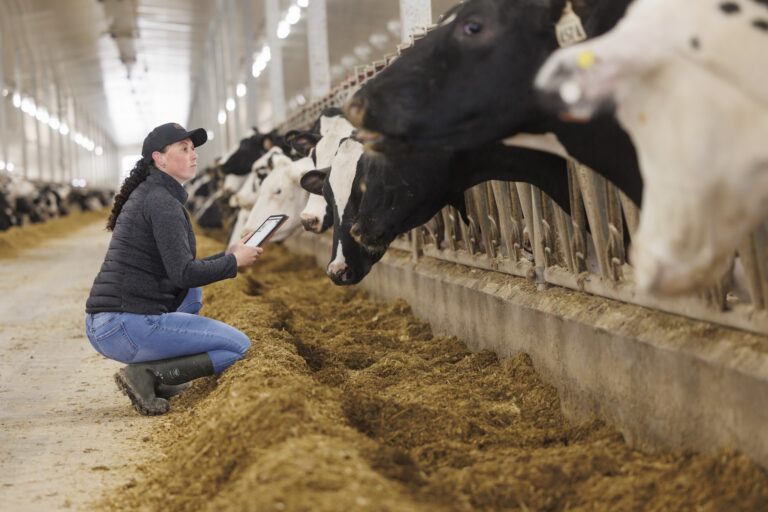


Some four decades have passed and AdFarm remains a going concern, a testament to how strong primary industries generate more economic activity than shows up in tallies of gross domestic product.
“I have Grade 12 English. Can’t draw a stick man. I couldn’t turn on a computer. But that didn’t matter in those days,” said McConnell, who stepped down as CEO in 2007. “I surrounded myself with people who knew what they were doing and built a marketing and communications firm that became quite large.”
Agriculture might be on the cusp of a moment like the one that launched McConnell’s career. Climate change and a new wave of technological advances are changing the rules of what grows where.
In an interview, Agriculture Minister Heath MacDonald marvelled at Canadian farm technology that is “out of the world,” such as a machine developed on Prince Edward Island that drives through fields identifying diseases by taking pictures of plants. British Columbia’s 4AG Robotics, a maker of robots that harvest, trim and pack mushrooms, just raised $40 million in a Series B funding round the company said will help it “meet surging global demand” for autonomous harvesting.
Everyone is impressed by the opportunity. “Canada has everything it takes to be [an] agricultural innovation powerhouse,” Laurent Carbonneau, head of policy at the Council of Canadian Innovators, said recently on LinkedIn. The Canadian Chamber of Commerce published a policy brief last month that calls agriculture and food a “cornerstone” of the economy and “enormously important” to Canadian prosperity—with “even more to offer.” The Chamber noted that Canada is one of the few net exporters of food, an important advantage as Asia’s growing middle class increases global demand for nutrition.
But there’s something missing. The industry is an afterthought in Ottawa, where many would struggle to name the agriculture minister. That matters in a country like Canada, which often relies on policy to offset disadvantages such as a small domestic market and risk-averse lenders.
Canada’s most important exports are oil and gas, metals and minerals, automobiles and auto parts, and food. Three of those face uncertain futures, while demand for the fourth isn’t going anywhere. If Prime Minister Mark Carney was elected to make the country less dependent on the U.S., then scarce resources must be used to supply ourselves with more of the things we need, and to develop products the rest of the world wants.
“Oil is Canada’s leverage today,” Mark Olson, founder of Flokk Systems—which makes a handheld device that helps cattle farmers manage their herds—wrote in a LinkedIn post earlier this year. “Food is Canada’s primary, and far more effective, leverage for tomorrow.”
Yet that’s not the conversation we’re having. All anyone wants to talk about these days is pipelines, critical minerals and quantum computers. Former industry minister Navdeep Bains talked of creating 10 more Shopifys, not 10 more McCain Foods. The mission of Stephen Harper’s government was to make Canada an energy superpower, not the country that would feed the world.
The food industry has suffered from being left out of the narrative for so long. Canada is a muscular player in the global food business, but not a dominant one. The value of agriculture and agri-food exports increased by some 270 per cent between 2000 and 2023, to about $100 billion, but Canada’s share of the global market actually slipped, according to RBC Thought Leadership. If the trend continues, Canada will be the world’s ninth most important food exporter in a decade, down from fifth at the start of the 2000s, RBC estimates.
New analysis by Farm Credit Canada explains some of the slippage. The report shows that productivity growth in the industry stalled amid weak investment in technology and a diminished commitment to innovation. Authors Bethany Lipka and Isaac Kwarteng calculate that research and development and other forms of “knowledge generation” declined precipitously between the early 1990s and the mid-2000s, as measured by the value of such knowledge relative to the farmgate value of production.
Canada was the runaway leader three decades ago; it now trails Japan, the U.S. and the average of its peers in the Organisation for Economic Co-operation and Development, according to Lipka and Kwarteng. Productivity growth peaked at around two per cent in 1990s and 2000s, and has since tumbled to less than one per cent. That’s not a marker typically associated with a superpower. “This trend threatens Canada’s leadership position within the global food system,” Lipka and Kwarteng wrote.
Weak productivity isn’t unique to agriculture. The solutions are also familiar. Carbonneau and the Council of Canadian Innovators want Health Canada to accelerate approvals of new food products. The Chamber wants the federal government to backstop farmers affected by the trade wars with the U.S. and China, help producers find new markets and encourage technological adoption by getting fast internet to rural areas. The Farm Credit report suggests a tight focus on investment in technology.
McConnell had a different thought. “We’re missing leadership,” he said. McConnell wasn’t referring to individuals. Rather, it was a comment on how narratives drive action. Good stories need heroes and for a long time the food industry hasn’t really had any. At the cabinet table, agriculture is “way over in the corner, we should be at the top,” McConnell said. Farmers and processors tend to bicker over money, he added, while the industry is represented by so many lobbies that it’s not really represented by anyone.
It’s an important insight. Agriculture’s potential is undeniable. Maybe so undeniable that complacency set in. Canada could be a food superpower, but only if the people who care about the industry start telling a cohesive story. If they don’t, the conversation will continue to spin around pipelines, cars and quantum.
Kevin Carmichael is The Logic’s economics columnist and editor-at-large. He has spent more than two decades covering economics, business and finance for outlets including Bloomberg News, The Globe and Mail and the Financial Post, where he also served as editor-in-chief.



Loading...
Thanks for sharing!
You have shared 5 articles this month and reached the maximum amount of shares available.
CloseThis account has reached its share limit.
If you would like to purchase a sharing license please contact The Logic support at [email protected].
CloseGift the full article!
You have gifted 0 article(s) this month and have 5 remaining.
Recipients will be able to read the full text of the article after submitting their email address. They will not have access to other articles or subscriber benefits.
Photo: Todd Korol for The Logic
Most Popular This Week




In-depth, agenda-setting reporting
Great journalism delivered straight to your inbox.
News
National Bank CEO warns AI alone won’t give banks a lasting edge
Briefing
Canada and Ontario commit over $5B to support tariff-hit steel sector
Hackers will see cars as major targets in next 3 years, 83% of car-tech workers say
EA shutting down Edmonton studio BioWare
Best business newsletter in Canada
Get up to speed in minutes with insights and analysis on the most important stories of the day, every weekday.
Exclusive events
See the bigger picture with reporters and industry experts in subscriber-exclusive events.
Membership in The Logic Council
Membership provides access to our popular Slack channel, participation in subscriber surveys and invitations to exclusive events with our journalists and special guests.





