CHARLOTTETOWN — Canada’s new agriculture minister said he will assess policy through an “economic lens,” and that he might eventually do a “scrub of the regulatory regime,” a shift that could unlock expansion and innovation in an industry that tends to punch below its weight.
Skip to content

News
Heath MacDonald wants to cut red tape to boost Canada’s agriculture sector
The agriculture minister says he’s bringing an economic focus to the job
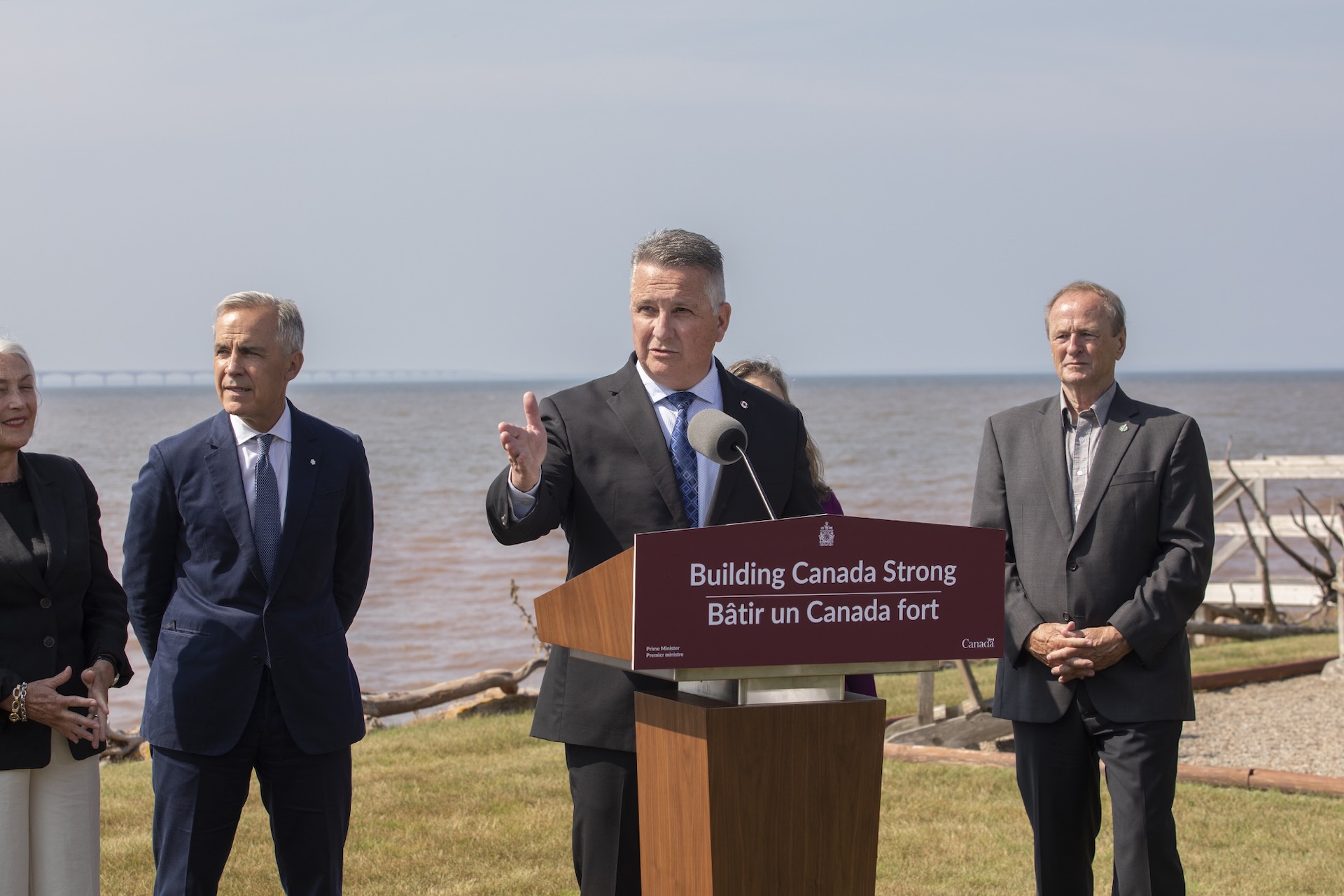
Federal agriculture minister and Prince Edward Island MP Heath MacDonald, with Prime Minister Mark Carney in Albany, P.E.I. on Monday. Photo: The Canadian Press/Ron Ward
CHARLOTTETOWN — Canada’s new agriculture minister said he will assess policy through an “economic lens,” and that he might eventually do a “scrub of the regulatory regime,” a shift that could unlock expansion and innovation in an industry that tends to punch below its weight.
Heath MacDonald, a former Prince Edward Island finance minister and his province’s representative in Prime Minister Mark Carney’s cabinet, made the comments during an interview with The Logic last week.
Primary agricultural and food processing account for about seven per cent of Canada’s gross domestic product, yet the person who oversees all of that is often an afterthought in Ottawa.
Talking Points
- Prime Minister Mark Carney appointed Heath MacDonald agriculture minister in May
- A former provincial finance minister and entrepreneur, MacDonald says he’s applying an “economic lens” to agriculture policy, and hopes to cut red tape
The stature of the agriculture minister’s job has faded along with that of the industry. RBC Thought Leadership published research earlier this year that showed Canada’s share of the global food trade is on track to drop to ninth place from its current seventh, and from fifth at the start of the century.
“We need more focus on agriculture,” MacDonald said. “My job is to get it to a point where people are talking about it all the time.”
A question about what’s been keeping him busy since Carney named his cabinet in May brought two responses. The first was “boots on the ground,” by which MacDonald meant meeting as many of his provincial counterparts and other farm and food leaders as quickly as possible. He said he’s already visited Quebec, Ontario, Saskatchewan and Alberta, where he spent the better part of a week meeting people at the Calgary Stampede.
Related Articles

The second thing MacDonald shared was a subtle critique of the previous government’s approach to agriculture and food production. “Putting an economic lens on everything that’s done in agriculture,” MacDonald said. “That’s extremely important and perhaps that was missing in some of the areas of making decisions, you know, when you compare us to the U.S., the [U.S. Department of Agriculture], a lot of their decisions are made with economic lenses included.”
The co-founder of SMS-marketing firm BamText, MacDonald is a rookie in Ottawa, but has a history of walking straight into cabinet. He was first elected to the provincial legislature in 2015, and then-premier Wade MacLauchlan was impressed enough to name him tourism and economic development minister, eventually promoting him to finance.
Things went bad for MacLauchlan’s government in 2019, when the premier lost his seat and his Liberal party tumbled to third place in the legislature. MacDonald survived, one of only six Liberals who won their districts. He resigned in 2021 and thought he was finished with politics. Then Carney won the federal leadership race. After a 90-minute meeting with the new leader, MacDonald said he went home and sought his wife’s permission to get back in the game. He won his riding with almost 58 per cent of the votes.
“I think I’m as non-partisan as it gets in this business,” MacDonald said.
An emphasis on economic growth could please farmers and processors across the political spectrum. Agriculture ministers must accept a split personality. They are charged with an array of subsidy programs that are meant to encourage growth. They also oversee regulatory institutions such as Canadian Food Inspection Agency and the Pest Management Regulatory Agency that exist to make sure food is safe to eat and that farmers take proper care of the environment.
The latter objective often conflicts with the former. For example, Jon Lomow, co-founder of Fieldless Farms, an indoor grower of lettuce and herbs, wrote a policy note for Build Canada that calls on governments to set a target of becoming almost completely self-sufficient in food by 2045. His first recommendation on how that could be achieved: remove regulatory roadblocks.
MacDonald appears willing to do so.
“We’re doing a transformation of government. The prime minister wants to be fiscally responsible,” MacDonald said. “So I look at those types of things as saying, ‘Well, they’re not going to cost us any money.’ So one, why wouldn’t we? Two, you’re helping out an industry. Three, you’re making that an equal playing field for our exporters, importers. It just makes sense.”



Loading...
Thanks for sharing!
You have shared 5 articles this month and reached the maximum amount of shares available.
CloseThis account has reached its share limit.
If you would like to purchase a sharing license please contact The Logic support at [email protected].
CloseGift the full article!
You have gifted 0 article(s) this month and have 5 remaining.
Recipients will be able to read the full text of the article after submitting their email address. They will not have access to other articles or subscriber benefits.
Photo: The Canadian Press/Ron Ward
Most Popular This Week




In-depth, agenda-setting reporting
Great journalism delivered straight to your inbox.
News
A tech firm born from post-Brexit trade chaos sets its sights on Canada
Briefing
U.S. authorities arrest Canadian cybersecurity exec
Czech defence conglomerate CSG buys 9.5% stake in MDA Space
Dominion Dynamics strikes preliminary deal to produce ground drones with Ukraine’s Tencore
Best business newsletter in Canada
Get up to speed in minutes with insights and analysis on the most important stories of the day, every weekday.
Exclusive events
See the bigger picture with reporters and industry experts in subscriber-exclusive events.
Membership in The Logic Council
Membership provides access to our popular Slack channel, participation in subscriber surveys and invitations to exclusive events with our journalists and special guests.





