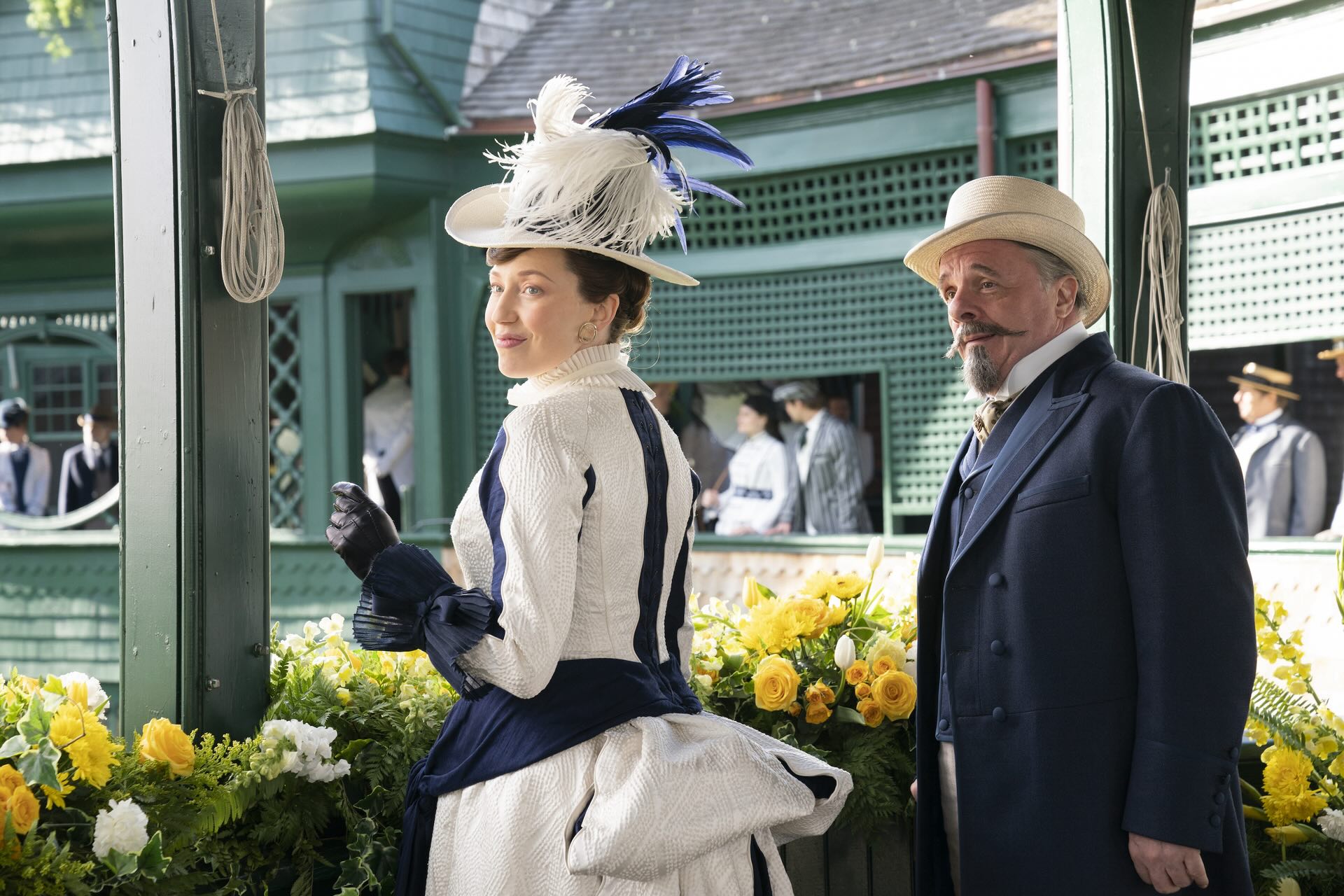
The first thing you notice in the HBO series The Gilded Age is the hats. They are a treat for the eyes, albeit one that probably should remain a vestige of another time. The late 19th-century craze for plumage destroyed vast numbers of birds and helped drive the Carolina parakeet to extinction.
Skip to content

Commentary
Carmichael: ‘The Gilded Age’ is a bingeable lesson in the economics of disruption
It’s not just about the hats
The Gilded Age’s 19th-century fashions may seem exotic to modern audiences, but the economic backdrop will be considerably more familiar. Photo: HBO Handout/Alison Cohen Rosa
The first thing you notice in the HBO series The Gilded Age is the hats. They are a treat for the eyes, albeit one that probably should remain a vestige of another time. The late 19th-century craze for plumage destroyed vast numbers of birds and helped drive the Carolina parakeet to extinction.
Next, you start to sense that everything on the screen feels familiar. That’s history’s way of sending word that New York in the 1880s has a lot to teach us about how to manage the joy and the pain that will come with the new industrial revolution that’s only just begun.
Finally, by the close of the second season, you realize The Gilded Age is about economics. The Civil War had ended only a couple of decades earlier, and the wealth gap is stark, so social justice is an important subplot.
Related Articles



But it’s the awesome power of innovation that moves the story forward. That’s what makes the show so relevant. Today’s tech bros would need to learn to appreciate a finely cut suit, but otherwise, Downton Abbey creator Julian Fellowes’s latest costume drama could be a template for a story of what we’re living through now. It’s even the time of the original “Tariff Man,” William McKinley, the father of the Tariff Act of 1890.
University of Chicago economist Arnold Harberger taught that productivity grew like mushrooms, which seemingly burst into being out of nowhere. He observed that a relatively small number of industries drive productivity growth at any given time, explaining how periods of technological disruption produce such spectacular gaps between winners and losers.
The Gilded Age distills this dynamic perfectly, adding a human element to Harberger’s framework that shows why these moments are so disruptive. A railroad-and-steel baron who has harnessed the era’s greatest general-purpose technology—the steam engine—combines ruthless determination and unrestrained ambition to build the economy, while amassing fabulous wealth that his wife deploys to upend New York society. Colonial America’s original aristocracy—including an heir of John Jacob Astor, who became the Revolution’s first multimillionaire by selling opium and beaver pelts and investing in real estate—struggles to adjust, albeit while being pampered by platoons of servants. One of these families nearly loses everything after being conned by a fake crypto… whoops, I mean a fake railroad company.
Art is what you make of it. The Gilded Age is social history, and most people—once they’re over the hats—will respond to the personal stories, such as young Marian Brook’s luckless romantic life. But my partner and I binge-watched the show’s three seasons during a stretch when I wrote about the following: the implications of the general purpose technology at the centre of the current industrial revolution; the angst of a complacent old-money economy that is in danger of watching the future leave it behind; the ongoing degradation of Canada’s natural capital; and our complicated psychological relationship with debt.
(Oddly, I also wrote about JPMorgan Chase, the Wall Street bank whose iconic forebearer, John Pierpont Morgan, arrives on the scene early in the third season of The Gilded Age. Morgan is probably best known for leading a bailout of the U.S. government after a tariff-enhanced financial panic in 1893 and organizing Wall Street banks to arrest a stock market collapse in 1907. Given America’s modern embrace of import taxes and the bubble in AI stocks, it was hard not to see Morgan’s arrival as some kind of sign.)
The economics profession is letting go of the pretense that it practices a hard science that can explain everything with fancy math. Joel Mokyr, one of the winners of this year’s Nobel Prize in economics, is primarily a historian. Mokyr developed his theory that sustained growth requires constant invention and innovation by studying the Industrial Revolution, not by creating complex models.
Last year’s winners—regular collaborators Daron Acemoglu, Simon Johnson and James A. Robinson—were recognized for their theory that open institutions generate prosperity, while authoritarian governments inevitably lead to stagnation and decline. (In Why Nations Fail, Acemoglu and Robinson argue that American prosperity thrived because its democratic institutions prevented the robber barons from creating an oligarchy, a model of economic organization that their survey of world history shows to be destructive.) Harvard’s Claudia Goldin, another economic historian, won in 2023 for showing why labour markets favour men over women.
Some dislike this trend. “I’ve never read [Mokyr’s definitive book, A Culture of Growth], mostly because I’m inherently skeptical of cultural explanations of growth,” economist Noah Smith wrote in an analysis of this year’s prize. “I guess now I have to read it.”
My background is in reading and writing, so it could be motivated reasoning that causes me to cheer the return of qualitative analysis. But surely an overconfidence in the power of mathematics to model human behaviour explains some of the big mistakes policymakers have made in recent decades. Bank of Canada governor Tiff Macklem acknowledged at an event in Washington, D.C. this week that “we need a richer playbook” for confronting supply shocks like the one that caused inflation to surge in the aftermath of the COVID-19 pandemic.
History doesn’t repeat because the setting is never the same. The dot-com crash left behind useful infrastructure that became the foundation for the lengthy period of growth that followed. It would be a mistake to assume that the data centres on which AI companies and their enablers are spending hundreds of billions of dollars are the same as a network of fibre-optic cables. Powerful computer chips become obsolete quickly, suggesting that if the AI bubble bursts, we’ll be left with nothing but very expensive warehouses.
But history rhymes because it’s made by humans, and the way we respond to things changes very slowly. That’s why if you get hooked on The Gilded Age, you needn’t feel guilty. It’s research for the consequential decisions that we’ll all be making as we adjust to what’s coming.
Kevin Carmichael is The Logic’s economics columnist and editor-at-large. He has spent more than two decades covering economics, business and finance for outlets including Bloomberg News, The Globe and Mail and the Financial Post, where he also served as editor-in-chief.



Loading...
Thanks for sharing!
You have shared 5 articles this month and reached the maximum amount of shares available.
CloseThis account has reached its share limit.
If you would like to purchase a sharing license please contact The Logic support at [email protected].
CloseGift the full article!
You have gifted 0 article(s) this month and have 5 remaining.
Recipients will be able to read the full text of the article after submitting their email address. They will not have access to other articles or subscriber benefits.
Photo: HBO Handout/Alison Cohen Rosa
Most Popular This Week




In-depth, agenda-setting reporting
Great journalism delivered straight to your inbox.
Exclusive
Inside the provinces’ pitches to the world’s biggest investors
Briefing
Cohere’s Gomez says Silicon Valley giants shouldn’t get to set the rules for AI
TD pledges $150B in new financing and support in key Canadian sectors
Scotiabank commits more than $100B to fund Canadian businesses
Best business newsletter in Canada
Get up to speed in minutes with insights and analysis on the most important stories of the day, every weekday.
Exclusive events
See the bigger picture with reporters and industry experts in subscriber-exclusive events.
Membership in The Logic Council
Membership provides access to our popular Slack channel, participation in subscriber surveys and invitations to exclusive events with our journalists and special guests.