It’s been a tough start to the budget season for fiscal hawks.
First, British Columbia Finance Minister Katrine Conroy presented a pre-election financial plan that forecasts a deficit wider than the shortfall the province ran during the COVID-19 recession, and the province’s largest debt burden as percentage of gross domestic product in almost forty years.
Then, New Democratic Party Leader Jagmeet Singh announced that he and Prime Minister Justin Trudeau had agreed on legislation that would provide universal coverage of contraception and diabetes medication at a cost of about $1 billion a year.
“Single-payer pharmacare is a risk our country can’t afford right now,” Kathy Megyery, a senior vice-president at the Canadian Chamber of Commerce, said in a statement.
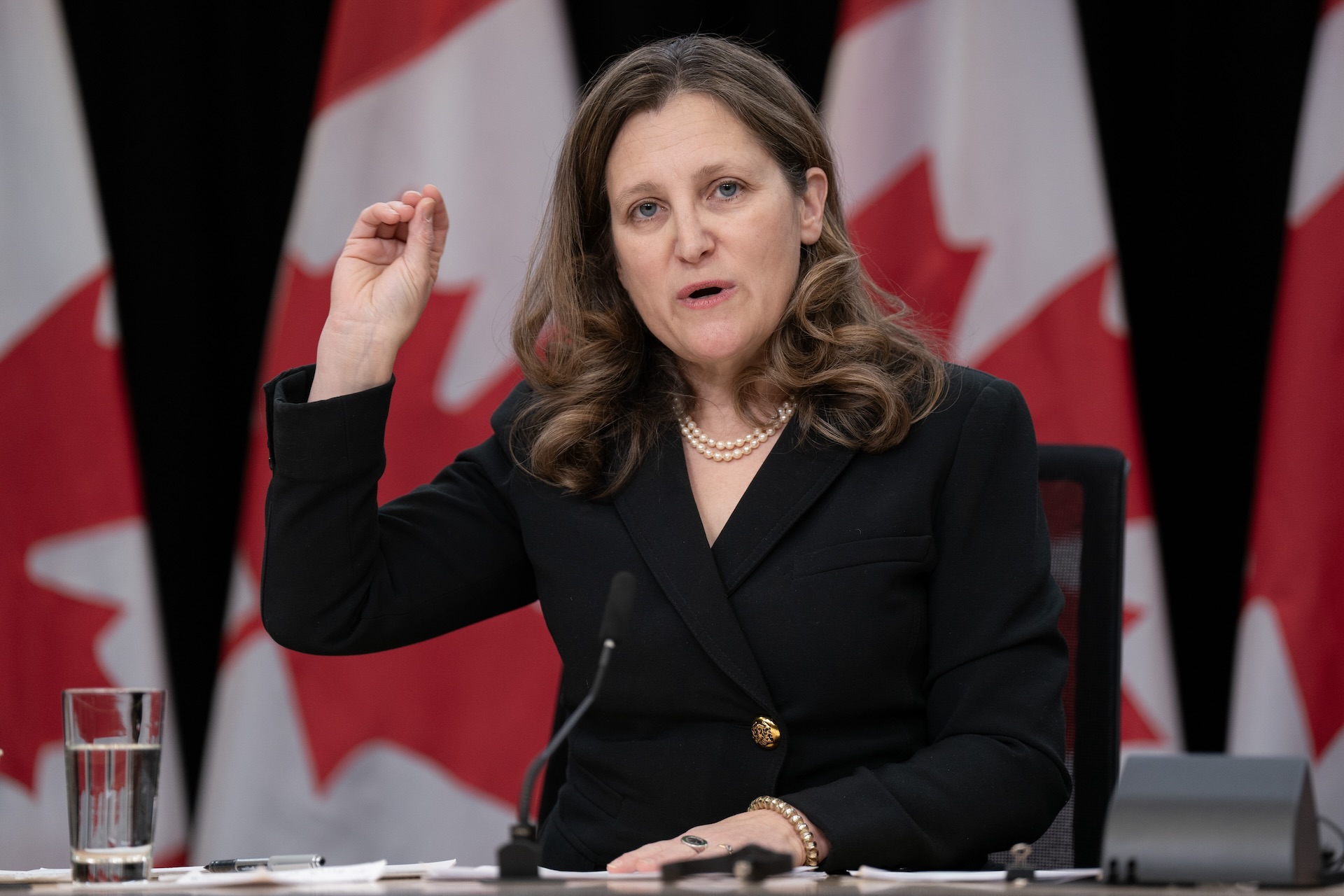
The desire of the party that keeps Trudeau in power for more social spending proved more persuasive than the various fiscally conservative economists, small-government think tanks and business lobbyists who insist Canada is on the road to perdition. “We believe in investing in the health of Canadians,” Finance Minister Chrystia Freeland said at a press conference Tuesday. “We laid out a clear set of fiscal guideposts in the fall economic statement. We will meet those guideposts.”
Freeland’s fall fiscal update pledged to keep the deficit from growing in the immediate term, keep the debt-to-GDP ratio on a downward track and get the deficit-to-GDP ratio below one per cent by 2027. That’s no one’s definition of austerity, but it’s better than most of Canada’s peers, which should be enough to keep the bond vigilantes at bay.
Given all the disruption that’s happening, Freeland’s approach is a reasonable mix of prudence and long-term bets. Canada can afford a pharmacare program if that’s how it chooses to use scarce resources. And though resources are more scarce than they were in the late 1990s and during the commodities boom of the early 2000s, the federal government and the provinces can borrow at relatively reasonable rates.
The average yield on five- to 10-year federal debt was 3.35 per cent in January, according to Bank of Canada data. That’s a significant increase from 1.76 per cent, the average of the past 10 years. But it’s nothing like the double-digit rates Canada paid in the early 1990s, when the country was on the verge of becoming a fiscal basketcase. Today, the government of Canada is among a dwindling number of sovereigns with a AAA credit rating, yet some who favour austerity frame their arguments as though Canada were on the verge of a debt crisis.
“Deficits impose a disproportionate tax burden on future generations,” the Fraser Institute’s Jake Fuss and Grady Munro wrote in The Globe and Mail earlier this month.
Not if that spending generates economic growth, or helps build a social safety net that offsets inequality. Ambitious finance ministers have been ignoring the advice of economists and thought leaders since Alexander Hamilton read Adam Smith’s The Wealth of Nations, used those ideas to help him demolish the notion that the U.S. economy should be based on agriculture, and then dismissed Smith’s theory of free trade in favour of import tariffs and subsidies that he felt were necessary if fledgling American factories were to have a chance against established competitors in Europe.
Hamilton liked free trade in theory, but “experience,” he wrote in the “Report on the Subject of Manufactures,” showed that “men are often so much governed by what they are accustomed to see and practice, that the simplest and most obvious improvements, in the [most] ordinary occupations, are adopted with hesitation, reluctance and by slow gradations.” In other words, getting out of the way of the invisible hand might well improve the welfare of individuals, but you can’t trust it to achieve larger national objectives. Those “may therefore require the incitement and patronage of government,” according to Hamilton.
Context matters. Canada isn’t a developing country in the early stages of building an industrial base, able to count on high rates of future growth to pay off whatever debt it takes on today. But we’ve entered a moment where disruption is everywhere. An aging population, the mental health crisis and the threat of further pandemics demand an overhaul of our approach to health, welfare and retirement. Climate change and artificial intelligence will transform the global economy. Geopolitical rivalry will demand a greater financial commitment to defence. All this while inequality feeds political polarization that is making democracies harder to govern.
Is this really a moment when governments should prioritize balancing their budgets because, in theory, that’s optimal policy? Experience suggests the stakes are too high.
Fuss and Munro would balance the federal budget by cutting “corporate welfare.” Good advice in the 1990s, when a new free-trade agreement with the United States and Mexico and the prospect of freer trade with China offered Canadian companies lots of opportunity. But that’s not the world we’re in today. It’s more like the period between 1921, when the Alberta government backed research at the University of Alberta into extracting bitumen from the province’s oilsands, and the late 1970s and 1980s, when government funding allowed a handful of private companies to turn those oilsands into a going concern.
The tens of billions of dollars in subsidies that Ottawa and the governments of Ontario and Quebec have deployed over the past couple of years could be wasteful, but the spending represents the same kind of bet we made on the oilsands. You can have a debate over the environmental costs of developing Alberta’s oil industry, but it’s impossible to argue those early investments were a waste of money.
Big spenders such as Freeland and the governments of British Columbia, Ontario and Quebec should certainly be held to account, but balancing the budget just for the sake of balancing the budget is no longer the right standard.
Kevin Carmichael is The Logic’s economics columnist and editor-at-large. He has spent more than two decades covering economics, business and finance for outlets including Bloomberg News, The Globe and Mail and the Financial Post, where he also served as editor-in-chief.