OTTAWA — Canada is not broken, Finance Minister Chrystia Freeland said in her speech delivering the Liberals’ fall economic update.
Skip to content

Special Report
Freeland turns to regulation to help Canadians feeling squeezed
Economic update sticks to Liberals’ declared fiscal anchor, which leaves minister little room to move
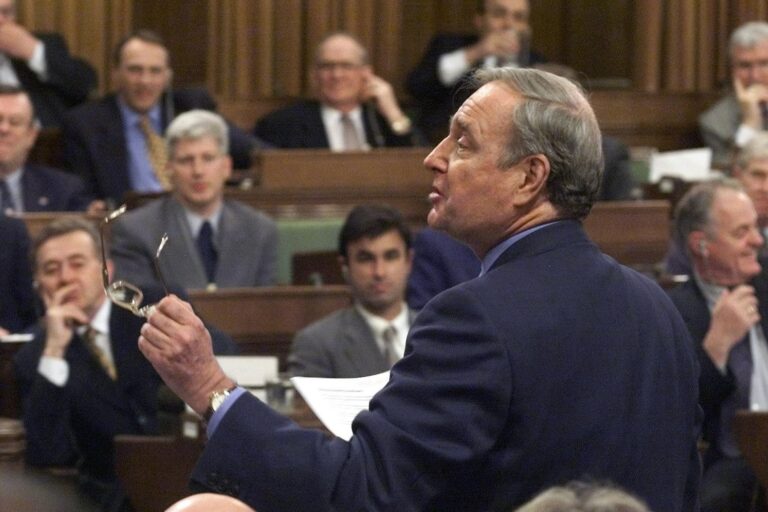
Finance Minister Chrystia Freeland delivers the fall economic statement in the House of Commons in Ottawa on Nov. 21. Photo: The Canadian Press/Adrian Wyld
OTTAWA — Canada is not broken, Finance Minister Chrystia Freeland said in her speech delivering the Liberals’ fall economic update.
But it has some cracks, which a government facing spending constraints seems set on caulking with regulation.
Talking Points
- Chrystia Freeland’s fiscal update forecasts deeper deficits but a devotion to the “fiscal anchor” of the national debt-to-GDP ratio
- The budget statement is replete with promises of new regulation and legislation meant to empower regular Canadians against big companies without costing the government very much
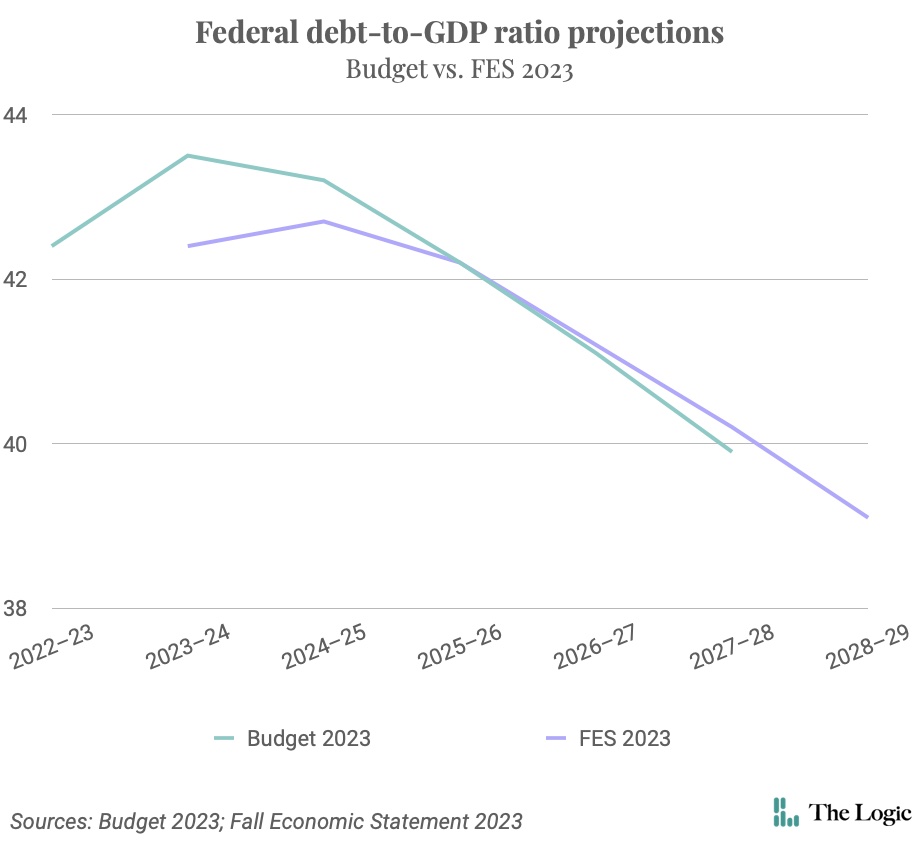
The Liberals now project that they will run deeper deficits in the coming years in raw dollars than they predicted in their last full budget—including a $23.8-billion deficit instead of $14 billion in 2027–28, which was as far out as the budget went in the spring—but their chosen “fiscal anchor” calculation, the ratio of debt to gross domestic product, stayed fairly steady.
A big move to support projects that cut carbon emissions draws up to $7 billion from the $15-billion Canada Growth Fund the Liberals announced in the 2022 budget, for instance. The update even promises deeper cuts in general spending than the $15.4 billion in reductions the Liberals said in the budget they would find over the next five years, with an additional $691 million to be found starting in 2026-27.
That leaves the government with relatively little room to manoeuvre, at a time when Freeland is keen to show that the Liberals see that “after three difficult years‚ with a global pandemic, global inflation and global interest-rate hikes—Canadians are worn out, frustrated and feeling the squeeze.”
“Probably the single biggest challenge right now is finding the balance between making the necessary investments in Canada and Canadians and ensuring that our economic plan is a fiscally responsible plan,” Freeland conceded, in response to a question from The Logic. The new plan achieves that balance, she added.
The fiscal update promises to attack things that can make the country feel broken, as if the powerful are nickel-and-diming the average person every chance they get. It does so in large part by imposing new restrictions on private actors—especially banks, telecom companies and landlords.
Read more on 2023 fall economic statement

A full chapter is devoted to housing, though by far the biggest ticket is a previous promise to take federal sales tax off new rental-housing construction, a $4.6-billion item spread over six years. The document devotes more words to cracking down on short-term rentals like Airbnbs, promising to eliminate income-tax benefits for “hosts” running illicit businesses and to help municipalities enforce their own restrictions—the latter a $50-million cost over three years.
The update also spells out a new “Canadian mortgage charter,” with measures like making banks lay out customers’ options at least four months before they hit renewal deadlines.
A section titled “Making life more affordable” is a laundry list. “Modernize the competition framework”—that is, overhauling how companies have to fight with each other for customers’ business—gets less ink than requiring airlines to seat parents and kids together for no extra charge; or a promise to “work on” the roaming fees telcos charge when you take your phone into another country.
Reforming competition is abstract, something that corporate lawyers and some very dedicated consumer advocates think about. Paying Air Canada $50 to not have your five-year-old surrounded by strangers on your way to see Grandma—or a $100 roaming charge that racks up within minutes of crossing the U.S. border to buy cheaper groceries—are more relatable problems.
Related Articles


(These things are in the same section of the economic statement as the Liberals’ previously announced pledges on freezing the carbon tax on heating oil and supporting conversion to electric heat pumps. Ill-starred those might be, but they come from the same place.)
Elsewhere, the Liberals promise to exclude colleges and universities from declaring bankruptcy (or using similar processes), explicitly citing the cuts at Laurentian University in Sudbury, Ont., in 2021.
“These amendments will reduce the risk of negative consequences in possible corporate restructuring and public post-secondary educational institutions, such as reduced programming,” the document says.
This would not actually solve the financial problems that would lead a school to consider declaring bankruptcy; administrators and provincial governments would still have to figure out what to do about such a crisis. But they wouldn’t have the federal laws on insolvent corporations giving them cover for the painful cuts they would likely still need to make, or the reneging they would still need to do on financial commitments.
Other items on the laundry list include a sales-tax exemption on psychotherapy and counselling (costing $10 million a year), and extending parental leave under the employment insurance program to cover adoption (eventually reaching $12.6 million a year to cover about 1,700 families).
Neither of these is a big line item, but they both cover situations that lead people to shake their heads and tsk at the perfidy of governments that tax mental health care, or treat adoptive parenthood as less than biological.
Many of the Liberals’ previous budgets and economic updates have kicked off processes or planted seeds—like the Canada Growth Fund—that they knew would take a long time to grow, flower and bear fruit even if everything went exactly as planned. These measures can kick in almost immediately, just about as soon as the government can pass an enabling bill.
This economic statement speaks of a government, buried in the polls and facing an election in less than two years, that wants results it can show now, but without much spare cash to produce them.



Loading...
Thanks for sharing!
You have shared 5 articles this month and reached the maximum amount of shares available.
CloseThis account has reached its share limit.
If you would like to purchase a sharing license please contact The Logic support at [email protected].
CloseGift the full article!
You have gifted 0 article(s) this month and have 5 remaining.
Recipients will be able to read the full text of the article after submitting their email address. They will not have access to other articles or subscriber benefits.
Photo: The Canadian Press/Adrian Wyld
Most Popular This Week




In-depth, agenda-setting reporting
Great journalism delivered straight to your inbox.
Commentary
Carmichael: Being boxed in will help Canada focus on what matters
Briefing
Rio Tinto gets nearly $165M in additional federal funds for Quebec aluminum
U.S. to lift tariffs on some Canadian products crucial to Maine: Collins
Carney warns of tech dependence after Starlink disruptions in Ukraine
Best business newsletter in Canada
Get up to speed in minutes with insights and analysis on the most important stories of the day, every weekday.
Exclusive events
See the bigger picture with reporters and industry experts in subscriber-exclusive events.
Membership in The Logic Council
Membership provides access to our popular Slack channel, participation in subscriber surveys and invitations to exclusive events with our journalists and special guests.






