General Fusion has secured almost $22 million in financing from public-sector programs to fuel the development of a reactor to demonstrate its novel nuclear technology.
Skip to content


News
General Fusion gets $22M more to build B.C. test reactor
Canadian Nuclear Laboratories, BDC Capital back Richmond, B.C. firm
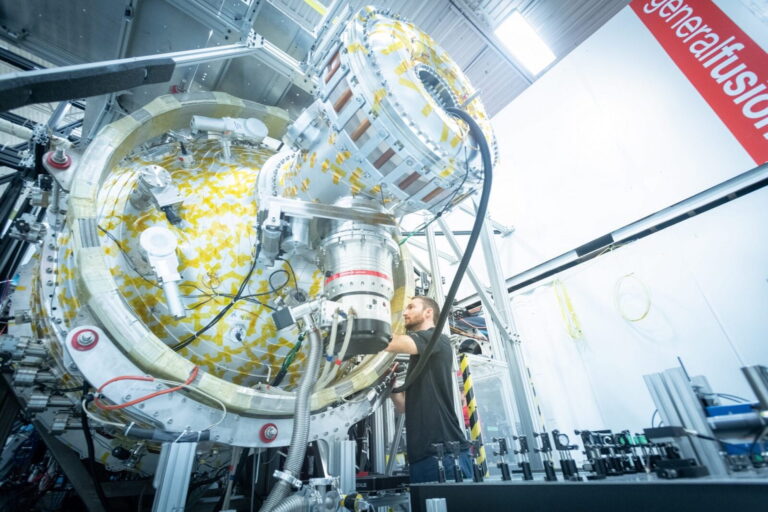
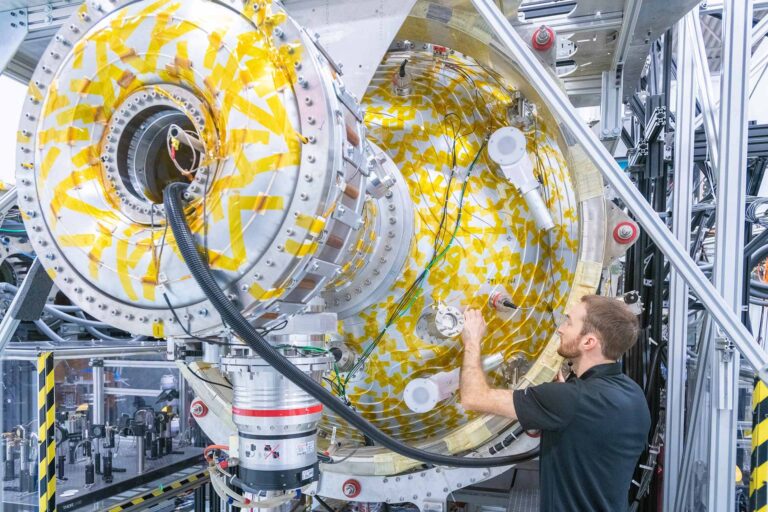
General Fusion staff create a solid lithium liner for a compression experiment in its step in designing the company’s reactor. Photo: General Fusion | Handout
General Fusion has secured almost $22 million in financing from public-sector programs to fuel the development of a reactor to demonstrate its novel nuclear technology.
The firm expects its Lawson Machine 26 (LM26), under construction at the firm’s headquarters in Richmond, B.C., to achieve critical scientific breakthroughs in the next two years. Here’s what you need to know:
Talking Points
- Canadian Nuclear Laboratories and BDC Capital are each putting $10 million into General Fusion’s Lawson Machine 26, a reactor meant to demonstrate the viability of nuclear fusion as a source of energy
- The company hopes its new model, under construction in Richmond, B.C., can reach a key temperature and generate more energy than it uses to run
The science, roughly: Fusion is the reaction that powers stars, generating energy by combining the nuclei of atoms. To prove that General Fusion’s version works, the LM26 must be able to heat plasma—the matter mixture at its core—to 100 million degrees C and keep it there. Then, the reaction must hit scientific “breakeven,” meaning it gives off more energy than was required to create it.
The money: New investor Canadian Nuclear Laboratories (CNL) and returning backer BDC Capital are each putting $10 million into General Fusion’s LM26 project.
“What they’ve been able to accomplish as a private fusion company over the years is absolutely remarkable,” said Steve Bushby, CNL’s vice-president for science and technology. The federally owned organization, which runs R&D facilities for the country’s atomic agency, recently expanded its programs for nuclear science and prototype reactors to include fusion.
Hatch, a Mississauga, Ont.-based engineering firm, also participated in the financing.
Related Articles
General Fusion had raised an initial $28.5 million in equity financing and a $5-million grant from the British Columbia government in August 2023, when it announced the LM26 program. In December, the federal Strategic Innovation Fund committed another $5 million, an add-on to a previous $49.3-million award.
“We are out raising capital almost on a perpetual basis,” General Fusion CEO Greg Twinney told The Logic in June, on the sidelines of a CNL summit on the technology in Ottawa. The firm has used the early results of LM26 to pitch public- and private-sector backers for further financing. It says it’s now raised about two-thirds of the funding it needs to reach its temperature target.
The path: General Fusion was originally planning a US$400-million demonstration facility at the UK Atomic Energy Authority’s campus in Culham; that reactor would have been about 70 per cent the size of a commercial power plant. It was targeting a nine-figure raise and seeking $335 million from the Canadian government.
But last year, the 140-person firm scaled down both its prototype design and financing target. “Introducing LM26 allows us to de-risk, raise additional capital and further the milestones that we want to achieve with the next machine,” said Twinney.
The market: General Fusion has been at this for over two decades—physicist Michel Laberge started the firm out of a University of British Columbia lab in April 2002. But recent research advancements have sparked significant commercial and investor interest in the space.
CNL’s event included attendees from newer startups like Oak Ridge, Tenn.-based Type One Energy and Devens, Mass.-based Commonwealth Fusion Systems, which are pursuing different technologies they claim are the fastest ways to get to usable fusion energy.
Bushby said CNL is looking to work with other industry players, noting that Canada may be an attractive site for firms to assemble supply chains or set up demonstration facilities. (CNL recently launched a joint venture with Japan’s Kyoto Fusioneering to supply fuel to several reactor types.) The world needs “a lot of energy,” Bushby said; he anticipates there will be more than one winner in the fusion space, just as in traditional fission.
Despite the new competition, Twinney said he’s “very confident” General Fusion has the right approach. The firm’s final design will use a liquid-metal compression system, allowing it to avoid a long-standing problem in which the reaction degrades the first wall of the machine’s chamber. Twinney also claims the firm’s technology will be more cost-effective for power plants than those of others in the space.
“I want to be first to market, because I believe there’s huge advantages to doing that,” he said, acknowledging competitors have announced similar timelines. “You need to look at all the approaches and say, ‘Which one is most likely to become a power plant?’”
Loading...
Thanks for sharing!
You have shared 5 articles this month and reached the maximum amount of shares available.
CloseThis account has reached its share limit.
If you would like to purchase a sharing license please contact The Logic support at [email protected].
CloseGift the full article!
You have gifted 0 article(s) this month and have 5 remaining.
Recipients will be able to read the full text of the article after submitting their email address. They will not have access to other articles or subscriber benefits.
Photo: General Fusion | Handout
Most Popular This Week




In-depth, agenda-setting reporting
Great journalism delivered straight to your inbox.
Commentary
Carmichael: Was Chicken Little stirring panic, or just taking precautions?
Briefing
Carney plans to discuss US$135B defence bank with new U.K. prime minister
B.C. nearing federal MOU of its own as talks continue on Alberta’s West Coast pipeline
Quebecor urges CRTC to block Corus restructuring as part of takeover push
Best business newsletter in Canada
Get up to speed in minutes with insights and analysis on the most important stories of the day, every weekday.
Exclusive events
See the bigger picture with reporters and industry experts in subscriber-exclusive events.
Membership in The Logic Council
Membership provides access to our popular Slack channel, participation in subscriber surveys and invitations to exclusive events with our journalists and special guests.