OTTAWA — Canada is the world’s main source of the key element in generating power by crushing smaller atoms into bigger ones; in Vancouver’s General Fusion, it has a leading contender to commercialize the technology. It does not have a formal plan for pressing these advantages.
Skip to content

 Innovation Minister François Philippe Champagne, left, and Natural Resources Minister Jonathan Wilkinson have expressed interest in a national fusion-energy program. Photo: Adrian Wyld & Ethan Cairns/The Canadian Press

News
Canada eyes nuclear fusion energy program, laying groundwork as peers surge ahead
Research advances caught minister’s eye early this year, prompting hustle inside Natural Resources Canada
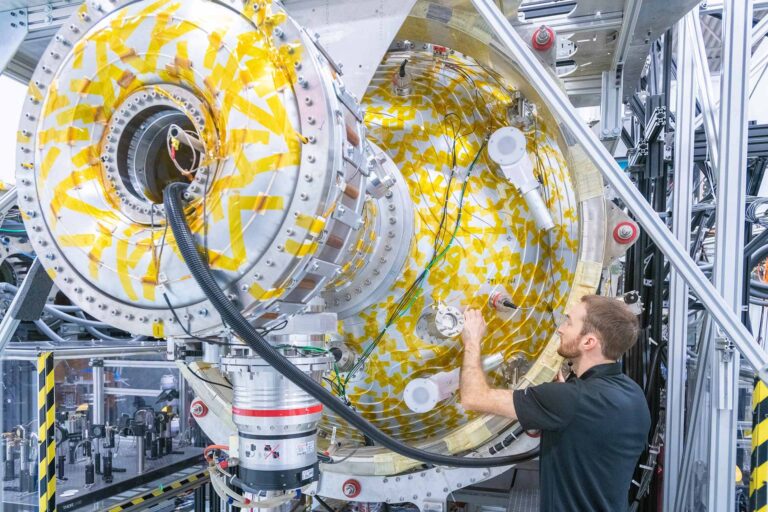
A General Fusion plasma injector. The company recently announced plans for a test nuclear fusion reactor in Richmond, B.C., that can keep an internal temperature of 100 million degrees Celsius. Photo: General Fusion/Handout
OTTAWA — Canada is the world’s main source of the key element in generating power by crushing smaller atoms into bigger ones; in Vancouver’s General Fusion, it has a leading contender to commercialize the technology. It does not have a formal plan for pressing these advantages.
The federal government has begun to lay groundwork for one.
Talking Points
- Canada has a rich nuclear history but has supported fusion-power research without a coherent plan
- By astonishing luck, Canada is the key supplier of the element at the core of most fusion plans
Natural Resources Minister Jonathan Wilkinson and Innovation Minister François-Philippe Champagne are both interested in “a fostering environment for fusion R&D in Canada and anchoring the potential energy security and economic benefits in Canada,” said a briefing note for Wilkinson’s deputy minister, the department’s top public servant. The Logic obtained a redacted version of the note, dated May 23, through an access-to-information request.
Fusion, the reaction that powers stars, combines two or more small atomic nuclei into one bigger one, releasing enormous amounts of energy and heat.
Unlike fission, the more established nuclear-power process of breaking large atoms up into smaller ones, fusion doesn’t generate large amounts of lethal radioactive waste.
But before you can get energy out of the process, you need the astronomical heat and pressure in which fusion takes place, which demands enormous amounts of energy to begin with. The trick is to get more out of a fusion reaction than you put in; scientists have managed it in experimental conditions, but not on commercially useful scales.
Related Articles

And you need fuel. Most nascent fusion projects rely on tritium—an unstable form of hydrogen that has two neutrons in its nucleus, instead of the usual zero. Tritium is extremely rare in nature, mainly to be found floating around in the upper atmosphere. A useful concentration costs $30,000 a gram.
Working fusion reactors could be configured to make more tritium themselves, but figuring out where a potential fusion-energy industry will find enough of it to get started is a significant preoccupation.
Today, tritium comes from one source: Because it happens to be a byproduct of the fission process in Canadian-made Candu nuclear reactors, “Canada has the world’s largest civilian stockpile of tritium,” Wilkinson’s spokesperson, Carolyn Svonkin, told The Logic in response to questions about a potential fusion program.
That stockpile is small. One person could carry around all the contained tritium in the world, and the number of fusion experiments currently planned could use it all up. But Canada’s Candu reactors give the country a big head start toward being a global supplier.
“We are the world leader in storage and handling of tritium, a key component of most fusion technologies’ fuel,” said Greg Twinney, General Fusion’s CEO, in an email to The Logic.
Customers have come knocking. In 2020, the U.K. fusion research site bought an experimental supply of tritium from Canadian Nuclear Laboratories (CNL), the contractor that runs the venerable atomic-research site in Chalk River, Ont.
CNL has development deals with General Fusion, a British competitor called First Light Fusion and Japan’s Kyoto Fusioneering. The last, announced just in September, involves building a Kyoto Fusioneering technology testing facility at Chalk River.
Canada is also cooperating with an international consortium on a large fusion reactor project in France called ITER, albeit not as a consortium member. Formed in less fraught times, the group includes the European Union, United States, India, Japan, South Korea, China and Russia, and has persisted despite tensions among the members. (Canadians had wanted to host the ITER project at Ontario’s Darlington nuclear plant, but the group picked France.)
The U.S. and U.K. “are making strides in demonstrating the production of net energy output from fusion reactions, while building fusion supply chains and clarifying the regulatory process for fusion systems,” the briefing note said. Canada, in contrast, has spent 25 years dispensing money “through several one-off, small-scale funding awards.”
About $100 million has gone to General Fusion, which has been working on the process for 20 years, including nearly $50 million in one Strategic Innovation Fund (SIF) grant. General Fusion recently announced plans for a test reactor in Richmond, B.C., that can keep an internal temperature of 100 million degrees Celsius.
It’s raised a total of nearly US$525 million, according to PitchBook data, including a US$130-million round in 2021 that included Singapore’s Temasek, Jameel Investment Management, hedge fund Segra Capital, Jeff Bezos and Tobi Lütke.
The company has previously asked for $335 million toward its commercialization strategy, though, and the plans for a B.C. test reactor—for which it has sought $40 million over three years—came after a US$400-million scheme for a larger machine in the United Kingdom faltered in a tough time to raise capital.
One reason the company had intended to do the work halfway around the globe was that the U.K. has a fusion research site called the Culham Centre for Fusion Energy, run by its atomic energy authority.
The U.K., United States and Japan could be models for Canada, Twinney told The Logic.
Natural Resources Canada wanted “to deepen our current understanding of the fusion landscape and help inform possible funding decisions,” the briefing note said. It would assemble a panel of internal experts, including some working with the department on casual contracts, and work up some recommendations “on potential strategic actions in this space” by the end of July.
The results have not yet arrived on the minister’s desk, Svonkin wrote in an email. “At this time, we will continue to fund clean technology and energy innovation through several existing channels, including the SIF and Smart Renewables and Electrification Pathways Program.”
The U.K. is a regulatory leader on fusion, with the United States also making significant moves, Twinney wrote, pointing to a British decision to regulate fusion reactors separately from fission reactors. In the U.S., a proposed regulation would cover fusion reactors only as facilities with nuclear byproducts. The two countries just announced a fusion-energy partnership to push the technology forward.
Canada is a member of an international working group on fusion regulation (with the U.K. and Japan) that issued very preliminary recommendations in October, essentially just saying that there should be harmonized fusion regulation that is only as onerous as necessary.
“As the world innovates in the race to net zero, Natural Resources Canada continues to engage with Canadian industry to continue to make sure Canada plays a leadership [role] in the cleantech space,” Svonkin wrote.



Loading...
Thanks for sharing!
You have shared 5 articles this month and reached the maximum amount of shares available.
CloseThis account has reached its share limit.
If you would like to purchase a sharing license please contact The Logic support at [email protected].
CloseGift the full article!
You have gifted 0 article(s) this month and have 5 remaining.
Recipients will be able to read the full text of the article after submitting their email address. They will not have access to other articles or subscriber benefits.
Photo: General Fusion/Handout
Innovation Minister François Philippe Champagne, left, and Natural Resources Minister Jonathan Wilkinson have expressed interest in a national fusion-energy program.
Most Popular This Week




In-depth, agenda-setting reporting
Great journalism delivered straight to your inbox.
Commentary
Carmichael: Canadian ignorance about India is a strategic weakness
Briefing
Aritzia shares pop after earnings rise 204%
First Nation in Alberta goes to court over fast-tracked oil pipeline
Chinese EV maker Geely Auto Group to launch in Canadian market in 2027
Best business newsletter in Canada
Get up to speed in minutes with insights and analysis on the most important stories of the day, every weekday.
Exclusive events
See the bigger picture with reporters and industry experts in subscriber-exclusive events.
Membership in The Logic Council
Membership provides access to our popular Slack channel, participation in subscriber surveys and invitations to exclusive events with our journalists and special guests.





