OTTAWA — Burnaby, B.C.-based General Fusion has chosen a campus in the United Kingdom for a key new facility intended to show its fusion-energy technology is commercially viable. The firm—whose backers include the Canadian federal government, sovereign wealth funds and e-commerce billionaires—aims to have the US$400-million pilot plant operational in 2025.
Skip to content

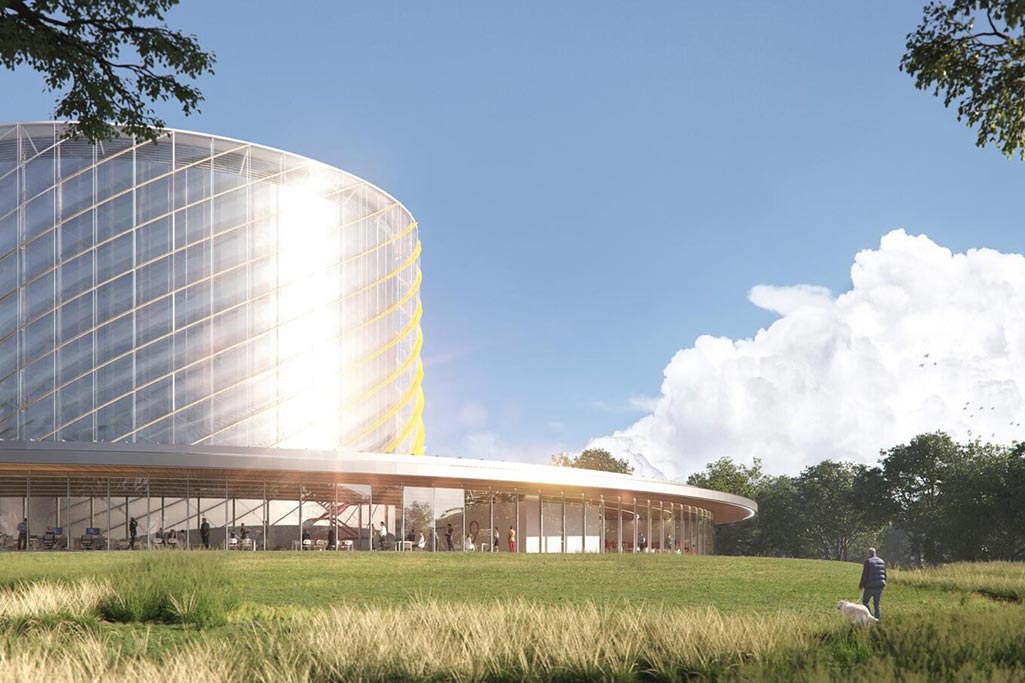 A rendering of General Fusion’s planned demonstration plant on the UK Atomic Energy Authority’s Culham campus. Photo: General Fusion

News
‘A stepping stone’: B.C.’s General Fusion to build US$400M pilot plant in U.K.
Photo: General Fusion | Twitter
OTTAWA — Burnaby, B.C.-based General Fusion has chosen a campus in the United Kingdom for a key new facility intended to show its fusion-energy technology is commercially viable. The firm—whose backers include the Canadian federal government, sovereign wealth funds and e-commerce billionaires—aims to have the US$400-million pilot plant operational in 2025.
“It’s a stepping stone to the long term, which is building fusion power plants,” said CEO Christofer Mowry from London in an interview with The Logic. The company’s goal is for its technology to be used in commercial operations before the end of the decade.
Talking Point
General Fusion will build a US$400-million demonstration plant to test and showcase its fusion technology in the U.K., where it will have access to expertise operating similar machines. The Burnaby, B.C.-based clean-energy startup has raised US$300 million to date from sovereign-wealth and venture-capital funds, as well as e-commerce billionaires. It has also received significant funding from the Canadian federal government.
Founded in 2002, General Fusion now has over 140 employees. It’s raised about US$300 million to date from investors including Singapore’s Temasek Holdings, Malaysia’s Khazanah Nasional, oil giant Cenovus Energy, and the family offices of Amazon CEO Jeff Bezos and Shopify CEO Tobi Lütke. The company and its competitors are trying to show it’s technically possible and economically viable to generate energy the way stars do. In simple terms, fusion combines different hydrogen isotopes to produce energy.
The new demonstration facility will be located at the Culham Science Centre, run by the UK Atomic Energy Authority (UKAEA), the company announced Wednesday. “It was really important to have expertise in operating and maintaining a large fusion machine,” said Mowry. “Culham is … one of the world’s leading operational fusion research centres.”
The Oxfordshire campus hosts the Joint European Torus (JET), which is being used to test design features and materials for the ITER, a 35-country effort to build a device in the south of France that can produce 500 MW of power. The JET is “scheduled to be decommissioned around the timeframe that we’ll be starting up, so it’s a natural opportunity to access that expertise,” said Mowry, although General Fusion hasn’t yet determined whether it will hire directly from those teams.
Building a presence at Culham is “an inflection point for the company,” said board member Zoltan Tompa, director of the Business Development Bank of Canada’s cleantech practice. It’s “not only because it helps provide [the] credibility and validation from an internationally-recognized authority on fusion energy, but also because they’re able to tap into an incredible brain trust,” he said.
General Fusion declined to provide specifics of any financial support it’s receiving from the U.K. government, but Mowry acknowledged “there is a broad deal” with the UKAEA for the demonstration plant. In Canada, the federal government has previously provided significant funding to the company. In October 2018, then-innovation minister Navdeep Bains announced a $49.3-million award from the Strategic Innovation Fund (SIF) for General Fusion to “develop a first-of-its-kind large-scale prototype plant,” with the firm committing to spend $150 million on R&D. It’s also received $1.69 million from the National Research Council over the last decade, federal public disclosures show.
Mowry said General Fusion considered setting up the demonstration plant at home. “We were going to try hard to see if it made sense to do it in Canada,” but “it couldn’t be a prerequisite,” he said, noting that “we’ve been trying to be pretty transparent with the government all along.” Building on Culham’s fusion expertise improves the company’s chances of success, which is ultimately good for Canadian taxpayers who’ve helped fund it, he argued.
General Fusion’s SIF award “was negotiated so that Canada would maximize the full benefits from this investment including the retention of intellectual property,” said Sophy Lambert-Racine, a spokesperson for Innovation, Science and Economic Development Canada. “The contribution agreement includes provisions to address situations such as the location for the building of a prototype demonstration plant.” General Fusion remains in compliance with the terms of the deal, she said.
In April, Toronto-founded semiconductor firm Alphawave IP announced plans for a London IPO and said it had shifted its headquarters to the U.K. and would set up its new R&D centre there, citing the local talent and investor ecosystems. General Fusion has no plans to relocate to the U.K. or elsewhere, according to Mowry. “The headquarters, most of our people [and the] core of the technology is in [the] Vancouver [area],” he said, noting that the firm has been hiring during the pandemic. It plans to triple headcount overall.
“I think Canadians and the federal government should be thrilled about the fact that this is a very significant validation and stepping stone for one of the most promising Canadian technology companies,” said Tompa, noting that the Culham project will help accelerate the firm’s expansion.
General Fusion’s pilot facility will be about 70 per cent of the size of the final power plants. It aims to prove that the machine can achieve a plasma—a state of matter—at a temperature of 150 million C “in a power plant-relevant environment,” said Mowry. It’s also trying to show that the power generated is economically competitive with other sources. All in, fusion should be the lowest-cost form of energy available, per the firm.
The new facility won’t actually produce electricity, but General Fusion plans to lower the technology risk by attaching its system to conventional steam-turbine setups. “The purpose of this is not by itself to just do some fancy science project, but to create a clean-energy technology that can allow us to address climate change,” said Mowry. The company will sell its equipment to power-plant operators rather than running them itself, and hopes the demonstration facility will help secure early customer orders.
Fusion startups have raised significant sums in recent years, with 31 companies receiving a combined US$2.35 billion in total, according to PitchBook data. Tompa said the growth of private investment validates the space, citing the arrival of top-tier investors like Temasek. “The more capital [and] bright minds focusing on some of the hardest, most intractable of problems facing clean-energy production, the better,” he said, noting that General Fusion stands apart for its technical maturity and approach to the technology.
The pilot plant will make it easier for the company to access further financing, according to Mowry. “This is the world’s first public-private partnership in fusion,” he said. “Hopefully [there will] be more. What’s important is we remain in the lead.”



Loading...
Thanks for sharing!
You have shared 5 articles this month and reached the maximum amount of shares available.
CloseThis account has reached its share limit.
If you would like to purchase a sharing license please contact The Logic support at [email protected].
CloseGift the full article!
You have gifted 0 article(s) this month and have 5 remaining.
Recipients will be able to read the full text of the article after submitting their email address. They will not have access to other articles or subscriber benefits.
Photo: General Fusion | Twitter
A rendering of General Fusion’s planned demonstration plant on the UK Atomic Energy Authority’s Culham campus.
Most Popular This Week




In-depth, agenda-setting reporting
Great journalism delivered straight to your inbox.
News
Cohere plans to acquire cyber startup Aisle and set up a new security division
Briefing
Banks should have kill switches, IDs for AI agents, says global finance watchdog
B.C. First Nations decry rushed consultations as Major Projects Office CEO promises to do better
Feds pledge $100M to back Nova Scotia’s plans for offshore wind farms
Best business newsletter in Canada
Get up to speed in minutes with insights and analysis on the most important stories of the day, every weekday.
Exclusive events
See the bigger picture with reporters and industry experts in subscriber-exclusive events.
Membership in The Logic Council
Membership provides access to our popular Slack channel, participation in subscriber surveys and invitations to exclusive events with our journalists and special guests.






