OTTAWA — General Fusion has asked the federal government for $335 million to continue to develop its novel nuclear technology in Canada, as countries around the world vie for clean energy’s holy grail.
Skip to content



Exclusive
General Fusion seeks $335M from federal government as countries contend for clean-energy breakthrough
B.C. firm plans to use funding to develop power-plant systems
General Fusion’s plasma injector, which the company says is “the world’s largest and most powerful of its kind.” Photo: General Fusion | Handout
OTTAWA — General Fusion has asked the federal government for $335 million to continue to develop its novel nuclear technology in Canada, as countries around the world vie for clean energy’s holy grail.
Physicist Michel Laberge founded the company in April 2002, initially working out of lab space at the University of British Columbia. Now headquartered in Richmond, B.C., it has a staff of over 200. The firm and its fusion-sector competitors aim to generate power by combining atoms rather than splitting them apart as conventional fission reactors do.
Talking Points
- General Fusion has asked the federal government for $335 million in financing to continuing developing its technology in Canada
- Countries are offering increasingly large incentives for fusion firms and private-public partnerships, following a flood of private-sector funding and some key scientific breakthroughs in the space
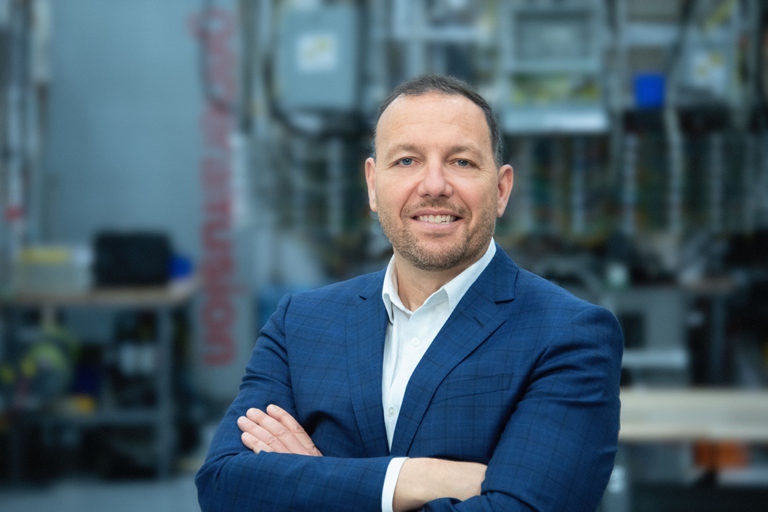
General Fusion made the request, worth US$250 million, to Ottawa in November 2022 as part of Finance Canada’s consultations in advance of the 2023 federal budget. The capital would help pay for the firm’s “commercialization strategy as we prepare to get zero-carbon fusion energy on the grid by the early 2030s,” CEO Greg Twinney told The Logic.
General Fusion is working with industry partners and national labs to develop existing power-plant technology so that it’s compatible with a future commercial-scale fusion reactor. The company would use the federal funding to do that work at its Richmond headquarters, Twinney said. The firm plans to grow its workforce to 300 by 2027, then another 30 per cent annually in the following decade.
General Fusion is seeking either a grant, or an investment in exchange for shares or warrants, although the type of financing and stake are still under discussion.
“We are proud to be a Canadian company,” Twinney said, citing the firm’s origins and employment figures. “That being said, we are a private company that is on the path to revolutionize the energy system worldwide, and that takes capital. As a result, it is important for us to monitor and pursue potential funding opportunities globally.”
Related Articles

General Fusion has already been awarded about $100 million in federal funding, including $49.3 million from Ottawa’s flagship Strategic Innovation Fund (SIF) announced in October 2018. Sustainable Development Technology Canada and the National Research Council of Canada’s Industrial Research Assistance Program have also supported the firm. But Twinney said federal programs like SIF don’t have specific allocations for fusion, so companies like his face greater competition for public capital in Canada than they do in other countries.
In June 2021, General Fusion announced it would build a US$400-million demonstration plant at the United Kingdom Atomic Energy Authority’s (UKAEA) Culham campus in Abingdon, England. The U.K. government has allocated over £400 million for fusion, including £184 million for Culham. It’s an “equity partner” in General Fusion, director of government relations Amee Barber told a parliamentary committee last November, but the company declined to disclose details.
In November 2021, General Fusion set up a U.S. office in Oak Ridge, Tenn., near a flagship U.S. Department of Energy (DoE) nuclear lab. Last September, the department launched a US$50-million program to support public-private partnerships working towards fusion pilot plants. Congress has approved a budget of US$713 million for the DoE’s Fusion Energy Sciences program for the 2022 fiscal year. The Biden administration’s US$369-billion Inflation Reduction Act (IRA) also set aside US$280 million for construction and equipment in the field.
Both the U.S. and U.K. have dedicated offices disbursing fusion funding, and cover costs for building plants and demonstration facilities, Twinney noted. Canada’s research-focused programs typically do not.
Other startups are feeling the pull. Investors in Munich-based Marvel Fusion have been pushing the firm to “potentially move to the U.S.,” CEO Moritz von der Linden told the Financial Times last month.
Finance Canada declined to comment on whether General Fusion’s proposals are under consideration for the upcoming budget, but spokesperson Marie-France Faucher confirmed that deputy minister Michael Sabia met with company representatives in November. Ottawa has made large-scale investments in the past, including a $1.44-billion equity and debt commitment to Ottawa-based Telesat’s delayed low-Earth orbit satellite network.
It’s not just governments putting up capital. Fusion energy companies around the world raised US$4.22 billion in 51 venture deals between 2018 and 2022, according to data PitchBook provided to The Logic; US$2.99 billion of that came in 2021 alone. Several startups have firmed up their business plans and made scientific advancements over the last two years, said Adam Rodman, founder and chief investment officer at Segra Capital Management, a Dallas-based firm focused on nuclear energy. Fusion is also the latest clean-energy solution to benefit from investor interest in the green transition.
General Fusion has raised nearly US$393 million to date from a global investor base, according to PitchBook data. Backers include Singaporean sovereign wealth funds Temasek and GIC and their Malaysian equivalent Kahazanah Nasional Berhad; Calgary-headquartered Cenovus Energy; and VC firms Amsterdam-based SET Ventures and Stockholm-based Norrsken VC.
Other fusion firms have raised significantly larger sums. Massachusetts Institute of Technology spinout Commonwealth Fusion Systems has taken in US$2 billion and already has a staff of 275, per PitchBook. It also has a deal with the UKAEA. Foothill Ranch, Calif.-based TAE Technologies has raised US$1.35 billion.
But “General Fusion has the most credible plan to commercialization,” according to Rodman, who cites the company’s reactor design and the fact it’s already considering the commercial-scale power-plant systems it will need. “How are you actually going to get electricity on grid? That means a lot to the end user.” Segra invested in the firm’s US$130-million Series E in November 2021.
Rodman said he hasn’t pushed General Fusion to move if Ottawa doesn’t meet its capital ask. But “what practically happens is you follow the funding,” he said, noting that “there are other governments that will be looking to accelerate them as a company.”
In addition to its own financing request, General Fusion is recommending that Ottawa establish a $400-million, five-year fusion energy fund to back commercialization projects. Twinney said the proposal has been endorsed by 17 companies and universities.
Fusion energy may contribute to getting to net-zero emissions by 2050, but it’s “not something that is going to be available right away,” said Alan Ahn, senior resident fellow at Third Way, a Washington, D.C., think tank. He cited the December 2022 experiment at a California DoE lab that for the first time achieved a reaction that generated more energy than the laser that created it required. “It’s a momentous milestone,” he said, but only produced enough extra power “to boil a couple of kettles of water.” It’ll take time to get to grid-deployable plants.
Policymakers, particularly in Europe, have expressed concern that the IRA will give U.S. green industries an advantage and countered with their own subsidies. But Ahn noted that companies don’t currently have commercial-ready fusion systems that can be deployed in clean-energy projects to cash in on the bill’s tax credits. When the technology does achieve maturity, the U.S. and allied nations should look to pool resources and jointly develop supply chains rather than compete for companies amongst themselves, he said.
Correction: This article has been updated to correct the name of the think tank Third Way.



Loading...
Thanks for sharing!
You have shared 5 articles this month and reached the maximum amount of shares available.
CloseThis account has reached its share limit.
If you would like to purchase a sharing license please contact The Logic support at [email protected].
CloseGift the full article!
You have gifted 0 article(s) this month and have 5 remaining.
Recipients will be able to read the full text of the article after submitting their email address. They will not have access to other articles or subscriber benefits.
Photo: General Fusion | Handout
Most Popular This Week




In-depth, agenda-setting reporting
Great journalism delivered straight to your inbox.
Commentary
Carmichael: Canadian ignorance about India is a strategic weakness
Briefing
Aritzia shares pop after earnings rise 204%
First Nation in Alberta goes to court over fast-tracked oil pipeline
Chinese EV maker Geely Auto Group to launch in Canadian market in 2027
Best business newsletter in Canada
Get up to speed in minutes with insights and analysis on the most important stories of the day, every weekday.
Exclusive events
See the bigger picture with reporters and industry experts in subscriber-exclusive events.
Membership in The Logic Council
Membership provides access to our popular Slack channel, participation in subscriber surveys and invitations to exclusive events with our journalists and special guests.