
Listen Now
0:00
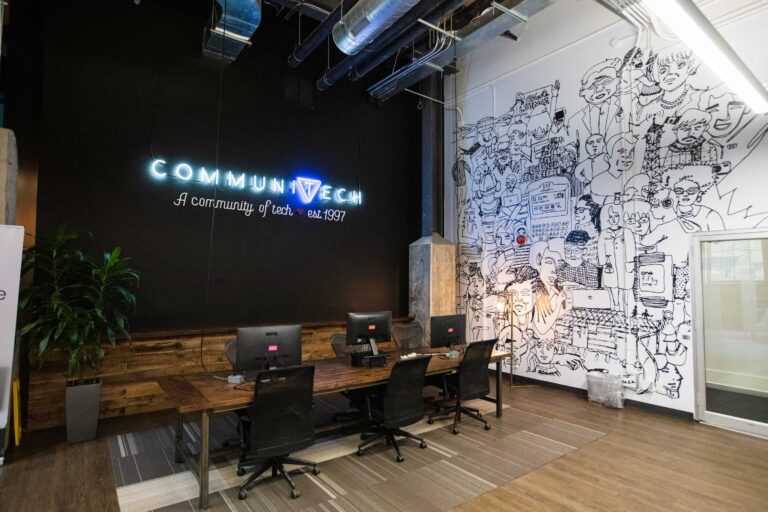
WATERLOO — The first time Sheldon McCormick stepped foot inside Communitech, he was struck by how quiet it was.
An outsider of the local tech community, McCormick had heard lore of the building at the heart of Waterloo Region’s startup scene—once bustling with founders, investors and politicians hustling to try and shape Canada’s new economy.
Talking Points
- In his first year as CEO, Sheldon McCormick curbed Communitech’s national ambitions and refocused the tech hub on local entrepreneurs in the Waterloo Region. At the same time, he has worked to broaden its reach beyond tech founders to include employees and businesses in more traditional industries, such as construction and health care.
- The changes have boosted engagement with members, many of whom had lost touch with Communitech in recent years. Communitech’s workforce has also shrunk by about half under McCormick, who is betting a leaner organization can have a bigger impact.
By the time McCormick arrived as CEO in April 2025, much of the building sat empty. During the pandemic, many entrepreneurs lost touch with the organization, as remote work cleared out its offices and halted in-person events. At the same time, Communitech’s priorities began to drift from serving local startups toward national ambitions that many founders in the region felt came at their expense. When the world reopened, new habits had formed and trust had frayed and Communitech, under then-CEO Chris Albinson, struggled to bring people back together.
Across Canada, startup organizations were grappling with the same question: what role should they play in an era of remote work, fragmented founder communities and rapid technological change?
Related Articles


Albinson departed in October 2024, setting off Communitech’s search for a new leader. By the spring of 2025, the organization’s board had decided McCormick was the person to fix things. Part of that meant returning Communitech to its roots as a gathering place for Waterloo Region founders. But it also required breaking with some of the assumptions and habits that had shaped Communitech over the three decades since it launched. “I felt like Communitech had this incredible history, and that it needed to evolve,” McCormick told The Logic.
A little more than a year into the job, there are signs the strategy is working. Founders who had strayed from Communitech are returning. Local tech leaders who once kept the organization at arm’s length are getting involved, hosting events and encouraging founders to engage again. The organization has narrowed its focus back to just Waterloo, while trying to position itself as a bridge between new technologies like AI and the traditional industries that still anchor much of the region’s economy.
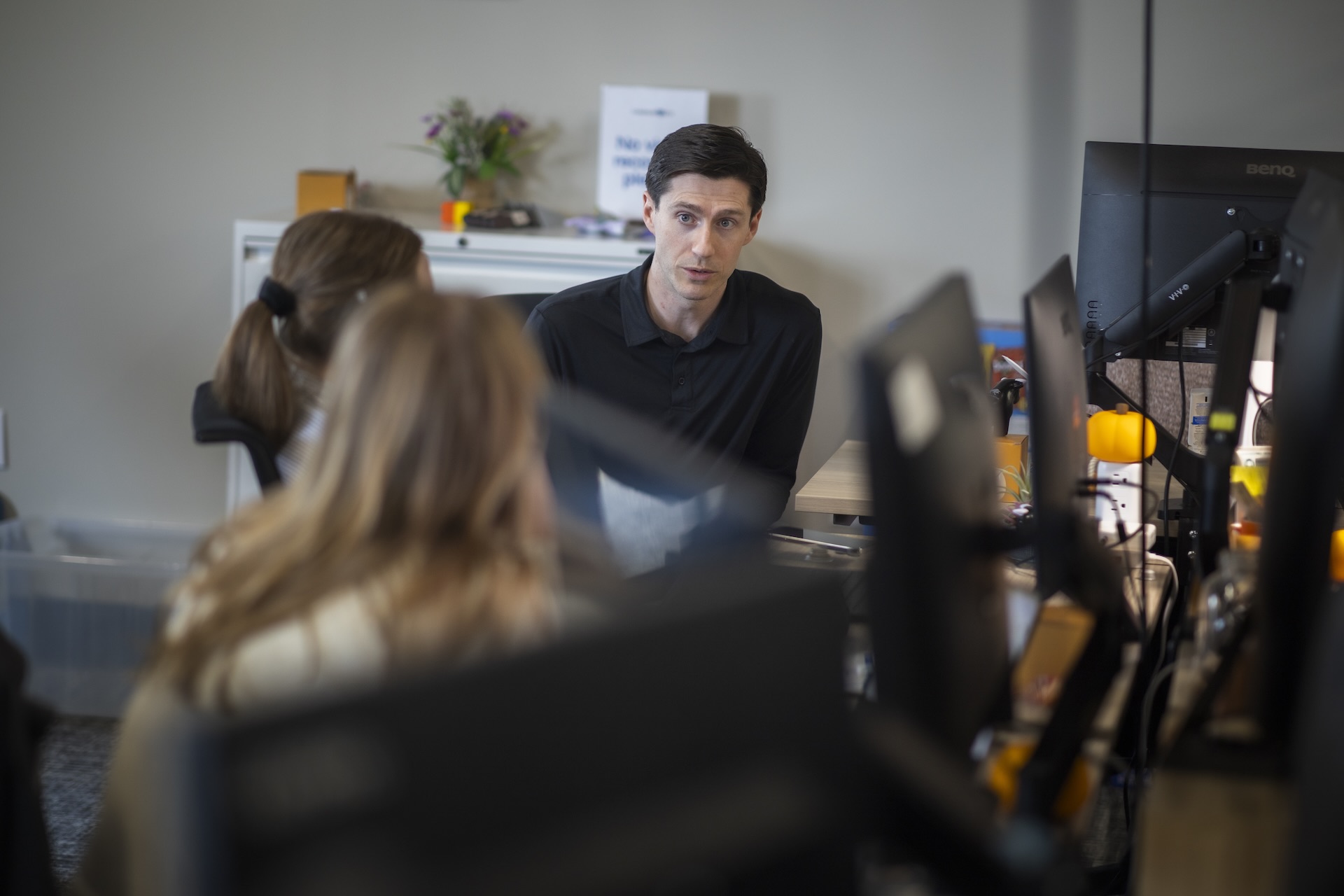
The reset has not been painless. McCormick has made deep cuts to Communitech’s workforce, slashing the team to 45 people, about half the size it was when he took over. Some people left voluntarily when he made the decision to require staff return to the office five days a week. McCormick believes that the cuts have helped Communitech focus on its members. He said the organization’s engagement stats, a measure of hours members spent at Communitech and at its events, is up 60 per cent since he started as CEO. This, he said, is a sign his plan is working.
“I knew that there was going to be some pain,” McCormick said, “but part of the appeal of taking on the opportunity was that there was a lot of work to do.”
McCormick grew up in Sydney, N.S., the son of a nurse and a road-construction worker and had what he describes as a “profoundly normal” upbringing. In junior high school, a teacher noticed his talent for arguing and encouraged him to join the debate team. (“Good on her for actually having such a productive way to handle what was probably a really annoying kid,” McCormick joked.) Competitions and training camps throughout high school took him to Oxford, U.K., and Toronto, exposing him to a wider world and, eventually, a future outside Nova Scotia.
A scholarship to Queen’s University in Kingston, Ont., set him on a path toward management consulting. After a stint at Monitor Deloitte in Toronto from 2009 to 2014, McCormick caught the tech bug. His roommate at the time had recently sold his startup Vuru to accounting firm Wave, and flush with exit cash, he boasted about taking something called an Uber limousine to work everyday. McCormick became fascinated with the messiness of the business model, including the political, labour and operational challenges it was bound to face. “I saw I could actually be pretty useful,” he said. In 2014, he joined the company and was soon helping launch UberX in Toronto during the company’s early Canadian expansion.
In 2018, after four years at Uber, McCormick wanted to build something of his own. In early spring of that year, he teamed up with entrepreneur and investor Anshul Ruparell and engineer Craig Dunk to launch Properly, a Toronto real estate startup that promised to simplify the home-selling process by guaranteeing homeowners a price for their house before it hit the market.
The company raised over US$130 million dollars during the pandemic-era housing boom. Then, in 2022, interest rates spiked and the market turned. Revenue nosedived 80 to 85 per cent in less than a year, McCormick said, forcing the company to sell for far less than the founders had hoped.
By late 2024, McCormick had moved to Kitchener with his family and was considering his next act when his wife, who is from Kitchener, came home from a holiday party with an idea: Communitech was looking for a new CEO, she said, and McCormick should go for the job.
McCormick spent his first three months at Communitech on what amounted to a listening tour. He met with founders, executives and community leaders, asking what role the organization should play in Waterloo’s tech industry.
Jacqui Murphy was one of the people McCormick met with early on. A longtime Waterloo tech executive, Murphy had been around during Communitech’s infancy, when the organization was just a handful of people in a back room of the Taaz Communications office, the tech-marketing firm where Murphy worked in 1997. Murphy was one of the first volunteers helping launch Communitech, which had remained a constant throughout her career that spanned startups, venture capital and senior leadership roles in the region’s tech industry.
In recent years, though, Murphy lost touch with Communitech. She stopped going to events, and by extension, she became disconnected from what was going on across the region’s tech sector. “If somebody had said to me, ‘who are the top 10 tech companies in Waterloo Region?’ I’d be like, ‘I don’t know.’”
When she met McCormick shortly after he started in spring of 2025, Murphy saw a chance to revive Communitech’s role as a connective tissue. She told him founders needed more reasons to leave their home offices, reconnect with each other and learn what was happening in the tech community.
Versions of that message came up repeatedly as McCormick met with local leaders. Greg Dick, co-founder and CEO of Waterloo-based Open Quantum Design, said McCormick took the feedback to heart. “You can see by the results of what he’s done, he really got it,” said Dick. “He figured out this community pretty quickly.”
Some of the changes were symbolic. One of McCormick’s earliest decisions was to restore Communitech’s original logo, a subtle signal to the community that the organization was trying to reconnect with its earlier identity. “It was so simple and so meaningful,” said Dick. “There’s no ego in that. It was just: Communitech is here, we’re back and we’re committed to the region.”
Other moves were more concrete. Along with reducing headcount, Communitech’s physical footprint also shrunk by about half of what it was at its peak. The organization made the decision before McCormick took over, but operating out of a smaller physical space is central to his vision for the organization. “We’re still committed to downtown Kitchener, and the real estate from a convening standpoint is still important,” McCormick said, “but I would like Communitech to be defined by its broader role in the community, not be a place.”
He sees that role as serving more than just tech founders, who have historically been Communitech’s focus. He’s now trying to engage a much larger pool of employees at local tech companies who may one day become entrepreneurs themselves. He’s also considering how tech startups and scaleups can work with more traditional industries like health care and construction. In his view, the region’s deep pool of technical talent can help these sectors boost their productivity and ultimately buoy the local economy.
That thinking has guided some of Communitech’s newer programming. After joining the organization, McCormick helped expand a series of sector-focused gatherings called Founders And—as in founders and physicians, for example, or founders and builders—which bring together startup and industry leaders for conversations about where their businesses intersect. Entrepreneur Nabil Fahel had been running the program independently since launching it in 2024. McCormick loved the idea so much he convinced Fahel to join Communitech and bring the series with him.
McCormick also helped start a new co-op program with the University of Waterloo, Wilfrid Laurier University and Conestoga College that places students at small- and medium-sized businesses in town, where they build AI systems for the companies stuck using legacy technology.
Some entrepreneurs say they’re starting to see McCormick’s efforts pay off. While planning one of the organization’s newer initiatives—a dinner series called Next Act designed to connect experienced operators considering their next move—Murphy learned that tech executive and entrepreneur Mike Kirkup had just left his company, Arlo. The two are now building elder-care startup Elderella together. “Communitech was directly involved in Elderella starting,” Murphy said.
The organization has also reshaped its board, paring it down and increasing representation of tech executives. The shift began before McCormick arrived, but he has continued pushing the organization toward a more founder-led model, and said he plans to add more entrepreneurs to the board this fall.
Adam Belsher, CEO of Magnet Forensics and one of the newer Communitech directors, said the changes reflected a growing belief that Communitech needed to become more focused on local companies’ needs.
Prior to McCormick, Belsher said the organization was spread too thin and that its goals had become unclear. Leadership seemed more focused on securing government dollars, he said, without having a clear sense of how the funding would help its members. Headcount expanded with the organization’s creeping mission, stretching the budget to its limit. Belsher worried that any reduction in that funding could cause major issues for the ever-expanding Communitech.
McCormick is ultimately looking to rebuild Communitech as a hub for members, by members. That means relying less on government money and more on revenue from memberships, he said. If the people are paying to use its services, that’s a good indication the organization is working as it should, McCormick said.
He thinks Communitech can be just as—if not more—effective with a smaller budget and leaner team. He said the 60 per cent spike in engagement is another good proxy of whether members are getting value from the organization. In the longer term, McCormick said he’ll consider Communitech successful if companies in town are adding zeros to their revenue lines.
Before he became Communitech’s CEO, McCormick was skeptical of the tech-hub model. Their mandates could be misguided, he thought, and it was hard to tell if they created real value for founders.
Similar doubts had been building in Kitchener-Waterloo for years. A constellation of newer organizations had taken over many of the functions Communitech once served. Velocity deepened its ties to student founders. Catalyst Commons became a gathering place for manufacturing companies. Elsewhere, smaller founder-led networks sprang up around sectors like healthtech, defence and quantum. The sector no longer revolved around a single institution, raising questions for some of whether it even needed Communitech anymore.
Now, McCormick argues there is, once again, a strong case for a central tech hub. AI is rewriting the rules of company building, and Communitech can help founders, employees and companies in traditional sectors navigate the staggering amount of change, McCormick said. “The startup playbook is totally changing, the venture creation playbook is changing, investor mindsets are changing,” he said. “That’s an opportunity for Communitech to be that community convener,” he added, “to create access for people who have the appetite to learn, the appetite to evolve.”