Listen Now
0:00
Some of Canada’s biggest banks and pension funds have joined the race to recruit executives to oversee their push into AI, creating demand for a senior role that barely existed a year ago but is increasingly drawing talent away from rivals.
According to a LinkedIn labour market report published in January, employers created 298,000 head of AI positions globally between 2023 and 2025. In Canada, the role has rapidly become an executive one. Research from IBM’s Institute for Business Value—based on surveys of 80 chief executives and 80 C-suite tech leaders across the country—found that 81 per cent of Canadian organizations surveyed now have a chief AI officer.
Talking Points
- According to IBM research, 65 per cent of CEOs in Canada are comfortable using AI to inform strategic decisions, even as 68 per cent of CIOs and CTOs say they are accountable for AI systems they do not fully control
- Some of the biggest post-secondary institutions in the country are now offering chief AI officer programs to senior executives
The position often commands the high compensation packages typically associated with top corporate leadership. According to executive research firm Equilar, the median pay package for chief AI officers based primarily in the U.S. was roughly US$1.6 million in September 2025, with top earners approaching US$3.5 million.
The chief AI officer’s mandate differs from that of a chief technology officer (CTO), said Manav Gupta, vice-president and CTO of IBM Canada, in an interview with The Logic. Whereas CTOs are responsible for an organization’s overall technology strategy and stack, chief AI officers are tasked with overseeing AI adoption, setting priorities, establishing safeguards and ensuring the technology delivers business value.
Related Articles


“I think [this] technological shift is seismic enough that it requires board-level oversight,” Gupta said. Having a dedicated AI executive is often a sign that an organization has moved beyond experimentation and is focused on generating meaningful business value from the technology, he said, establishing clear accountability for AI-related outcomes.
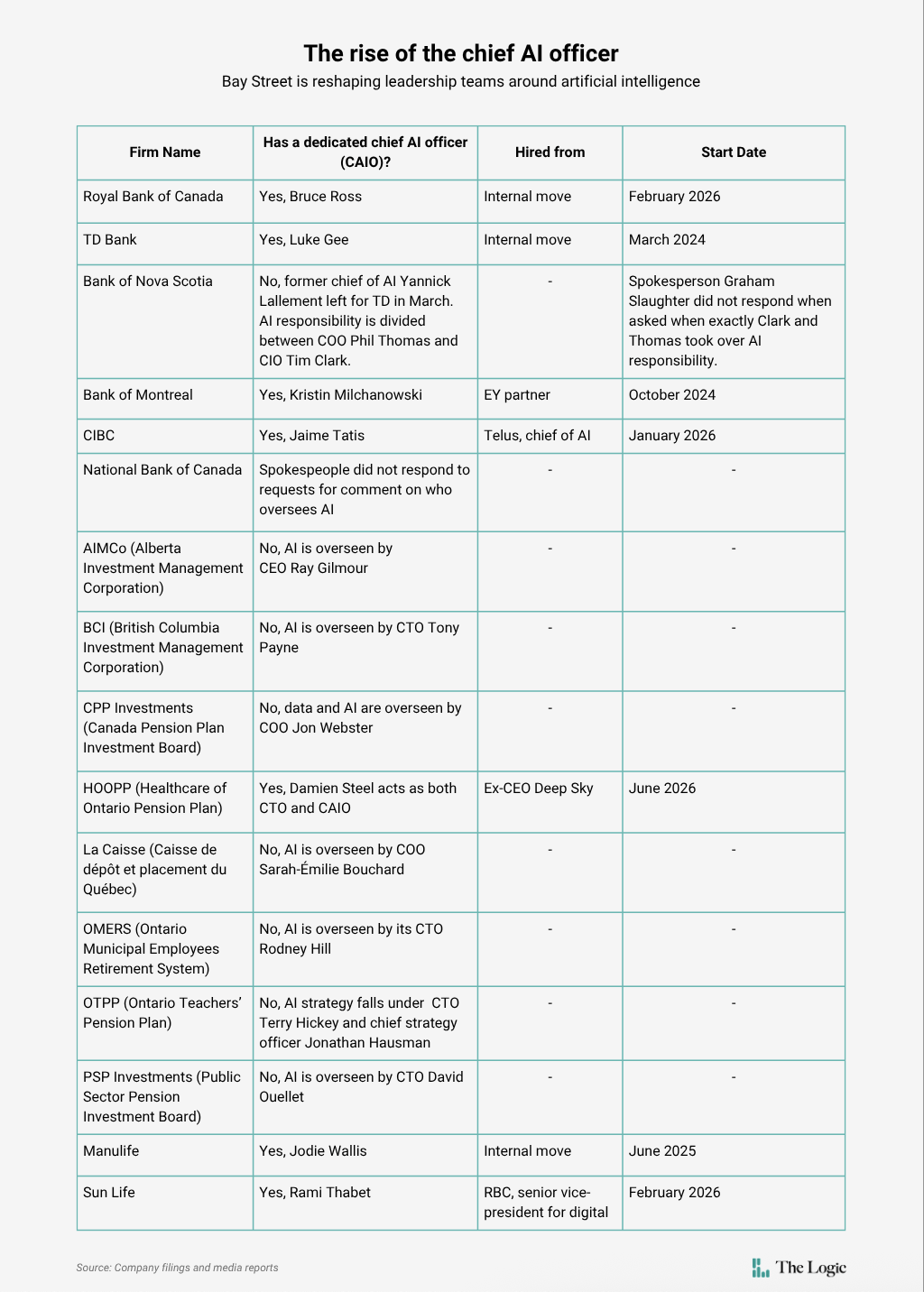
Two of Canada’s six largest banks have appointed dedicated chief AI officers (CAIO) over the past year, while TD and BMO assigned Luke Gee and Kristin Milchanowski to the role in March 2024 and October 2024 respectively. At Scotiabank, former chief AI officer Yannick Lallement, who held the role since June 2023, left in March to become vice-president of technology AI modernization at TD, according to his LinkedIn profile. Spokesperson Graham Slaughter confirmed in an email that the bank does not currently have a CAIO, with AI oversight shared between chief operating officer Phil Thomas and chief information officer Tim Clark. National Bank did not respond to requests for comment on how AI leadership is structured within the organization.
Canada’s largest pension funds, by contrast, have largely opted against creating standalone chiefs of AI positions, instead layering responsibilities onto existing roles. At OMERS, PSP Investments and BCI, AI sits with the chief technology officer. At the Canada Pension Plan Investment Board and La Caisse, oversight falls under the chief operating officer. Ontario Teachers’ splits accountability between its CTO and chief strategy officer, while chief executive Ray Gilmour leads AIMCo’s AI strategy. HOOPP is the exception, where newly appointed chief technology and AI officer Damien Steel oversees strategy, the closest among the group to a dedicated AI role.
The rise of AI leadership comes as organizations try to close the gap between what executives want from the technology and what can actually be delivered. IBM found that 65 per cent of Canadian CEOs are comfortable using AI to inform major strategic decisions. Yet more than two-thirds of Canadian CIOs and CTOs said they are accountable for AI systems they do not fully control, while nearly three-quarters said AI adoption is outpacing existing governance capabilities.
Gupta said the tension marks a reversal of earlier tech trends. Historically, IT departments championed new technologies and worked hard to convince business leaders of their value. With AI, however, executives are “excited” about driving adoption while tech teams wrestle with actual implementation, including rapidly evolving models, regulatory uncertainty and a shortage of AI talent.
The challenge is particularly acute in Canada, Gupta added, where many organizations have historically been “fast followers” rather than early adopters of emerging technologies.
IBM found that only 43 per cent of AI initiatives in Canada have delivered their expected return on investment over the past two years. Gupta said many organizations adopt the technology for the sake of it, rather than tying projects to specific business problems they are trying to solve.
The challenges have helped fuel demand for a new generation of AI leaders and a growing industry dedicated to training them. Canadian post-secondary schools are rolling out executive programs aimed at current and aspiring chief AI officers.
The University of Toronto’s Rotman School of Management, for example, will launch the first cohort of its chief technology and AI officer program in August. The five-to-six-month course, priced at roughly $17,000, is designed for senior executives with at least a decade of experience. The University of Waterloo launched a similar six-month program in April costing $15,500, executive director of the university’s corporate education arm Aaron Pereira said in an email.
Walid Hejazi, economics professor and director of executive programs at Rotman, said demand has exceeded expectations, particularly among pension funds, consulting firms and banks. The decision to create the program came about six months ago, after conversations with Bay Street firms revealed widespread uncertainty around AI strategy and governance, he said.
“I can’t tell you the number of conversations I’ve had with companies where I have 30 people [in a room] and there is no alignment on what’s going on in the company, what they should do or what they shouldn’t do [when it comes to AI],” Hejazi said.
While some executives argue that the chief AI officer role may become obsolete as AI becomes embedded across organizations, Gupta and Hejazi believe that the role is here to stay for the next several years.
“I think AI is a technological force like few others before it,” Gupta said. “We are very early into the cycle, which means that we will see this technology evolve.”
Editor’s note: This story has been updated with information BMO supplied to The Logic post-publication.