Skip to content

Canada's Business and Tech Newsroom

  • Professional Subscription
  • Partnerships & Advertising
  • Licensing & Syndication
Log In Subscribe
Welcome,
  • My Account
  • Log Out
  • Business
  • Tech
  • National
  • The Big Read
  • Briefings
  • Commentary
Search
Log In Subscribe
Welcome,
  • My Account
  • Log Out
Commentary

Carmichael: The Liberals’ budget won’t help all businesses—and that’s a good thing

Listen Now
0:00
Commentary

Carmichael: The Liberals’ budget won’t help all businesses—and that’s a good thing

Their industrial strategy prioritizes economic growth over appeasing special interests, including the small business lobby

By Kevin Carmichael
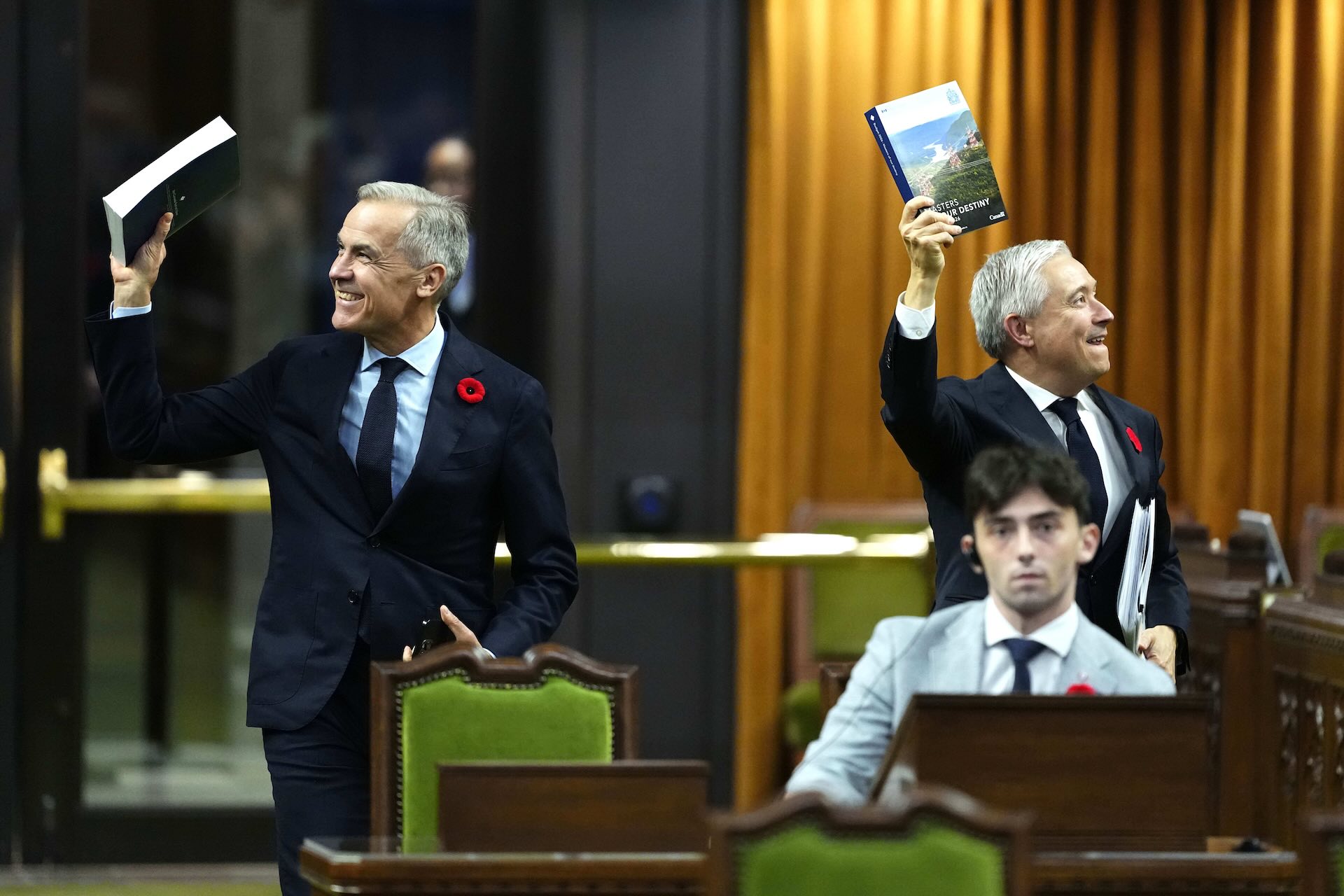
Finance Minister François-Philippe Champagne and Prime Minister Mark Carney arrive in the House of Commons to table the federal budget on Nov. 5, 2026. Photo: The Canadian Press/Justin Tang
Nov 14, 2026 | 7:00 AM ET
A A
A Small A Medium A Large
Share

Gift

Share

Listen Now
0:00

The Canadian Federation of Independent Business was born out of a tax revolt. The way it tells the story, founder John Bulloch was in the bathtub reading the federal government’s 1969 white paper on taxation when he discovered Prime Minister Pierre Trudeau was inclined to raise the rate smaller companies pay on income to 50 per cent.

Trudeau’s finance minister, E.J. Benson, said he was ending an “arbitrary concession to small corporations” in favour of “shareholders with small incomes rather than corporations with small incomes.” Bulloch saw a government poised to “hammer small business and middle-income Canadians.” Outraged, he organized a grassroots campaign that forced Trudeau and Benson to back off. Bulloch turned his protest movement into the independent business federation, or CFIB, in 1971. A quarter-century later he was invested into the Order of Canada for creating a “vehicle” that has allowed smaller businesses to “positively influence legislation and policies at various levels.” Bulloch died in April at the age of 92.

Related Articles
An image of a person holding a book titled, "Masters of our destiny: Budget 2026." The person is wearing a dark suit and tie and standing in front of a Canadian flag, visible in the background.

The Liberals are spending Canada’s energy windfall in a bid to boost productivity

By Joanna Smith
An image of Mark Carney against a light and dark background.

Carmichael: Carney and Champagne’s budget sends the bond market a message

By Kevin Carmichael
An image of an individual walking past a large, multi-coloured painting in a gallery.

Carmichael: Canada’s sovereignty needs more than a strong economy

By Kevin Carmichael

I’ve been thinking about the CFIB because of its response to the budget. The financial plan that Prime Minister Mark Carney and Finance Minister François-Philippe Champagne unveiled on Nov. 5 advances the most pro-business agenda a federal government has offered in recent memory. The most costly measure, announced in the run-up to budget day, is the Productivity Mega Deduction on business investment. Yet the CFIB was as outraged as ever. “Mega disappointing,” said president Dan Kelly, because Carney and Champagne refused to cut small business taxes and increase spending on U.S. tariff relief. 

I’m unsure if the CFIB’s frustration is a positive or negative omen. Maybe both. The proposals that disturbed Bulloch’s bath were an attempt by the government of the day to turn the findings of the Royal Commission on Taxation into policy. We’ll never know if a more coherent tax system would have helped the economy adjust to an earlier period of war, inflation and political instability. What we do know is that the upheaval of those years was the start of a difficult couple of decades that featured recessions in the early 1980s and the early 1990s. 

But Bulloch won his fight over taxes. He also cemented the notion that mom-and-pop shops deserve special treatment. The CFIB stands out among Canada’s established lobbies because of how often it gets its way. In 2008, the preferential rate dropped to 11 per cent from 12 per cent. Former prime minister Justin Trudeau cut the rate to nine per cent on the first $500,000 of income, an expenditure that costs the federal treasury some $6 billion per year.

Smaller companies have it pretty good in Canada, at least when it comes to tax treatment, which is what makes CFIB’s take on the budget so interesting. I think it says something about the extraordinary moment we’re in. When Carney says this is a hinge moment in history, he seems to believe it, beyond overt ideological or partisan motivation. The budget outlines an industrial strategy designed to generate economic growth rather than please special interests, including business interests. The winners are those most willing to disrupt an economy that has stagnated. The “losers” are those who had gotten used to winning, including the Canadian Home Builders’ Association, which was upset that the budget avoided more demand-side sops that do little but stoke home prices.   

The best example of this strategy is the Canada Growth Incentive, which would give wealthy taxpayers a break on their capital gains taxes if they invest those gains in a Canadian startup—but not just any startup. The budget lists nine types of businesses for which the tax break won’t apply, including consultants, accountants, lawyers and “any business whose principal assets is the reputation or skill of one or more employees.” Many industries were also excluded, agriculture, real estate and entertainment among them. Franchisees also were left out. 

Canada’s political class tends to avoid the backlash that comes with picking favourites. One of the better recent examples is the Global Innovation Clusters, a program that spreads its budget allocation across five sectors instead of trying to move the needle in one. The Canada Growth Incentive deliberately targets investors and startups at the edge of the technological frontier, a place where only those seeking scale will survive. That’s also where sustainable economic growth happens. A pipeline will increase gross domestic product while it’s being built, but then it becomes a source of rent. New ideas and ambitious companies are what drive economies forward. The budget suggests Carney has concluded that Canada is lacking in both. 

Scaling isn’t a new challenge. Most Canadian companies start as micro firms and stay that way, according to a report by the Scotia Growth Institute. The innovation clusters represent one attempt at solving the problem. Constant tweaking of the Scientific Research and Experimental Development Tax Credit is another. In 2012, former prime minister Stephen Harper put up $400 million to backstop venture funding, creating the foundation for what is now the $1-billion Venture and Growth Capital Catalyst Initiative. Nothing Ottawa has tried appears to have moved the needle. Productivity growth has been mostly stagnant since the end of the COVID-19 pandemic and venture funding has slumped to its lowest levels since 2021. 

The growth incentive might be the catalyst that Canada’s policy mix has been missing. Sweden has had something similar in place since 2003, partly explaining why a small, open, northern economy is home to an outsized number of world-beating technology companies, according to economists Luis Garicano and Per Stromberg. The capital helps, but it’s more than that. Angel investors who have scaled companies are good at spotting entrepreneurs who have what it takes to follow in their footsteps. Ricardo Hausmann and Eric Protzer of Harvard’s Growth Lab call it “experienced capital,” and it’s what separates Silicon Valley, Sweden and other innovation hotspots from the pretenders. 

Gift the full article

One of the best parts of the budget is another thing that Kelly dislikes. “It makes absolutely no sense” to exclude “about half the businesses” that could use the growth incentive, he said in his post-budget press release. Actually, it makes perfect sense if the goal is to generate economic growth from scarce resources. Based on the Canadian experience, a policy that lets a wealthy person get a break on their taxes by investing in an accounting firm or a mine would be a tax giveaway.

Carney wants to reward growth. It’s a crucial distinction that one of the country’s most important business lobbies appears unwilling to accept. 

Kevin Carmichael is The Logic’s economics columnist and editor-at-large. He has spent more than two decades covering economics, business and finance for outlets including Bloomberg News, The Globe and Mail and the Financial Post, where he also served as editor-in-chief.


#commentary #economy #Federal Budget 2026 #productivity #taxes

Sponsored Content

The road to risk-smart regulation

By Deborah Aarts

Why cybersecurity needs to match pace with AI

By Jessica Aftimus Rosa

How to shift your workforce from AI experimentation to adoption

By Jessica Aftimus Rosa
Paid promotional content

Loading...

Thanks for sharing!

You have shared 5 articles this month and reached the maximum amount of shares available.

Close
This account has reached its share limit.

If you would like to purchase a sharing license please contact The Logic support at [email protected].

Close
Want to share this article?

Upgrade to all-access now

Close
Gift the full article!

You have gifted 0 article(s) this month and have 5 remaining.

Copy link and gift
Copy Link
Email to a friend
Send Email
Gift on Social Media

Recipients will be able to read the full text of the article after submitting their email address. They will not have access to other articles or subscriber benefits.

Photo: The Canadian Press/Justin Tang

Most Popular This Week

An aerial-style rendering of a massive data centre on a prairie landscape of farm fields and trees.
Exclusive

Another giant data centre is in the works for northern Alberta—right next to Meta’s

By Meghan Potkins
A close-up of computer equipment with the Tenstorrent logo on the casing.
Exclusive

Tenstorrent is lobbying Ottawa for data-centre funding and sovereign AI contracts

By Catherine McIntyre
A new condo construction site is seen in downtown Toronto on Thursday, May 25, 2023.
News

Big banks and developers urge Ottawa to halt private capital’s retreat from housing

By Chaimae Chouiekh
Prime Minister Mark Carney, wearing a suit suit jacket, smiles and shakes hands with an Armed Forces member. Several rows of people stand behind them, wearing camouflage pants and red or white sweaters.
News

Canada’s Arctic defence push is overwhelming communities in the North

By David Reevely

In-depth, agenda-setting reporting

Great journalism delivered straight to your inbox.

A head-on shot of Nate Glubish seated and speaking into a microphone he's holding in his right hand. He's wearing a blue patterned blazer.
Exclusive

Alberta is bringing in rules to block frivolous data-centre proposals

By Meghan Potkins

Briefing

Bidding opens for a Canadian city to host new international defence bank headquarters

By David Reevely   |   Nov 13, 2026 | 4:33 PM ET

Microsoft slowly restores services after massive Exchange Online outage

By David Reevely   |   Nov 13, 2026 | 3:45 PM ET

BMO tells U.S. clients to confirm they’ve cut off AI agents’ access

By Chaimae Chouiekh   |   Nov 13, 2026 | 3:42 PM ET

Best business newsletter in Canada

Get up to speed in minutes with insights and analysis on the most important stories of the day, every weekday.

Exclusive events

See the bigger picture with reporters and industry experts in subscriber-exclusive events.

Membership in The Logic Council

Membership provides access to our popular Slack channel, participation in subscriber surveys and invitations to exclusive events with our journalists and special guests.

Recent Popular Stories

Exclusive

Another giant data centre is in the works for northern Alberta—right next to Meta’s

By Meghan Potkins   |   Nov 11, 2026
An aerial-style rendering of a massive data centre on a prairie landscape of farm fields and trees.
Exclusive

Tenstorrent is lobbying Ottawa for data-centre funding and sovereign AI contracts

By Catherine McIntyre   |   Nov 11, 2026
A close-up of computer equipment with the Tenstorrent logo on the casing.
News

Wealthsimple launches AI assistant as Canada’s big banks block third-party agents

By Chaimae Chouiekh   |   Nov 5, 2026
An image of a man wearing dark clothing, standing on a stage and speaking. He is wearing a mic and gesturing. Behind him is a white and black background with text.
News

Canada’s Arctic defence push is overwhelming communities in the North

By David Reevely   |   Nov 9, 2026
Prime Minister Mark Carney, wearing a suit suit jacket, smiles and shakes hands with an Armed Forces member. Several rows of people stand behind them, wearing camouflage pants and red or white sweaters.
Commentary

Carmichael: Canada’s sovereignty needs more than a strong economy

By Kevin Carmichael   |   Nov 7, 2026
An image of an individual walking past a large, multi-coloured painting in a gallery.
News

Big banks and developers urge Ottawa to halt private capital’s retreat from housing

By Chaimae Chouiekh   |   Nov 10, 2026
A new condo construction site is seen in downtown Toronto on Thursday, May 25, 2023.

Canada's most influential executives and policymakers are reading The Logic

  • CPP Investments
  • Sun Life Financial
  • C100
  • Amazon
  • Telus
  • Mastercard
  • bdc
  • Shopify
  • Rogers
  • RBC
  • General Motors
  • MaRS
  • Government of Canada
  • Uber
  • Loblaw Companies Limited
logic-logo

Canada's Business and Tech Newsroom

100% human-crafted journalism

Newsroom

  • News Tips
  • AI Policy
  • Editorial Disclosures
  • Story Pitches

Company

  • About Us
  • Terms of Service
  • Privacy Statement
  • Corporate Information

Contact

  • Contact Us
  • Advertise
  • FAQs
  • Work at The Logic

© 2026 The Logic Inc. All Rights Reserved.

Trusted by leaders

Error

Account creation failed.

Please email us at [email protected].

Create Account

[wppb-register form_name=”cozmo-registration-form-for-modal”]

I do have an account
Login
or

[wppb-login]

I don’t have an account