
Skip to content

Canada's Business and Tech Newsroom

  • Professional Subscription
  • Partnerships & Advertising
  • Licensing & Syndication
Log In Subscribe
Welcome,
  • My Account
  • Log Out
  • Business
  • Tech
  • National
  • The Big Read
  • Briefings
  • Commentary
Search
Log In Subscribe
Welcome,
  • My Account
  • Log Out
Analysis

Alberta has dodged Trump’s trade war. The numbers prove it

Analysis

Alberta has dodged Trump’s trade war. The numbers prove it

An analysis of U.S.-Canada trade data suggests the province has suffered far less from Donald Trump’s tariffs than Ontario, B.C. or Quebec

By Jesse Snyder and Joanna Smith
Alberta Premier Danielle Smith took a different tone than her fellow premiers from the outset of the trade war. Photo: The Canadian Press/Jeff McIntosh
Jan 5, 2026
A A
A Small A Medium A Large
Share

Gift

Share

CALGARY — When Canadian leaders were looking to present a common front against U.S. President Donald Trump’s tariff threats early last year, Alberta Premier Danielle Smith struck a distinctly different tone.

While other premiers were getting behind a potential $155-billion counter-tariff package, Smith urged restraint. As Ontario Premier Doug Ford threatened to shut off power to the U.S., the Alberta leader emphasized America’s need for cheap crude oil, her province’s main export. Smith lobbied central Trump administration figures like U.S. Energy Secretary Chris Wright and U.S. Interior Secretary Doug Burgum, and even visited Trump’s Mar-a-Lago resort in Florida a week before his inauguration.

Talking Points

  • Alberta seems to have sidestepped the worst of Trump’s trade war, exporting its energy without trouble as other provinces wobble under punishing U.S. tariffs
  • A closer look at U.S.-Canada trade data illustrates the extent of the province’s privileged position 
  • With Trump in charge, however, experts warn against getting too comfortable

Nearly a year later, Alberta’s trade position with the U.S. is no less singular than its leader’s tactics. The province has thus far sidestepped the worst of Trump’s trade war, even as tariffs batter provinces like Ontario, B.C. and Quebec. 

To get a sharper sense of the situation, The Logic analyzed trade data to gauge Alberta’s relative exposure to U.S. duties. The results show that the province typically exports a small share of the Canadian goods hit with Section 232 tariffs. That is largely due to the U.S. decision not to put similar national-security tariffs on oil and gas, but the data suggests there is more to the story. Canada-U.S. trade figures from the five years before Trump returned to the White House show the province is far less vulnerable to the trade war than most others—and will remain so even if Trump makes good on his threat to slap tariffs on other sectors.

Related Articles
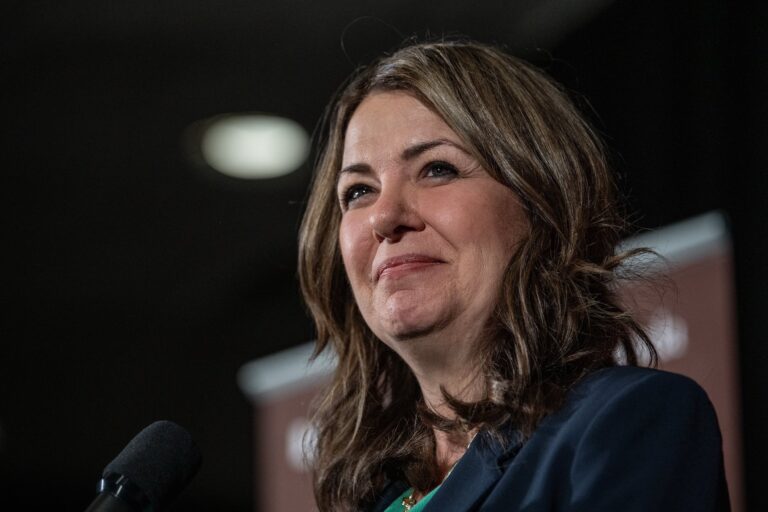
A close-up of Danielle Smith in front of a microphone. She's wearing an arch facial expression, with a close-lipped smile.

Danielle Smith wants Ottawa to do more to attract private investment in a new pipeline

By Joanna Smith
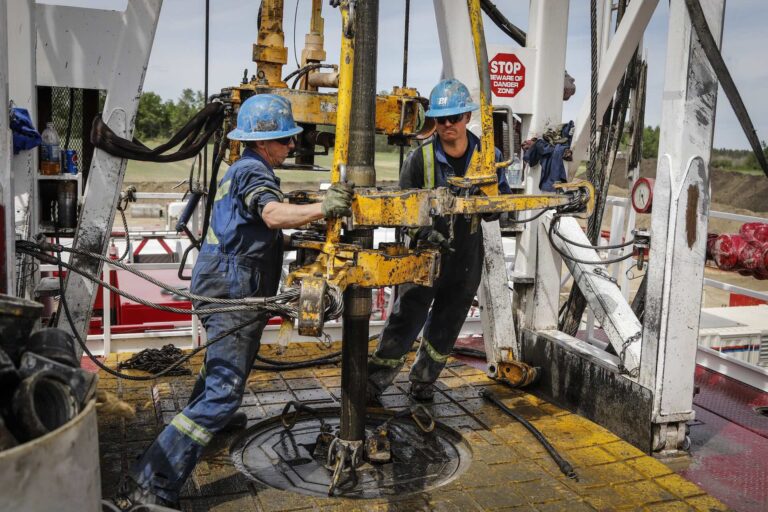
Two workers at an oil rig. A red sign behind them says, "STOP BEWARE OF DANGER ZONE."

As tariffs loomed, Canada’s oilpatch scrambled to catch up on its paperwork

By Jesse Snyder
A collage of Mark Carney, Pierre Poilievre, Doug Ford, Melanie Joly, Danielle Smith, and Justin Trudeau in front of blended American and Canadian flags.

As Trump tariffs loom, who speaks for Canada?

By Joanna Smith

When it comes to steel and most of the derivatives now hit with 50 per cent tariffs, for example, Alberta exported an annual average of $804 million to the U.S. from 2020 to 2024. That accounted for about five per cent of the average value of Canada’s total exports of those products. Ontario, on the other hand, accounted for about 68 per cent of those exports, equalling an average $11.1 billion per year.

Segmented bar chart titled "Relative calm" with the subhead "Alberta is less exposed than other provinces to Trump's national-security tariffs." It lists a number of tariffed industries (aluminum, autos, copper, lumber, medium/heavy machines, and steel) and gives a breakdown of how much of Canada's exports of that industry to the U.S. comes from each province. Alberta is less than 5% of every field except lumber, where it accounts for a little over 13% of Canada's lumber exports to the U.S.

The discrepancy is predictably starker when it comes to autos, a crown jewel of central Canada’s industrial belt. Ontario shipped an average of about $40 billion worth of autos to the U.S. per year over that period—nearly 99 per cent of Canada’s auto exports south of the border. (The Logic’s analysis did not include auto parts subject to Section 232 tariffs, as there is currently a full exemption for parts traded under the United States-Mexico-Canada Agreement.) 

Alberta is more exposed when it comes to lumber products now subject to Section 232 tariffs, including wooden furniture and cabinetry. The province made up 13 per cent of Canada’s exports to the U.S. in those categories. That was higher than Ontario, at 11 per cent, but well below British Columbia at 46 per cent.

Bar chart titled "Limited liability" with the subhead "Alberta's vulnerability to new potential tariffs under Section 232 is comparatively low. Bar chart showing how big the exports to the U.S. are in a variety of fields, broken down by province. The fields listed are semiconductors, processed critical minerals, aircraft and engines, polysilicon, drones, wind turbines, pharmaceuticals, PPE, and robotics and industrial machines. Polysilicon is the smallest field with only $162 million, virtually all from Quebec. The other fields top out at nearly $7.7 (processed critical minerals), and every one has Ontario (and in some instances Quebec, B.C., and/or Manitoba) significantly more exposed to Section 232 tariffs. Alberta's greatest exposure is in pharmaceuticals, where it represents roughly $1 billion of Canada's total $7.45 billion in exports.

To conduct its analysis, The Logic compiled a list of products subject to Section 232 tariffs, according to codes used by U.S. Customs and Border Protection, which are mostly harmonized with Canadian tariff codes. The Logic then examined export data from Statistics Canada for those specific product categories from 2020 to 2024, broken down by province and territory.

At a Toronto trade event in October, Smith acknowledged Ontario’s greater exposure to Trump’s tariffs, comparing her circumstances to those of Ford. “Doug has a very different set of difficulties that he’s facing, and I’m very, very mindful of that, because he’s hit by steel and aluminum and autos and softwood lumber,” she said. 

Alberta’s current situation, however, isn’t a result of pure luck, Smith argued. “Part of the reason for that, I think, is that we’re selling products that the Americans want, and we’ve made the case.” 

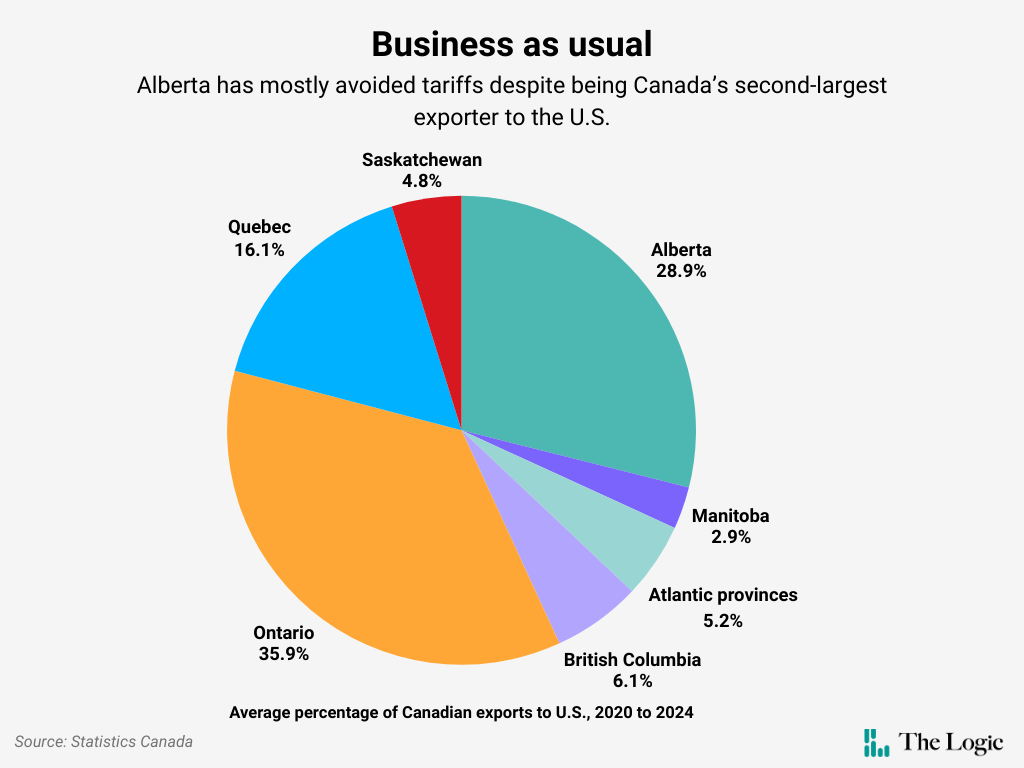
While oil and gas exports to the U.S. have insulated Alberta from the trade war, its reliance on that business also means its economy is the most exposed of any province—at least potentially. In 2023, Alberta’s merchandise exports to the U.S. accounted for 34 per cent of its total GDP, much higher than Ontario’s 18 per cent or Quebec’s 15 per cent, according to RBC research. From 2020 through 2024, Alberta made up an average of 29 per cent of Canada’s annual exports to the U.S., second only to Ontario’s 36 per cent.

Pie chart titled "Business as usual" with the subhead "Alberta has mostly avoided tariffs despite being Canada's second-largest exporter to the U.S." It shows the average annual share of Canada's exports to the U.S. from 2020 to 2024 was 35.9% from Ontario, 28.9% from Alberta, 16.1% from Quebec, 6.1% from British Columbia, 5.2% from the Atlantic provinces combined, 4.8% from Saskatchewan, and 2.9% from Manitoba.

Energy exports make up the lion’s share of the total. Alberta exported $121 billion worth of crude oil to the U.S. in 2024, about 75 per cent of the $162 billion worth of total goods it sold to the country.

Taylor MacPherson, an energy expert at the Montreal Economic Institute, said the U.S. refrained from leveling tariffs on Canadian oil and gas due to the deep integration of North America’s energy systems. The U.S. has purchased Canada’s fossil fuels for more than 100 years, he said, and today the country’s refineries are heavily dependent on Canadian oil. 

Those facilities are calibrated to accept Canada’s uniquely heavy oilsands blends, while the Canadian industry’s cost-cutting efforts, combined with a lack of pipeline capacity to non-U.S. markets, have kept Canadian crude relatively cheap. Perhaps more importantly to Trump, MacPherson said, tariffs on Canadian oil would raise the prices Americans pay at the gas pump.

“It effectively becomes taxing U.S. refineries and taxing U.S. drivers, and that’s political suicide,” he said. 

For now, Alberta’s privileged position appears secure. This past fall, a team of researchers with the New North America Initiative at the School of Public Policy at the University of Calgary conducted a similar analysis of the goods currently facing Section 232 investigations—probes the U.S. administration could use as the basis of new tariffs in the future.

Gift the full article

That analysis also showed that, even if Trump imposes import duties on pharmaceuticals, processed critical minerals, semiconductors, aircraft, wind turbines, drones, polysilicon, robotics or personal protective equipment, Alberta would remain relatively unaffected.

Carlo Dade, director of international policy at the school, said this could let Alberta direct resources toward “the fewer areas that will be heavily impacted”—work he said it can start doing as soon as Trump launches a Section 232 probe. Because, however secure its future looks now, Dade said, the province is in no position to take its circumstances for granted. “We’re in an era of unprecedented,” he said. “It means that Alberta can’t be complacent.”


#Alberta #Canada-U.S. trade #Danielle Smith #economy #Energy #National #tariffs

Loading...

Thanks for sharing!

You have shared 5 articles this month and reached the maximum amount of shares available.

Close
This account has reached its share limit.

If you would like to purchase a sharing license please contact The Logic support at [email protected].

Close
Want to share this article?

Upgrade to all-access now

Close
Gift the full article!

You have gifted 0 article(s) this month and have 5 remaining.

Copy link and gift
Copy Link
Email to a friend
Send Email
Gift on Social Media

Recipients will be able to read the full text of the article after submitting their email address. They will not have access to other articles or subscriber benefits.

Photo: The Canadian Press/Jeff McIntosh

Segmented bar chart titled "Relative calm" with the subhead "Alberta is less exposed than other provinces to Trump's national-security tariffs." It lists a number of tariffed industries (aluminum, autos, copper, lumber, medium/heavy machines, and steel) and gives a breakdown of how much of Canada's exports of that industry to the U.S. comes from each province. Alberta is less than 5% of every field except lumber, where it accounts for a little over 13% of Canada's lumber exports to the U.S.

Bar chart titled "Limited liability" with the subhead "Alberta's vulnerability to new potential tariffs under Section 232 is comparatively low. Bar chart showing how big the exports to the U.S. are in a variety of fields, broken down by province. The fields listed are semiconductors, processed critical minerals, aircraft and engines, polysilicon, drones, wind turbines, pharmaceuticals, PPE, and robotics and industrial machines. Polysilicon is the smallest field with only $162 million, virtually all from Quebec. The other fields top out at nearly $7.7 (processed critical minerals), and every one has Ontario (and in some instances Quebec, B.C., and/or Manitoba) significantly more exposed to Section 232 tariffs. Alberta's greatest exposure is in pharmaceuticals, where it represents roughly $1 billion of Canada's total $7.45 billion in exports.

Pie chart titled "Business as usual" with the subhead "Alberta has mostly avoided tariffs despite being Canada's second-largest exporter to the U.S." It shows the average annual share of Canada's exports to the U.S. from 2020 to 2024 was 35.9% from Ontario, 28.9% from Alberta, 16.1% from Quebec, 6.1% from British Columbia, 5.2% from the Atlantic provinces combined, 4.8% from Saskatchewan, and 2.9% from Manitoba.

Most Popular This Week

Andrew Forde, wearing a beige tweed blazer, black slacks and a white sweater, speaks on a stage at the Elevate conference in Toronto with three large blue screens in the backdrop. One screen displays the session topic, AI, another displays the logos for sponsors KPMG and Google, and a third screen depicts a photo of a stop sign covered in stickers. The stop-sign photo is labelled, “Stickers that beat supercomputers.”
News

KPMG’s AI whisperer says some Bay Street firms are falling into a productivity trap

By Anita Balakrishnan
The Big Read

ApplyBoard faces a reckoning as Canada’s immigration boom turns into a bust

By Claire Brownell and David Reevely
A shot of Anthony Hu in a semi-dark office, with his face illuminated by two computer screens.
The Big Read

Anthropic’s Mythos cracked software open like an egg. It’s just the beginning

By David Reevely
Susan Hawkins, chief executive officer of Payments Canada gestures with her hands as she speaks on stage in front of black screen at the Payments Canada Summit in Toronto.
Exclusive

Not all banks and fintechs will get access to the Real-Time Rail at launch

By Claire Brownell

In-depth, agenda-setting reporting

Great journalism delivered straight to your inbox.

Commentary

Carmichael: If an AI jobs apocalypse is coming, we’re not seeing it in the data

By Kevin Carmichael

Briefing

Anthropic says world needs option to slow AI development, as models learn to self-improve

By Murad Hemmadi   |   Jun 5, 2026

Ottawa taps the brakes on efforts to speed up project permitting

By Laura Osman   |   Jun 5, 2026

Kevin O’Leary scales back Wonder Valley Utah plans after objections from a key state legislator

By David Reevely   |   Jun 5, 2026

Best business newsletter in Canada

Get up to speed in minutes with insights and analysis on the most important stories of the day, every weekday.

Exclusive events

See the bigger picture with reporters and industry experts in subscriber-exclusive events.

Membership in The Logic Council

Membership provides access to our popular Slack channel, participation in subscriber surveys and invitations to exclusive events with our journalists and special guests.


Recent Popular Stories

News

Canada’s surprise plan to buy Saab command jets leaves competitors seeking answers

By David Reevely   |   May 29, 2026
A closeup of a scale model of a jet covered in pixellated camouflage, with sensor equipment attached to the top of its fuselage. There are civilians and uniformed military personnel milling in the background.
Exclusive

Canada awards Ford $464M to make F-Series trucks in Ontario

By Murad Hemmadi, Anita Balakrishnan and Joanna Smith   |   May 7, 2026
Blurred red, white and black cars zoom down a street in front of Ford’s Oakville, Ont., assembly plant on Friday April 5, 2024.
News

European and Asian firms want a stake in Canada’s photonics factory, Joly says

By Murad Hemmadi   |   May 7, 2026
The Big Read

ApplyBoard faces a reckoning as Canada’s immigration boom turns into a bust

By Claire Brownell and David Reevely   |   May 27, 2026
Exclusive

RBC Insurance chief to depart in shakeup of key strategic role

By Chaimae Chouiekh and Anita Balakrishnan   |   May 27, 2026
Low-angle view of an RBC logo sign in front of a tall glass-and-concrete office tower, with surrounding skyscrapers visible in the background.
Exclusive

Shopify makes cuts to its operations team in latest round of layoffs

By Aleksandra Sagan   |   May 4, 2026
Tobias Lutke in a black shirt and grey jeans sitting on a couch, gesturing with both hands pinching the air as he speaks

Canada's most influential executives and policymakers are reading The Logic

  • CPP Investments
  • Sun Life Financial
  • C100
  • Amazon
  • Telus
  • Mastercard
  • bdc
  • Shopify
  • Rogers
  • RBC
  • General Motors
  • MaRS
  • Government of Canada
  • Uber
  • Loblaw Companies Limited
logic-logo

Canada's Business and Tech Newsroom

100% human-crafted journalism

Newsroom

  • News Tips
  • AI Policy
  • Editorial Disclosures
  • Story Pitches

Company

  • About Us
  • Terms of Service
  • Privacy Statement
  • Corporate Information

Contact

  • Contact Us
  • Advertise
  • FAQs
  • Work at The Logic

© 2026 The Logic Inc. All Rights Reserved.

Trusted by leaders

Error

Account creation failed.

Please email us at [email protected].

Create Account

[wppb-register form_name=”cozmo-registration-form-for-modal”]

I do have an account
Login
or

[wppb-login]

I don’t have an account