Skip to content

News
Why Canada doesn’t build things
Three top executives who’ve spent years trying to get big projects moving reveal how bad the regulatory burdens really are
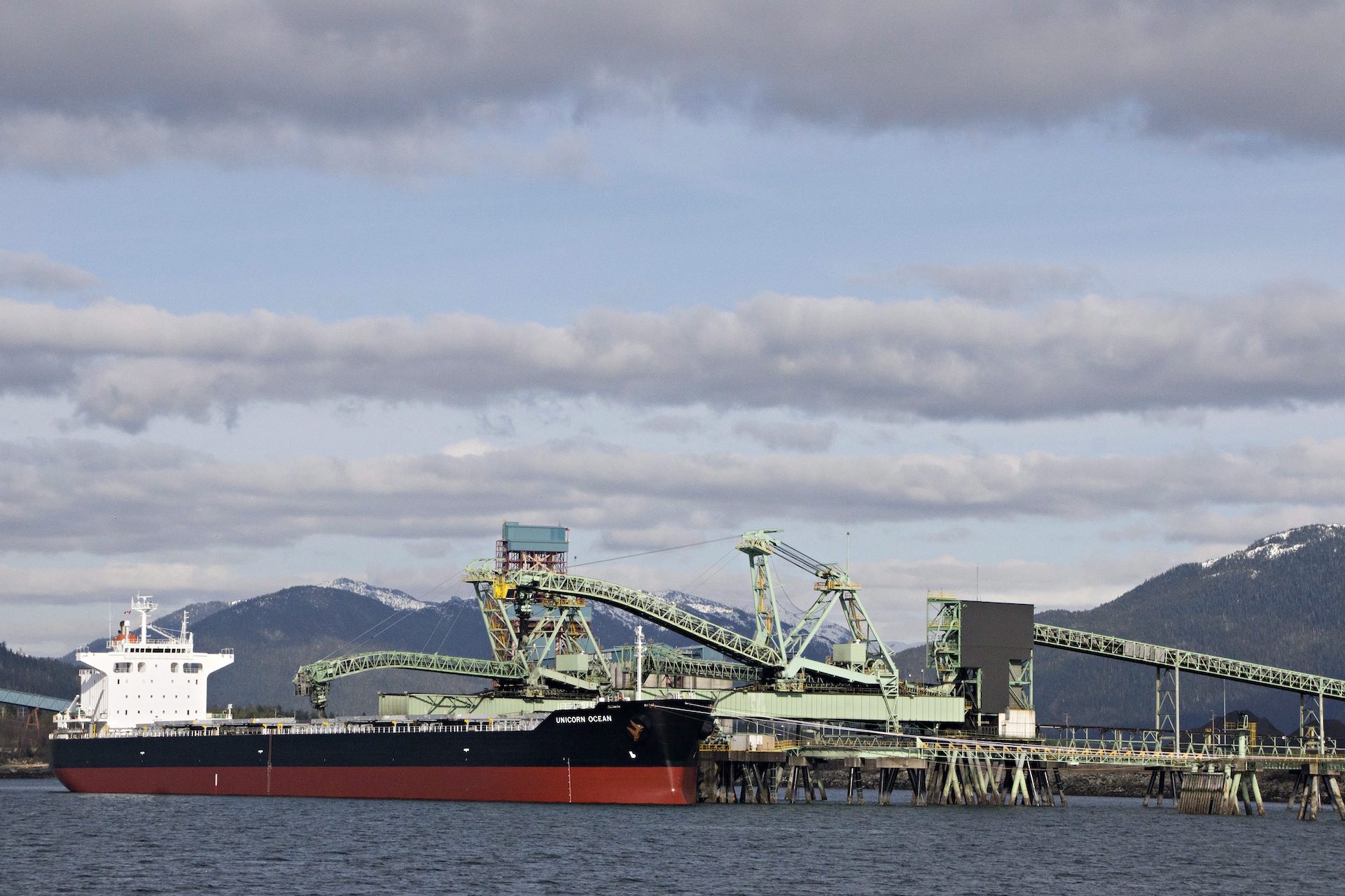
A ship loading coal at Trigon Pacific Terminals’ current facility at the Port of Prince Rupert, in B.C. Photo: The Canadian Press/Robin Rowland
OTTAWA — Like a lot of people trying to build big things in Canada, Anne-Raphaëlle Audouin is willing to jump through hoops to run a $3-billion transmission line for clean power and broadband internet to Nunavut, if only she can find out where the hoops are.
“I don’t know, as a project proponent, how those decisions are made,” said Audouin, CEO of Nukik Corp., an Indigenous-owned company. “We go in and we pitch our story, then we have zero visibility into what happens after that.”
Talking Points
- Prime Minister Mark Carney wants the Liberal government’s new Building Canada Act to smash regulatory obstacles that have kept important new ‘nation-building’ projects from proceeding
- The stories of three attempted projects—a hydro line, a port terminal and a mine—show how thick and interconnected those barriers can be, and how much more than one law will be needed to deal with them
The chief executives of companies with projects on drawing boards in different parts of Canada—Nukik’s hydro and broadband line, a B.C. port terminal, and a Quebec mine for battery materials—tell similar stories of murky approvals processes, conflicting demands from regulators and even a lack of clear answers about why their projects have stalled.
These are the problems that the Liberal government’s newly passed Building Canada Act, Bill C-5, is supposed to help some select projects sidestep.
“You’re constantly chasing your tail,” said John Passalacqua, CEO of First Phosphate, a Quebec mining company that has millions of dollars in funding but no mine yet. “You can never fulfil the task, because by the time you’ve done what you had to do, it’s already changed, or it’s too late, or the market has changed on you.”
The result: stasis.
“We just haven’t built mines. We just haven’t built projects. I mean, what do we build? We build nothing. We just push paper around all day long,” he said.
Related Articles


Audouin echoed that. “The process doesn’t work. It’s completely bureaucratic and it’s led by people who’ve never developed nation-building projects,” she said. “That’s why we are in complete paralysis in Canada in terms of infrastructure. It’s because people who are actively making those decisions have absolutely no clue what they’re talking about.”
The Kivalliq Hydro-Fibre Line is an obvious candidate for special treatment under the new law. The federal government has already supported the line’s early development. The Liberals mentioned it in a recent budget as a potential beneficiary of clean energy tax credits. It’s an explicit priority for the Nunavut government, and Manitoba is on board, too.
This has all added up to encouragement but no shovels.
One objection—or even just a question—around a table of officials seems to be able to stall progress, Audouin said, and Nukik doesn’t even hear about it.
“The machine just comes to a complete halt until maybe months after, when you re-engage,” she said. “That’s when they tell you that someone raised an issue.”
This is a particular problem for efforts like Nukik’s, she said.
“For Indigenous-owned projects, you don’t have infinite budgets to do lobbying every day of the year,” Audouin said.
Federal officials talk a lot about the need to de-risk projects without seeming to get that regulatory risk is a huge part of the problem in Canada, she said. “I think there needs to be a recognition that they can be a big bottleneck in terms of attracting private capital.”
On the West Coast, Trigon Pacific Terminals is seeking to build a new terminal to export liquified propane through the Port of Prince Rupert. Trigon CEO Rob Booker is championing the project. He worked his way up from loading ships and trains as a foreman to spearheading an expansion at Neptune Bulk Terminals in Vancouver and chairing the B.C. Marine Terminal Operators Association.
“I’m a builder. It’s what I love,” he said.
Trigon expects its terminal would cost $750 million—a lot of money, but not on the scale of, say, an $11.6-billion petrochemical plant near Edmonton (which Dow Chemical has paused but says it still intends to build), or the $34.2-billion estimated cost to expand the Trans Mountain pipeline.
“We just haven’t built mines. We just haven’t built projects. We build nothing. We just push paper around all day long.”
“I’m so far down in the decimal places that you and I probably can’t see the number about what portion of the GDP I can influence with this project,” said Booker. But because it’s a fossil-fuel project with greenhouse-gas implications, the terminal proposal gets a full examination under the federal Impact Assessment Act instead of a more limited review by the Prince Rupert port authority. “So now you’ve got the Government of Canada analyzing super-small projects.”
Most of the trouble arises where different jurisdictions bump into each other, though. The federal Department of Fisheries and Oceans might be willing to authorize dredging a harbour for new port infrastructure, but the provincial government has to sign off on what will happen to the muck after it’s pulled out of the water, Booker said.
“We don’t have a really smooth way to get that done in one step,” he said.
Electricity connections are another pain point. Federal regulators will ask where a project’s power is going to come from and what the carbon emissions will be, Booker said. In B.C., the cleanest electricity comes from hydro dams, which means negotiating with a provincial utility before he can tell the feds anything.
Passalacqua, at First Phosphate, is familiar with a version of the hydro problem. Mining is energy-intensive and First Phosphate, he said, is looking for electricity from Hydro-Québec.
“Hydro can’t give you megawatts until you have reached a certain level of maturity in the project. But you can’t reach that level of maturity in the project and you can’t get financing unless you have your hydro,” he said.
Passalacqua, whose experience is primarily as a financial operator, not a miner, thinks this pileup of impediments is why even Canadian pension funds don’t want to invest in Canada: regulators’ inability to say yes in time to take advantage of market opportunities.
“All of our money that should have been put here to build Canada is being sent away to projects outside of Canada because they feel like there’s easier permitting, there’s less headaches,” Passalacqua said.
The Building Canada Act wouldn’t have any bearing on this situation, which pits a provincial utility’s process for allocating scarce electricity against investors’ desire to fund projects that won’t be vaporized because Hydro-Québec chose to power a data centre instead. But that just illustrates how widespread the trouble is.
“It’s like the tax code. There’s so much of it now, and it’s just so intertwined,” Passalacqua said. “It’s like a whole system of duct tape.”



Loading...
Thanks for sharing!
You have shared 5 articles this month and reached the maximum amount of shares available.
CloseThis account has reached its share limit.
If you would like to purchase a sharing license please contact The Logic support at [email protected].
CloseGift the full article!
You have gifted 0 article(s) this month and have 5 remaining.
Recipients will be able to read the full text of the article after submitting their email address. They will not have access to other articles or subscriber benefits.
Photo: The Canadian Press/Robin Rowland
Most Popular This Week




In-depth, agenda-setting reporting
Great journalism delivered straight to your inbox.
Commentary
Carmichael: Canadian ignorance about India is a strategic weakness
Briefing
Aritzia shares pop after earnings rise 204%
First Nation in Alberta goes to court over fast-tracked oil pipeline
Chinese EV maker Geely Auto Group to launch in Canadian market in 2027
Best business newsletter in Canada
Get up to speed in minutes with insights and analysis on the most important stories of the day, every weekday.
Exclusive events
See the bigger picture with reporters and industry experts in subscriber-exclusive events.
Membership in The Logic Council
Membership provides access to our popular Slack channel, participation in subscriber surveys and invitations to exclusive events with our journalists and special guests.





