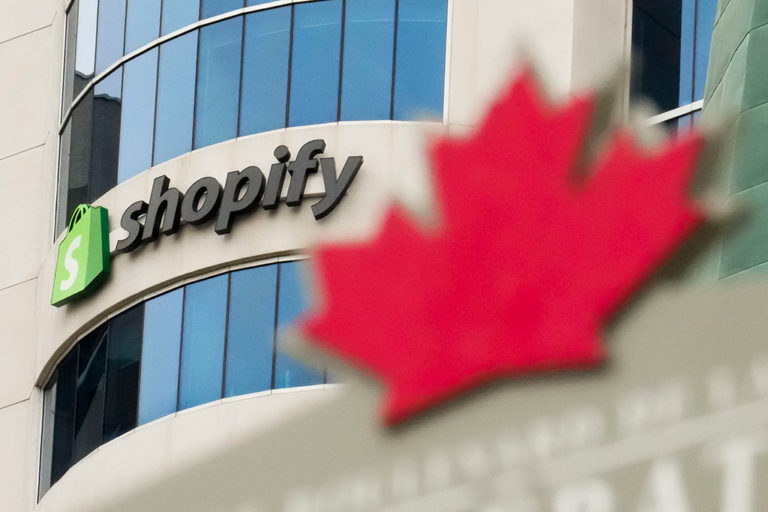
OTTAWA — Shopify’s moves to become a one-stop-shop for clients’ retail operations are paying off, as the firm exceeded market expectations for the third quarter, even as its merchants’ sales growth continued to tail off.
The commerce-technology company reported US$1.37 billion in revenue between July and September and an adjusted loss of US$0.02 per share; both figures beat analysts’ consensus estimates as compiled by FactSet. Shopify’s stock jumped as much as 19 per cent in Thursday trading on the New York Stock Exchange. Here are the numbers that matter in the company’s third-quarter earnings:
Talking Points
- Shopify reported US$1.37 billion in third-quarter revenue, with adjusted losses of US$0.02 per share, ahead of analysts’ consensus estimate
- The commerce technology company’s growth outpaced that of its merchants, as clients bought more services to operate their retail businesses
The key number: Shopify’s average cut of a merchant’s order rose to 2.14 per cent, up 16 basis points quarter over quarter—the largest increase in take rate in its time as a public company.
The firm’s merchant-solutions business consists of fees for longstanding add-ons like payment processing and cash advances, and for newer ones like banking and fulfillment. That business line brought in nearly US$990 million in revenue in the third quarter, up 25.7 per cent year over year. That’s significantly more sales growth than its merchant base. Gross merchandise volume (GMV), a measure of orders made through the platform, increased 10.5 per cent to US$46.2 billion for the third quarter. It’s never increased less year over year.
Shopify has outpaced its clients’ growth by selling them more services. Its money-spinning Payments service continues to permeate its merchant base, handling 54 per cent of GMV last quarter as the company launched it in four more European markets. Other financial products also made gains, including its buy-now, pay-later feature Installments, and its cash-advance service Capital, which it expanded to Australia.
Half the bump in its take rate came from Deliverr, the fulfillment startup it bought in May for US$2.1 billion. It’s fusing Deliverr’s logistics web with its own Shopify Fulfillment Network, and is planning a new app for merchants to use the combined system, president Harley Finkelstein said on an earnings call Thursday.
“While still early, Shopify appears to be on track with Fulfillment,” Richard Tse, analyst at National Bank Financial Markets, wrote in an investor note Thursday, adding that the service “has the potential to create a notable competitive advantage.”
Another recent addition has also shown signs of success. Shopify Markets, in wide release since January, lets merchants sell in local currencies, display location-specific content to buyers, and manage duties and other cross-border selling requirements. More than 175,000 clients have used it to date, said Finkelstein, of the “millions” the company has in total. (Shopify last reported a numeric merchant base figure a year ago, when the count stood at “over 1.7 million.”) “We are confident that adoption will continue to increase as merchants look for ways to grow their businesses beyond their domestic borders,” he said, noting that internal research finds localized content tends to boost sales.
Shopify still has “notable headroom when it comes to take rate, particularly as the company brings on larger merchants,” Tse wrote.
The bottom line: The company posted a net loss of US$158.4 million for the quarter, a number improved by a US$171.9-million boost from equity and other investments; Shopify’s stakes in publicly traded Affirm and Global-e Online, upon whose technology some of its new features are built, were worth US$959.5 million at the end of September. That’s down from US$3.2 billion at the turn of the year.
Adjusting for such factors, Shopify lost US$30 million, its second consecutive quarter in the (light) red. In July, the firm laid off 10 per cent of its workers, an estimated 1,000 people, citing a slower-than-expected retail transition to e-commerce as the pandemic waned. On her final earnings call, outgoing CFO Amy Shapero said the severance payouts cost US$30 million.
“We said this year was an investment year,” Finkelstein said, adding that “ultimately, this is a company that likes to be profitable, and we will get back there.”
What comes next: The final three months of the year are typically Shopify’s most lucrative, as shoppers flock to merchants’ Black Friday and Cyber Monday promos, and spend for the holiday season. On Thursday, Shapero said the firm expects GMV growth in the fourth quarter to beat that of the broader retail market, but noted that sales for both Shopify and its clients are likely to end up more even across the year.
“The reality is that growth has (is) moderated (ing) this year in the absence of the pandemic tailwind for online commerce,” Tse wrote. “While that may be true, we think it’s also true that Shopify’s platform is continuously improving in the face of that.”
Update: This story has been updated with quotes from analyst notes.