OTTAWA — Shopify is warning that this will be a “transition year,” as high inflation and the end of the COVID-19 online-shopping boom will hurt the company’s business of selling commerce tools to merchants. But it insists recent staff cuts won’t slow its product plans.
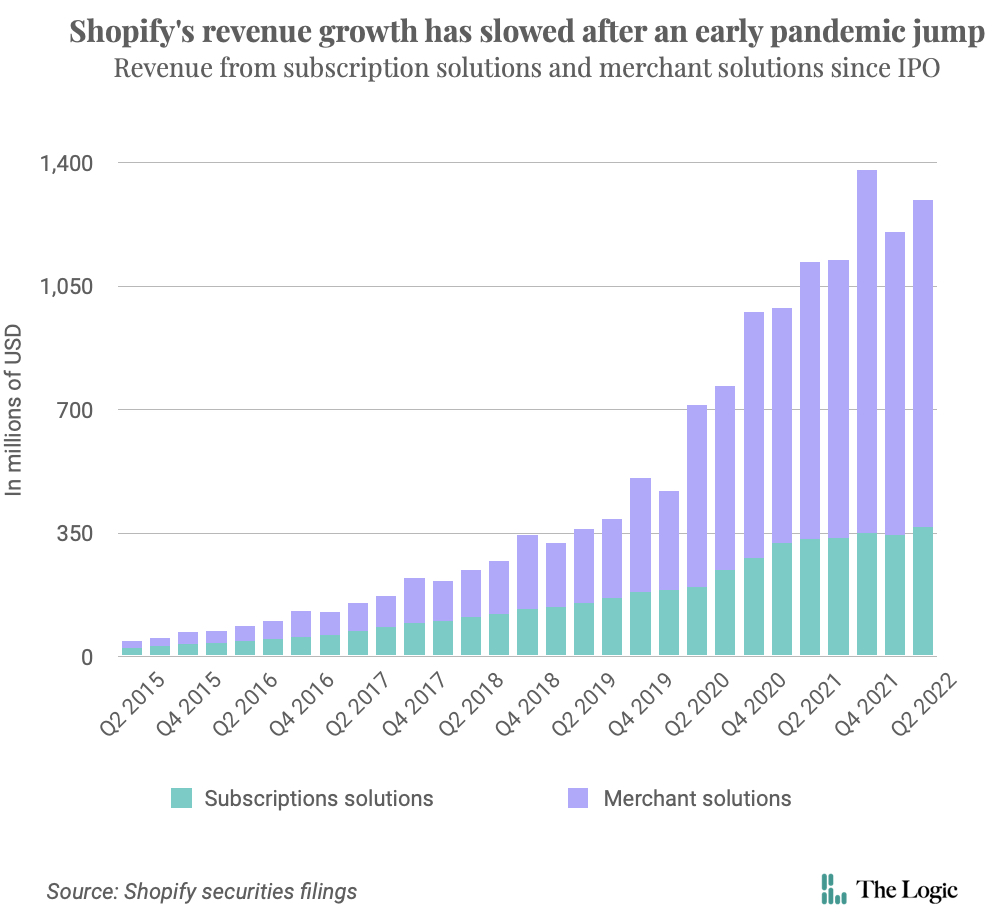
On Wednesday the firm reported US$1.3 billion in revenue in the second quarter, up 15.7 per cent year-over-year, compared to analysts’ consensus estimate of US$1.33 billion as compiled by FactSet. It comes one day after the firm announced plans to lay off a tenth of its workforce. Here are the numbers that matter in Shopify’s second-quarter earnings:
Talking Point
Shopify reported revenue of US$1.3 billion in the first quarter of 2022, up 15.7 per cent year over year, and an adjusted net loss of $0.03 per share, both just under analyst expectations. The firm is warning of more red ink ahead, as shoppers buy more from brick-and-mortar stores and less overall amid inflation fears.
Two key numbers: The firm’s clients sold US$46.9 billion worth of their products using Shopify’s technology last quarter, up 11 per cent from the same period last year. That’s the lowest-ever rate of growth of gross merchandise volume (GMV) Shopify has reported as a public company.
Shopify’s takings are closely tied to those of its customers, since it earns fees for services that they use to operate, like payment processing, merchant cash advances, and fulfillment. The company’s merchant solutions business brought in US$928.6 million in revenue between April and June, an 18.3 per cent year-over-year increase.
The firm posted higher growth than its merchants, because those are merchants using more of Shopify’s tools. On an earnings call Wednesday, CFO Amy Shapero cited increased use of its money-spinning Shopify Payments offering—53.1 per cent of GMV now flows through it—and Capital, the service through which it lends money to merchants. The firm has also seen promising uptake for Markets, a feature it launched in September 2021 that lets merchants offer their products to shoppers in other countries in local languages and currencies.
The market reaction: Shopify’s stock was up as much as 9.4 per cent in early Wednesday trading on the New York Stock Exchange, after falling sharply Tuesday on the layoff news. The share price remains below pre-pandemic levels, adjusted for a recent stock split.
The red light on the dashboard: The firm lost US$1.2 billion in the second quarter, which it mostly attributed to a US$1 billion drop in the on-the-books value of its equity holdings and investments; Shopify has picked up stakes in partners like Affirm and Global E-Online, which buoyed its earnings when those stocks were doing well. They’re now caught in an industry-wide slump—the iShares MSCI World Information Technology Sector, with US$211 billion in assets, was down 27.9 per cent this year through yesterday. Taking such factors into account, Shopify lost US$38.5 million, or US$0.03 per share, compared to analysts’ expectations of a US$0.02 per-share profit.
Things will get worse before they get better, executives cautioned on Wednesday. Shapero said Shopify’s adjusted operating loss is “expected to materially increase” in the third quarter, as it integrates logistics acquisition Deliverr and makes other in-house changes. But she said the company expects less red ink in the last three months of the year.
Shopify has managed to increase its operating income for the last five years, Shapero noted. “We expect 2022 will be different, more of a transition year in which e-commerce is largely reset to the pre-COVID trendline and is now pressured by persistent high inflation.”
Consumers in the U.S. and Europe—which together accounted for more than four-fifths of Shopify’s revenue last year—are increasingly worried about a looming recession, and may curb expenses as they brace for economic fallout. On Wednesday’s call, executives didn’t directly answer an analyst’s question about how much of the company’s merchants’ sales are discretionary spending, which would likely be the first thing consumers cut. “Apparel, cosmetics, beauty, home goods have tended to be the mainstays and the majority of the GMV,” Shapero noted, with “every category” across its clientele growing in the last quarter. She also cited the continued strength of food and beverage retail, a top performer in the early days of the pandemic.
What comes next, internally: On Tuesday, Shopify laid off 10 per cent of its 10,000-plus workforce. In a memo, CEO Tobi Lütke acknowledged the company made a flawed bet that the surge in online shopping over the last two years would persist past the pandemic.
“For the remainder of 2022, we expect to slow hiring to only the most strategic,” said Shapero. She also maintained that the company still plans to roll out a new compensation system—which allows staff to choose a mix of salary and stock—this quarter, at a cost of US$50 million through the end of the year.
“Everything that a software company does is about productivity [and to] be able to automate things that need to be automated,” Lütke said on Wednesday’s call. He pointed to the number of features the company’s technical team has launched over the last two years, and said the company plans to apply the same “organization and tooling” to the rest of the company. “We found huge efficiencies in the past, in things like underwriting for our [Shopify] Capital product and all these areas,” Lütke said. “This is what we’re gonna invest in now.”
He also pushed back on the suggestion that layoffs would affect the firm’s plans to roll out new products. “We’re not sacrificing anything in this,” he said.