North America’s aerospace industry could lose just as much, if not more, than the automotive sector if U.S. President Donald Trump enforces tariffs next month, industry experts have warned.
Skip to content

News
Trump’s trade war could decimate North America’s aerospace industry
The aerospace sector would be gradually but critically hobbled by tariffs, with investment disrupted and the future of key manufacturing hubs thrown into chaos
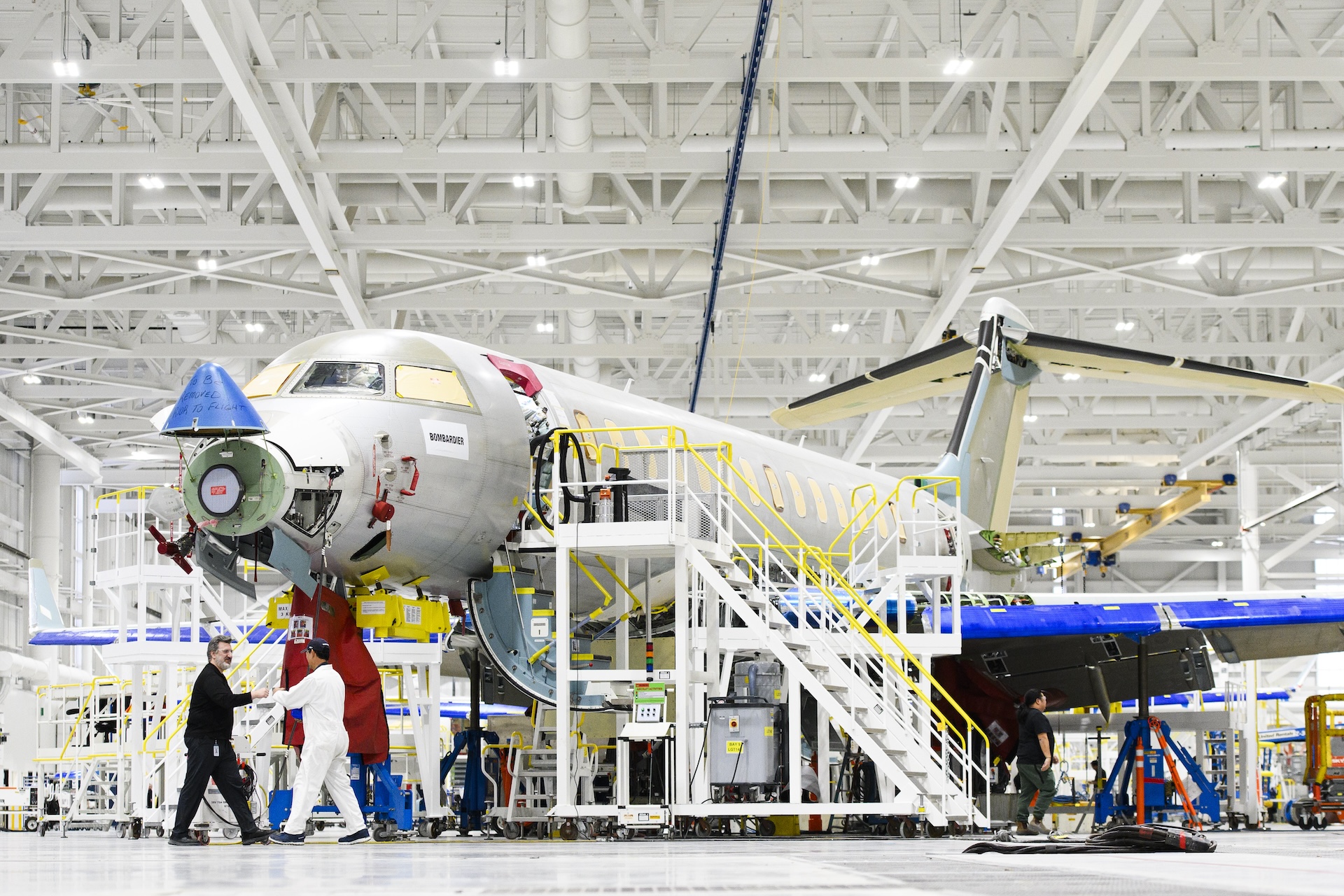
The Bombardier Aircraft Assembly Centre in Mississauga, Ont. The U.S. is the biggest destination for Canadian aerospace exports, according to government data. Photo: The Canadian Press/Christopher Katsarov
North America’s aerospace industry could lose just as much, if not more, than the automotive sector if U.S. President Donald Trump enforces tariffs next month, industry experts have warned.
The tariffs would decimate an industry that contributes $28.9 billion to Canada’s GDP and supports 218,000 jobs in the country. Canada is the second biggest recipient of U.S. exports of civil aircraft, engines and parts, while the U.S. is the biggest destination for Canadian exports, according to government data.
Talking Points
- Tariffs would be “extremely disruptive” to an industry dependent on tight-knit supply chains, with Canada and the U.S. both playing major roles in the construction of aircrafts
- The looming tariffs are threatening contracts and causing unease among investors as deals are put on hold
Tariffs would be damaging to the aerospace industry, affecting its intricate supply chains, pushing up costs and disincentivizing investment, KPMG aerospace and defence national leader Peter Graham said. “It’s extremely disruptive when you’ve depended on free trade,” Graham said, adding that the industry would now need to “re-evaluate” following Trump’s threat.
Canada and the U.S. are major trade partners in aerospace manufacturing, with over two-thirds of Canadian aerospace exports heading to America. Canada’s aerospace industry exported C$12.8 billion in products and parts to the U.S. in 2023, and America exported C$10.2 billion to Canada.
Related Articles


In Quebec, a major player in Canada’s aerospace industry, tariffs would wear on aerospace companies, increasing costs, complicating trade across the border, and slowing R&D, Mélanie Lussier, president of aerospace think tank Aéro Montréal told The Logic in an email. Throughout the manufacturing process components cross the Canada-U.S. border multiple times as they’re assembled, Lussier said, similar to the automotive industry. Aerospace could be even “more vulnerable” than the automotive industry to volatile costs and trade disturbances, Lussier wrote.
“Unlike the automotive sector, where impacts can be immediate, the effects on aerospace will be more gradual but just as critical, influencing investment and location decisions in the long run,” Lussier added.
Among aerospace exports, 59 per cent were elements of the supply chain—like engines, parts and components, according to a government report. Parts are moved across the border between Canada and the U.S., as well as other countries. Any aircraft that is dependent on Canadian suppliers will face an “outsized impact,” Graham said, including those reliant on small components and basic metals.
“You put in a tariff, it compromises the whole way the supply chain was created in the first place,” Graham said. Though there are fewer full units being made in aerospace than the automotive industry, the supply chains are “tight,” and lots of parts aren’t available in many countries, he added.
Canada and the U.S. have both signed the World Trade Organization’s Trade in Civil Aircraft Agreement, where they are required to abolish tariffs on civil aircrafts, engines, flight simulators and parts. The agreement has been in place since 1980.
The looming tariffs could leave countries reluctant to agree to long-term contracts for supply from Canada, and there’s also the question of whether the contracts allow Canadian companies to increase their prices, Graham added. Uncertainty is also causing M&A activity in the aerospace industry to slow, and it could reach a “standstill,” Graham said, causing disagreement in how to value companies.
Should tariffs be imposed, one of the biggest companies affected would be Quebec-headquartered Bombardier, which relies heavily on U.S. revenue. In 2023, the company made US$5.1 billion in revenue from customers in the U.S., out of a total US$8 billion.
Bombardier has been working on “multiple scenarios” and will spend the coming days working out next steps, company spokesperson Christina Lemyre McCraw told The Logic prior to the tariff pause.
Brian Bryant, international president of the International Association of Machinists and Aerospace Workers (IAM) said the union is “relieved that destructive tariffs” have been halted. Bryant said the pause was an opportunity for government, business and labour groups to come together. “Workers on both sides of the border deserve to drive policy conversations about their livelihoods, not be pawns in a larger political discussion,” Bryant said.



Loading...
Thanks for sharing!
You have shared 5 articles this month and reached the maximum amount of shares available.
CloseThis account has reached its share limit.
If you would like to purchase a sharing license please contact The Logic support at [email protected].
CloseGift the full article!
You have gifted 0 article(s) this month and have 5 remaining.
Recipients will be able to read the full text of the article after submitting their email address. They will not have access to other articles or subscriber benefits.
Photo: The Canadian Press/Christopher Katsarov
Most Popular This Week




In-depth, agenda-setting reporting
Great journalism delivered straight to your inbox.
News
An obscure data standard is the latest open banking holdup—and an unlikely political hot potato
Briefing
Cohere says it caught an Alibaba model trying to send data to a server in China
Feds and First Nations to work on sharing resource revenue, with a sovereign wealth fund one option
Zafin buys U.S. fintech Naehas in nine-figure deal
Best business newsletter in Canada
Get up to speed in minutes with insights and analysis on the most important stories of the day, every weekday.
Exclusive events
See the bigger picture with reporters and industry experts in subscriber-exclusive events.
Membership in The Logic Council
Membership provides access to our popular Slack channel, participation in subscriber surveys and invitations to exclusive events with our journalists and special guests.