OTTAWA — Prime Minister Justin Trudeau and U.S. President Donald Trump made a deal Monday afternoon to pause U.S. tariffs on Canadian goods for 30 days, after Trudeau promised additional moves to fight the smuggling of drugs and people across the American border.
Skip to content

News
Trump gives Canada 30-day reprieve on tariffs after calls with Trudeau
Canada agrees to appoint a ‘fentanyl czar’ and list drug cartels as terrorist groups. But Trump says averting tariffs in March hinges on reaching a new economic deal.
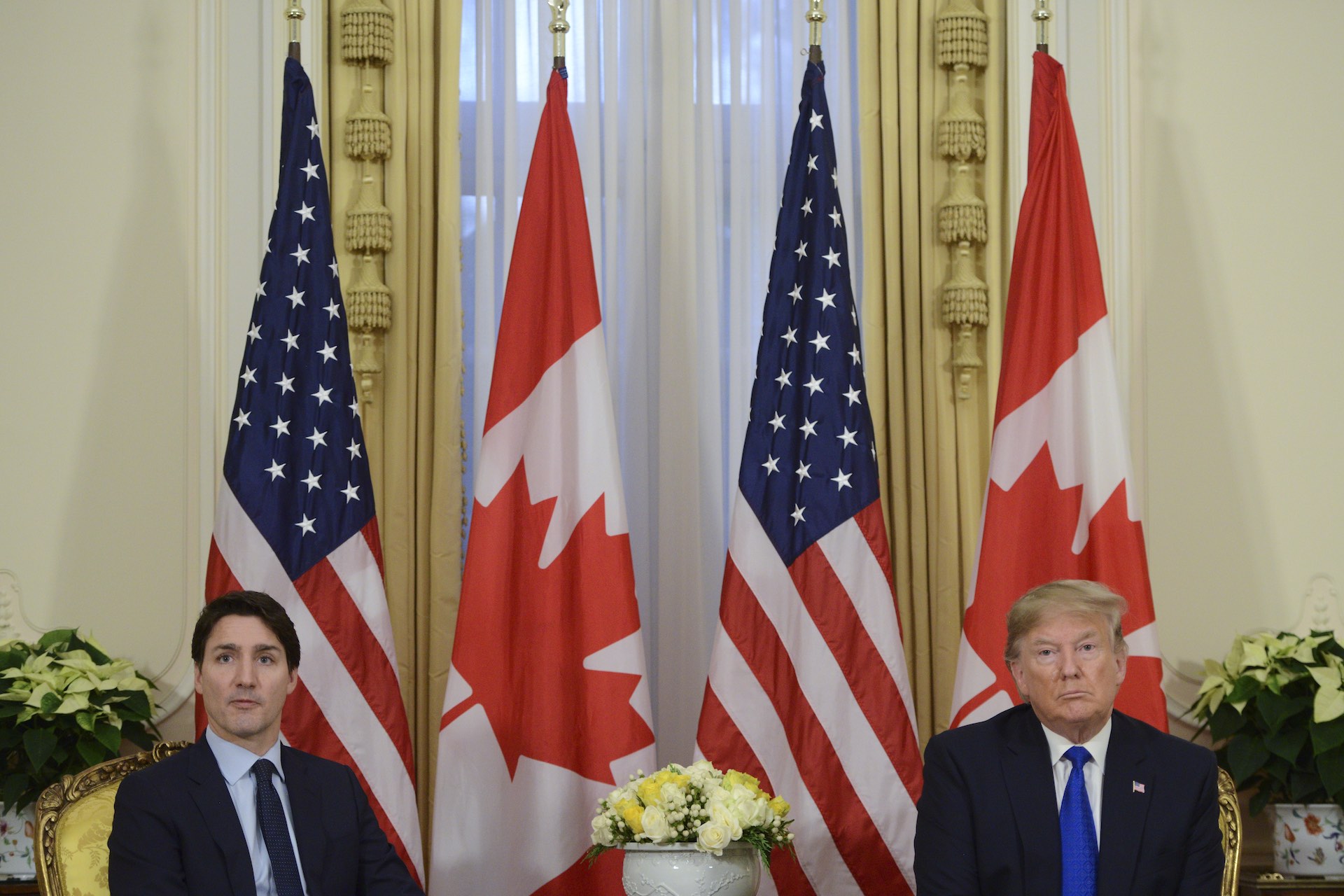
Prime Minister Justin Trudeau and U.S. President Donald Trump, seen here during a 2019 meeting in London, spoke twice by phone on Monday after weeks without contact. Photo: The Canadian Press/Sean Kilpatrick
OTTAWA — Prime Minister Justin Trudeau and U.S. President Donald Trump made a deal Monday afternoon to pause U.S. tariffs on Canadian goods for 30 days, after Trudeau promised additional moves to fight the smuggling of drugs and people across the American border.
Trudeau announced the agreement. Trump confirmed it shortly afterward, with a hint that he will want more by the next deadline in early March.
“I am very pleased with this initial outcome, and the tariffs announced on Saturday will be paused for a 30-day period to see whether or not a final economic deal with Canada can be structured,” he wrote on his Truth Social platform. “FAIRNESS FOR ALL!”
Talking Points
- U.S. President Donald Trump has delayed crushing tariffs on Canada after speaking twice by phone on Monday with Prime Minister Justin Trudeau
- In return for the 30-day reprieve, Canada agreed to new moves to fight the smuggling of drugs and people across the U.S. border, including the appointment of a “fentanyl czar”
- Trump suggested on social media that the two countries must reach “a final economic deal” during the delay for Canada to avoid tariffs on March 5
In the meantime, besides the existing $1.3-billion border package the Canadian government promised in December, the immediate agreement includes pledges by Canada to appoint a “fentanyl czar,” list drug cartels as terrorist organizations, and put $200 million into intelligence efforts against organized crime and the fentanyl trade.
Relief and angst
The postponement sets up yet another ride on the roller-coaster of Trump’s threats and retreats, this time leading up to March 5.
“We are encouraged to see an agreement was reached to delay the tariffs,” said Brian Kingston, of the Canadian Vehicle Manufacturers’ Association, whose members and their workers might be first to suffer badly in a tariff war. “The threat of tariffs will continue to create uncertainty for the auto industry but we have avoided an extremely damaging outcome for the North American industry.”
Lana Payne, the national president of the huge Unifor union, issued a statement saying Trump declared economic war on Canada and despite the current armistice, there’s no turning back.
Related Articles

“As a country, we must use the days ahead to continue to bring Canadians together, to plan for a potential trade war, and to use every single available lever to build a strong, resilient, and diverse economy,” she said.
Benjamin Bergen, president of the Council of Canadian Innovators, was similarly militant. Trump will be back, he said.
“Governments are committing to buy Canadian, to reduce interprovincial trade barriers, and to support the growth of our homegrown businesses,” he said. His group has been calling for all that for years, he said, and Canada’s leaders should keep it up.
Jean Simard, president and CEO of the Aluminum Association of Canada, greeted the delay as a “positive step” toward resolution, but warned, “It keeps us under a veil of uncertainty for the next 30 days as to what the outcome will be.”
That uncertainty is taking a toll, said Matthew Holmes, chief of public policy at the Canadian Chamber of Commerce. “There’s a sort of psychological warfare happening here,” he said, noting the unpredictability has material effects, as businesses scramble to get ready. “We’ve heard from some members who have done a month’s worth of business in a week.”
Dennis Darby, head of Canadian Manufacturers & Exporters, urged Canadian political leaders not to waste the extra time or abandon plans to strengthen the economy.
“This temporary reprieve must not be squandered,” he said in a statement that urged federal and provincial governments to “act decisively” in “developing robust contingency plans to protect Canadian manufacturers and workers if tariffs proceed and addressing the long-standing structural challenges hindering Canada’s economic growth.”
Two phone calls
After no direct contact between Trudeau and Trump since the Jan. 20 inauguration, the leaders talked twice Monday, once in the morning and again in the afternoon.
The afternoon call was just before Trump welcomed the Stanley Cup champion Florida Panthers to the White House. The Panthers beat the Edmonton Oilers for the hockey trophy last year.
Temporary truce with Mexico
In between the Trudeau-Trump calls, Trump and Mexico’s President Claudia Sheinbaum separately announced an agreement to pause tariffs for one month while they negotiate on border security. Trump touted a Mexican pledge to send 10,000 troops to the border to stop fentanyl smugglers and migrants; Sheinbaum said the United States would crack down on the flow of high-powered weapons into her country.
Mixed messaging
Senior aides to U.S. President Donald Trump contradicted their boss in public on Monday about the purpose of his tariff threats, complaining that Canada had been blowing up a simple call for co-operation on border security into a full trade war. Meanwhile, the president reiterated his demand that Canada become an American state and aired other grievances.
On CNBC, Trump economic adviser Kevin Hassett praised Mexico for being “very, very serious” about stopping drugs from entering the United States. He claimed Canada misinterpreted the president’s moves as a broader trade offensive, which he said would be senseless, and for seeking a fight with the U.S. for political reasons.
“I think that’s probably consistent with the policies that we’ve seen from [Canada’s] failed government in the past,” Hassett said. “Canada is like San Francisco and it’s spreading to the U.S.”
“This is a drug war, not a trade war,” Trump trade adviser Peter Navarro echoed in a separate TV appearance. He added that up to 100 terrorists have entered the U.S. through Canada.
Neither said anything about Canada’s previous moves on border security and fentanyl production.
Nor did they address Trump’s other publicly stated motives: using economic force to annex Canada (a desire Trump talked about again Monday), objecting to the oil-driven trade imbalance between the two countries, and praising tariffs as superior in general to income taxes.
Trump also raised a new complaint, in another Truth Social post, that U.S. banks aren’t allowed to do business in Canada, which they are, and do.
Poilievre’s proposal
Conservative Leader Pierre Poilievre advanced a border-control plan of his own in Vancouver. Trump’s tariffs are unjustified, Poilievre said, but the border needs fixing regardless.
He called for the Canadian military to be deployed to the frontier with the U.S., for Canada Border Services Agency to hire at least 2,000 more agents and to have its reach expanded beyond official crossings, for more technological solutions like drones and cargo scanners, and for monitoring of departures from Canada “so government officials know which deportees are in Canada illegally.”
With files from Anita Balakrishnan and Joanna Smith



Loading...
Thanks for sharing!
You have shared 5 articles this month and reached the maximum amount of shares available.
CloseThis account has reached its share limit.
If you would like to purchase a sharing license please contact The Logic support at [email protected].
CloseGift the full article!
You have gifted 0 article(s) this month and have 5 remaining.
Recipients will be able to read the full text of the article after submitting their email address. They will not have access to other articles or subscriber benefits.
Photo: The Canadian Press/Sean Kilpatrick
Most Popular This Week




In-depth, agenda-setting reporting
Great journalism delivered straight to your inbox.
The Big Read
Alberta’s referendum is just the start of the turmoil
Briefing
EverWind plans $10B data centre and wind development in Nova Scotia
Canada ready to force Stelco to sell its Canadian operations, Joly says
Feds plan a 60 MW defence-oriented data centre for Ottawa
Best business newsletter in Canada
Get up to speed in minutes with insights and analysis on the most important stories of the day, every weekday.
Exclusive events
See the bigger picture with reporters and industry experts in subscriber-exclusive events.
Membership in The Logic Council
Membership provides access to our popular Slack channel, participation in subscriber surveys and invitations to exclusive events with our journalists and special guests.






