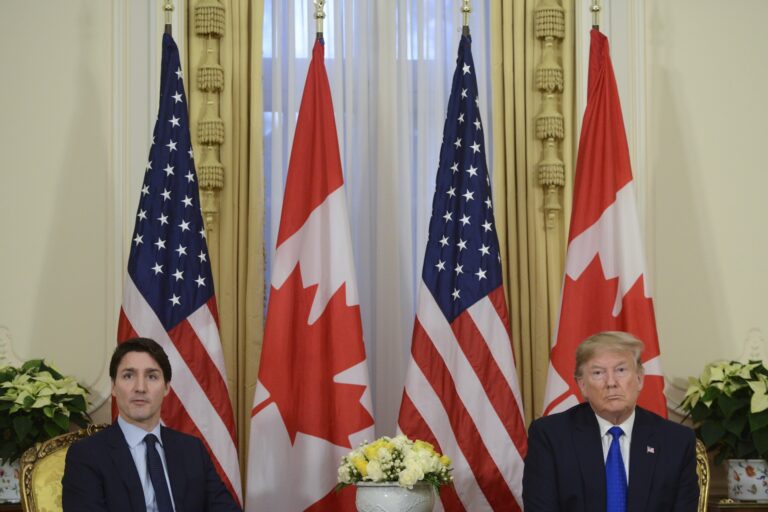
TORONTO — Prime Minister Justin Trudeau shared his theory about what U.S. President Donald Trump is really after with his threats to annex Canada, and stressed the need to soothe Mexico, as he gathered business, industry and labour leaders to share ideas on how to get through a potential trade war.
The Logic obtained a recording of some of the closed-door portion of Friday’s Canada-U.S. Economic Summit.
Hot mic moment
Talking Points
- Prime Minister Justin Trudeau said the United States wants Canada’s critical minerals, and that’s why President Donald Trump is talking about making it the 51st state. He was speaking to business leaders at a summit organized to discuss bilateral relations in the wake of Trump’s tariff threats.
- In a closed-door session, Trudeau also said the public mood had shifted in favour of east-west pipelines, that Canada needs to mend ties with Mexico, and that he favours building more nuclear reactors around the country. The Logic obtained a recording of his comments.
On stage before some 200 people in Toronto, Trudeau shared why he thinks Trump keeps talking about annexing Canada. “I’d suggest that not only does the Trump administration know how many critical minerals we have, but that may be very much a part of why they keep talking about absorbing us and making us the 51st state,” Trudeau said after organizers had asked the media to leave the room.
His remarks during what was supposed to be a closed-door part of the meeting were broadcast through speakers within earshot of the media before the sound was cut off. They were also audible on the recording obtained by The Logic.
Asked later whether Canada should guard its critical minerals from the U.S., Industry Minister François-Philippe Champagne said he has been reminding Americans that the two countries have an integrated supply chain and Canada is willing to work with the U.S. “on the basis of mutual respect—respecting our sovereignty [and] respecting the dignity of our workers and our industry.”
Summit attendees included top executives from Nano One, a B.C.-based battery materials company, Rio Tinto’s Alcan aluminum subsidiary and hydrogen firm Linde.
Where Mexico fits in
One of Trump’s stated justifications for tariffs is to stem the flow of fentanyl and illegal migrants into the United States. Canadian officials have stressed that Mexico accounts for a much larger share than Canada of both. In his public comments Friday, Trudeau reiterated that Canada “is responsible for a tiny part of the North American fentanyl problem,” although the government is still taking measures to minimize shipments.
Behind closed doors, he emphasized the need for Ottawa to cooperate with the Mexican government. “There are fences to mend with Mexico,” he said. “When a number of people mused publicly about jettisoning Mexico and going it alone, that really threw the Mexicans off.”
In November, both Trudeau and then-finance minister Chrystia Freeland said Ottawa shared Washington’s concerns about Mexico’s trade with China. They did not endorse Ontario Premier Doug Ford’s call for Canada to negotiate a bilateral deal with the U.S. instead of sticking with the U.S.-Mexico-Canada Agreement.
Pipelines and nuclear power
“The mood has changed in Canada” on energy projects, Trudeau said during the closed session, including “west-east pipeline possibilities coming forward again.” He also noted the need for “energy independence.”
Alberta Premier Danielle Smith has called for governments to back efforts to build LNG infrastructure to move oil to the country’s coasts. While Quebec has long been a major holdout over pipelines going east, Premier François Legault said Thursday he would authorize projects that have public buy-in. Recent polling shows widespread popular support for cross-country pipelines.
Canada also needs other kinds of energy infrastructure, Trudeau said during the closed session, adding: “I am a huge fan of nuclear.” Trudeau, who announced Jan. 6 that he would resign as prime minister after the Liberals choose a new leader, went on to say that his platform in the forthcoming election would have included “moving forward on three big reactors across this country.”
Those projects would have been either Candu’s Monark reactors, built by AtkinsRéalis, or competing ones from Westinghouse, which is owned by Brookfield Asset Management, he said. The two companies are competing for projects both in Canada and abroad.
What do American business leaders think?
In the closed session, Trudeau said Canada has “allies in the United States who are very much focused on making sure those tariffs don’t ever happen.” He predicted that a 25 per cent tariff would hit some U.S. industries “directly and negatively” in “very meaningful ways,” leading them to lay off thousands of workers on the day the measures are introduced. Still, U.S. business leaders have “been silent or neutral in their public statements on this,” Trudeau said. “That is a total reflection of the nature of the political sensitivities in the United States.”
Beth Burke, CEO of the Canadian American Business Council, told reporters that businesses on the other side of the border know the connection to Canada runs deep, and that fact is starting to resonate outside the business community. “I think everyday Americans are quickly realizing how important this is,” she said.
Busting down internal trade barriers
Internal Trade Minister Anita Anand has said the threat of U.S. tariffs against Canada has pushed premiers to get serious about liberalizing trade within Canada’s borders. This week, they agreed to move quickly on mutual recognition, which means if goods and services meet regulatory requirements in one province or territory, they would also clear the others.
They also agreed to improve labour mobility and shorten the list of exceptions to the 2017 Canadian Free Trade Agreement. Anand said Ottawa is ready to remove 39 exceptions to the agreement that are within federal jurisdiction. They relate to financial services, where the provinces already have their own regulations, as well as procurement. “We want to remove federal barriers to trade there, so it’s easier to compete for federal contracts,” Anand said.
Support for businesses
Isabelle Hudon, president and CEO of the Business Development Bank of Canada (BDC), said her agency was ready to “step in” to help small- and medium-sized businesses when the White House announced tariffs over the weekend.
The 30-day reprieve means BDC will not deliver any relief programs right now, but it is ready. “We’ve adapted our strategy to make sure that we’re there for entrepreneurs that need us in that very special moment,” she said.
Canadian software companies won’t face direct tariffs on their products, but most count the U.S. as a major market, if not their biggest. Tech-sector attendees at the summit included Daniel Debow, one of the founders of the new Build Canada group advancing economic policy proposals from entrepreneurs. SRTX CEO Katherine Homuth, who this week laid off 40 per cent of staff citing U.S. tariffs, was also there. So were Vector Institute CEO Tony Gaffney, Wealthsimple CEO Michael Katchen and Dayforce CEO David Ossip, whose firm is headquartered in Minneapolis but run from Toronto.
Canada needs to “figure out what the world wants and sell it,” Council of Canadian Innovators president Benjamin Bergen told reporters, saying the country only exports a short list of goods, primarily commodities. “We have to diversify what we sell to the world.” Bergen called for the federal government to fund cybersecurity startups developing new products, which he said could help respond to Trump’s “memetic warfare.”