News
Trudeau calls emergency meeting with premiers on Trump tariffs
No consensus among political and business leaders on whether to fight, bargain or back down
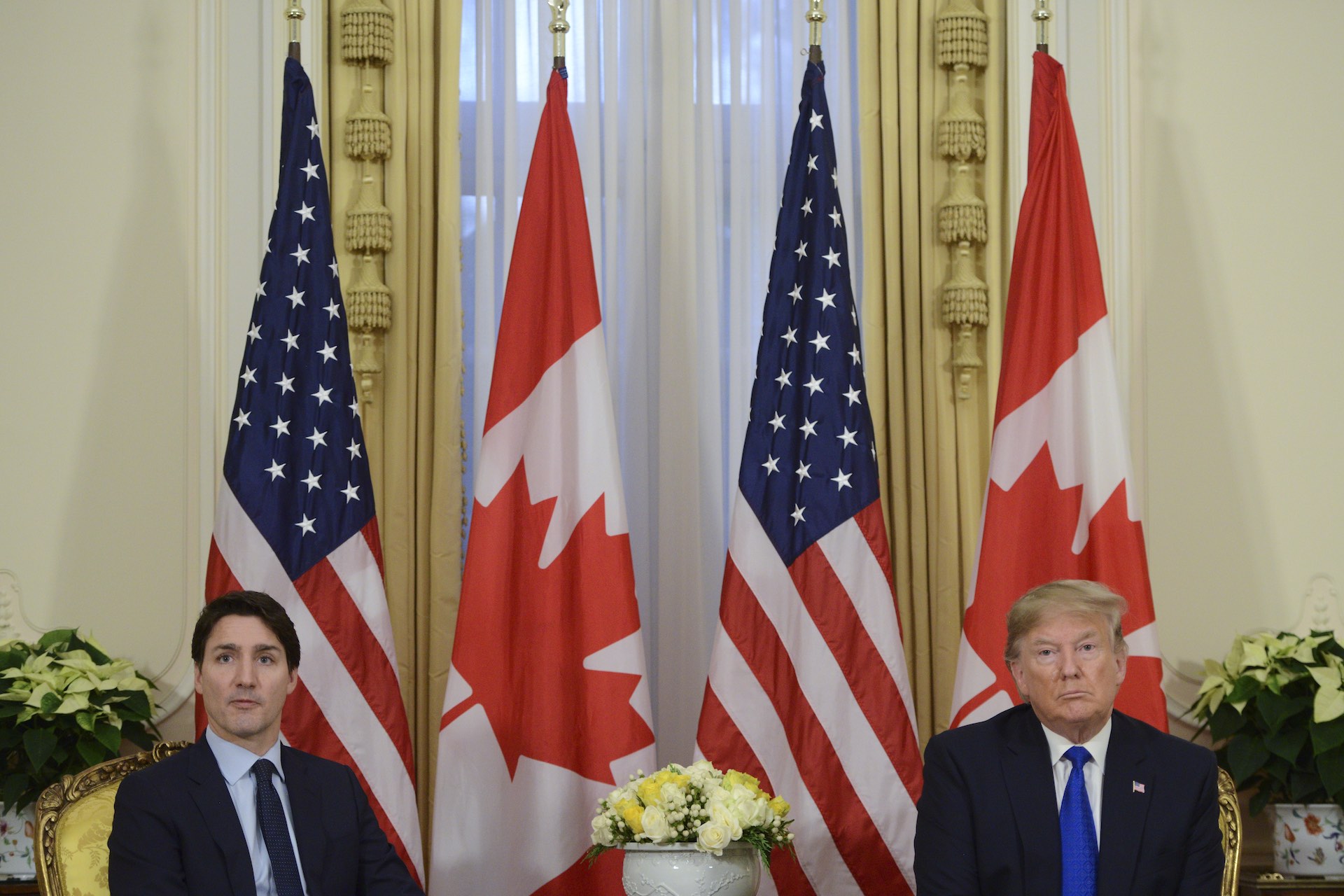
Prime Minister Justin Trudeau and Donald Trump meet during Trump's first term as U.S. president, before a NATO summit in London in December 2019. Photo: The Canadian Press/Sean Kilpatrick
OTTAWA — Prime Minister Justin Trudeau and the country’s premiers plan to meet virtually Wednesday at 5 p.m. EST, to try to find a common response to U.S. president-elect Donald Trump’s threats of 25 per cent tariffs on imports from Canada and Mexico.
Talking Points
- After three weeks of reassuring Canadians that the country would be fine once Donald Trump returns to the U.S. presidency, the Liberal government rushed to respond to his promise of 25 per cent tariffs
- Politicians and industry sent conflicting advice on whether to acquiesce to Trump’s demands, find other concessions or gird for battle
“One of the really important things is that we be all pulling together on this. The Team Canada approach is what works,” Trudeau said before a cabinet meeting.
What playbook the team will use is not obvious.
Ontario Premier Doug Ford, currently the chair of the provincial and territorial leaders, had written to Trudeau earlier on Monday to request a group meeting, which drew no immediate response. Then—in the middle of a meeting of the committee of ministers Trudeau re-formed to handle the Canada-U.S. relationship right after the American election—Trump posted to his Truth Social network.
A few hours later, Trudeau was on the phone with the president-elect. They “talked about some of the challenges that we can work on together,” Trudeau said. “It was a good call.”
Related Articles

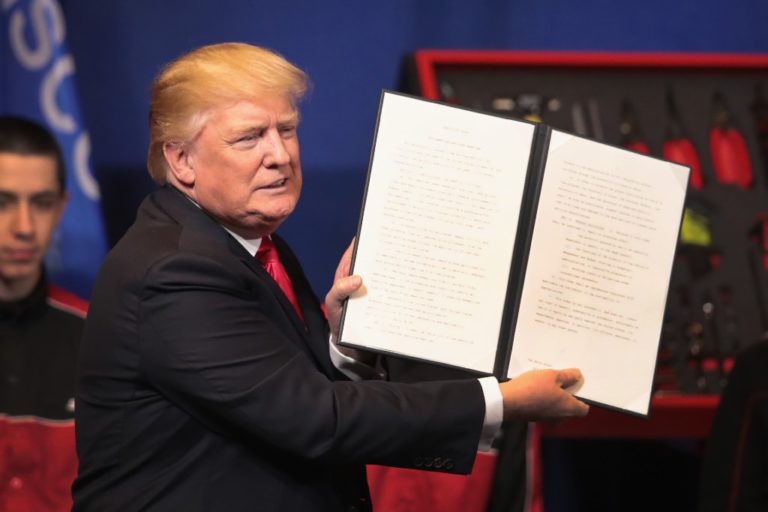

Senior ministers like Deputy Prime Minister Chrystia Freeland and Industry Minister François-Philippe Champagne have tried to soothe Canadians since Trump won the presidential election three weeks ago. The message: they’ve been here before and they know what they’re doing.
Nevertheless, Trudeau and the premiers are planning the same sort of emergency meeting on Trump as they used to hold on COVID-19.
This time, Trudeau’s position is weaker. Instead of having just won an election, albeit with a minority, he’s facing disaster in the next one and possibly won’t be able to ensure government operations are funded much longer because he can’t control the House of Commons.
One thing the first ministers will likely discuss: The premiers are unanimous, according to Ford, that Canada should ditch continental free trade in favour of separate deals with the United States and Mexico. Trudeau doesn’t want that.
Business groups aren’t of one mind, either.
The Canadian Federation of Independent Business’s president, Dan Kelly, said in a statement that Canada should try to be a better friend.
“Our governments must take all actions within our control to ensure we are a good and reliable trading partner for the U.S. and the world,” he said. “These include a stronger focus on crime, stabilizing our supply chains such as ports and railways, promoting our energy sector and reducing the regulatory and tax burdens facing Canadian businesses.”
The Canadian Chamber of Commerce said Canada should put up its dukes.
“Being America’s ‘nice neighbour’ won’t get us anywhere in this situation,” CEO Candace Laing said in her own statement. “It’s time to trade ‘sorry’ for “sorry, not sorry.’”
Yet in an interview with The Logic, the group’s chief economist Stephen Tapp said “this likely should be understood as the opening gambit in a larger game.”
Canada could offer up concessions on its digital-services tax (which largely targets U.S.-based tech giants) and agricultural supply management, alongside more defence spending and better access to critical minerals and energy, Tapp said.
Champagne echoed some of that thinking: “Let’s make sure that we put forward all the things that we can do strategically on the energy side, on critical minerals, on semiconductors,” he said on Parliament Hill.
Freeland signalled that Canada would be prepared to tariff U.S. goods right back, recalling the dollar-for-dollar retaliatory levies it imposed when Trump put tariffs on Canadian steel and aluminum in 2018. Canada had tried to head them off, but the U.S. tariffs lasted nearly a year.
“It was a challenging moment for our country. The important thing is we got through it, and our response was successful,” she said.
Advice from the opposition was similarly mixed.
NDP Leader Jagmeet Singh told Trudeau to “fight like hell.” The Bloc Québécois’s Yves-François Blanchet tweeted that everyone knows such tariffs’ impact on the U.S. economy would be too extreme for Trump to go ahead with them, so stop running around like “decapitated chickens.”
Conservative Leader Pierre Poilievre—whom more Canadians apparently would prefer were in charge of all this than Trudeau—stayed away from proposing tactical responses to what he called Trump’s “unjustified threat,” instead arguing that if Canada were stronger, it would be better able to deal with him.
“Our economy is teetering on the brink of collapse, and now we face this renewed threat,” Poilievre said. Trudeau should put partisanship aside and, essentially, adopt the Conservative program, he said, by scrapping the carbon tax, cancelling all other tax increases, boosting defence spending, encouraging resource development projects, reforming immigration and reversing all drug liberalization.
“President Trump has the right to put his workers and his nation’s security first,” he said. “I will put Canada’s workers and Canada’s security first.”
Poilievre scorned the idea that a united Team Canada is useful in this situation: ”We don’t need a spectacle of a bunch of politicians sitting around tables meeting and holding photo ops,” he said. “What we really need is an action plan with tangibles.”
With files from Catherine McIntyre



Loading...
Thanks for sharing!
You have shared 5 articles this month and reached the maximum amount of shares available.
CloseThis account has reached its share limit.
If you would like to purchase a sharing license please contact The Logic support at [email protected].
CloseGift the full article!
You have gifted 0 article(s) this month and have 5 remaining.
Recipients will be able to read the full text of the article after submitting their email address. They will not have access to other articles or subscriber benefits.











