News
How Trump’s tariff threats could become reality
The U.S. president has wide—but not unlimited—powers to tax imports

Donald Trump wields an executive order at a photo opportunity in Kenosha, Wis., in April 2017. The order to revamp visa rules for guest workers was one of several executive directives Trump signed during his first term as U.S. president. Photo: Getty Images/Scott Olson
U.S. president-elect Donald Trump abruptly announced Monday evening that immediately after his January inauguration, he’ll put 25 per cent tariffs on all imports from Canada and Mexico. He cited the flows of fentanyl and migrants into the United States as his reasons.
Here’s how the tariffs could work.
Can the president just do that?
The U.S. Constitution gives Congress, not the president, the power “to lay and collect taxes, duties, imposts and excises,” but Congress has passed laws over the years that delegate a lot of that authority to the president.
Which power would Trump use?
He hasn’t specified. His biggest gun is the International Emergency Economic Powers Act of 1977, which gives the president sweeping authority to control financial transactions to deal with national emergencies. Trump’s stated concerns about drugs and an “invasion” by “illegal aliens” seem as though they’d qualify.
Related Articles

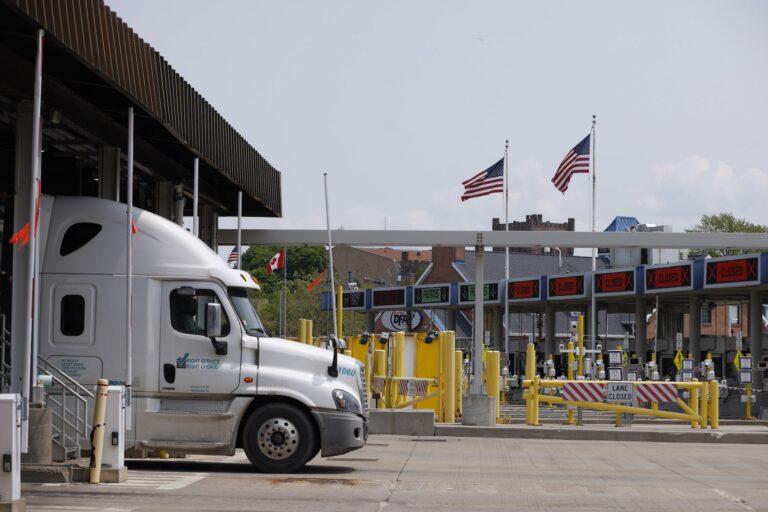
According to the official U.S. Congressional Research Service, no president has used that law to tariff goods from a specific country, but it has been used to ban specific imports and exports, so Trump probably could.
The bar for a “national emergency” is low. The agency reported that as of Jan. 15, the U.S. was in 39 ongoing national emergencies under the act—including the first one, declared when Iran took U.S. embassy staff hostage in 1979.
How did Trump tariff Canadian goods last time he was president?
His harshest move was taxing imports of steel and aluminum from numerous countries, including Canada, in 2018. He used power Congress gave the president in 1962’s Trade Expansion Act to tariff imports that, in his view, would “threaten to impair” U.S. national security. These are called “Section 232” tariffs.
Trump’s argument was that the United States needed a metals industry to supply critical industries and defence needs, and imports were undermining the domestic sector.
The tariffs on Canadian steel and aluminum kicked in on July 1, despite Canadian objections.
Trump made a new proclamation in May 2019 that the U.S. industry was healthy again and that he had determined that Canadian and Mexican metals were no longer a security threat, so he was removing the extra tariffs.
Are there other tariff mechanisms he could use?
Yes. The U.S. Trade Act of 1974 gave the president broad power to use tariffs to fight other countries that violate trade agreements with the U.S. or do anything that’s “unjustifiable” or “unreasonable” and burdens U.S. commerce. President Joe Biden used that power this year to tariff some high-tech imports from China, including solar cells and electric vehicles. These are called “Section 301” tariffs.
And there are “Section 201” tariffs, which are meant to stop goods flooding the U.S. market and imperilling domestic producers. These are more general but require a time-consuming investigation by the U.S. government’s trade commission, and they’re meant to be temporary.
Could tariffs be fought in court?
Yes. The president’s authority isn’t absolute. The key question would be whether a particular tariff was a proper use of the authority Congress has delegated to the president, and then whether Trump’s actions matched his stated reasoning. Such a challenge probably would not zip through the courts.
Congress could also, in theory, pass a law invalidating some or all of the president’s tariff moves, or repealing its delegation of authority entirely—the House of Representatives and the Senate gave the president these powers, and they can take the powers back. By Trump’s inauguration, though, both houses of Congress will be controlled by the president’s party, making that unlikely.
Join The Logic’s newsroom tomorrow, Wednesday, Nov. 27 at 2 p.m. ET, for a special virtual event on what U.S. president-elect Donald Trump’s tariff threat could mean for the Canadian economy. Register here.



Loading...
Thanks for sharing!
You have shared 5 articles this month and reached the maximum amount of shares available.
CloseThis account has reached its share limit.
If you would like to purchase a sharing license please contact The Logic support at [email protected].
CloseGift the full article!
You have gifted 0 article(s) this month and have 5 remaining.
Recipients will be able to read the full text of the article after submitting their email address. They will not have access to other articles or subscriber benefits.











