News
What Trump’s 25% tariff would mean for Canadian business
Key industries expected to be hit hardest are bracing for far-reaching consequences
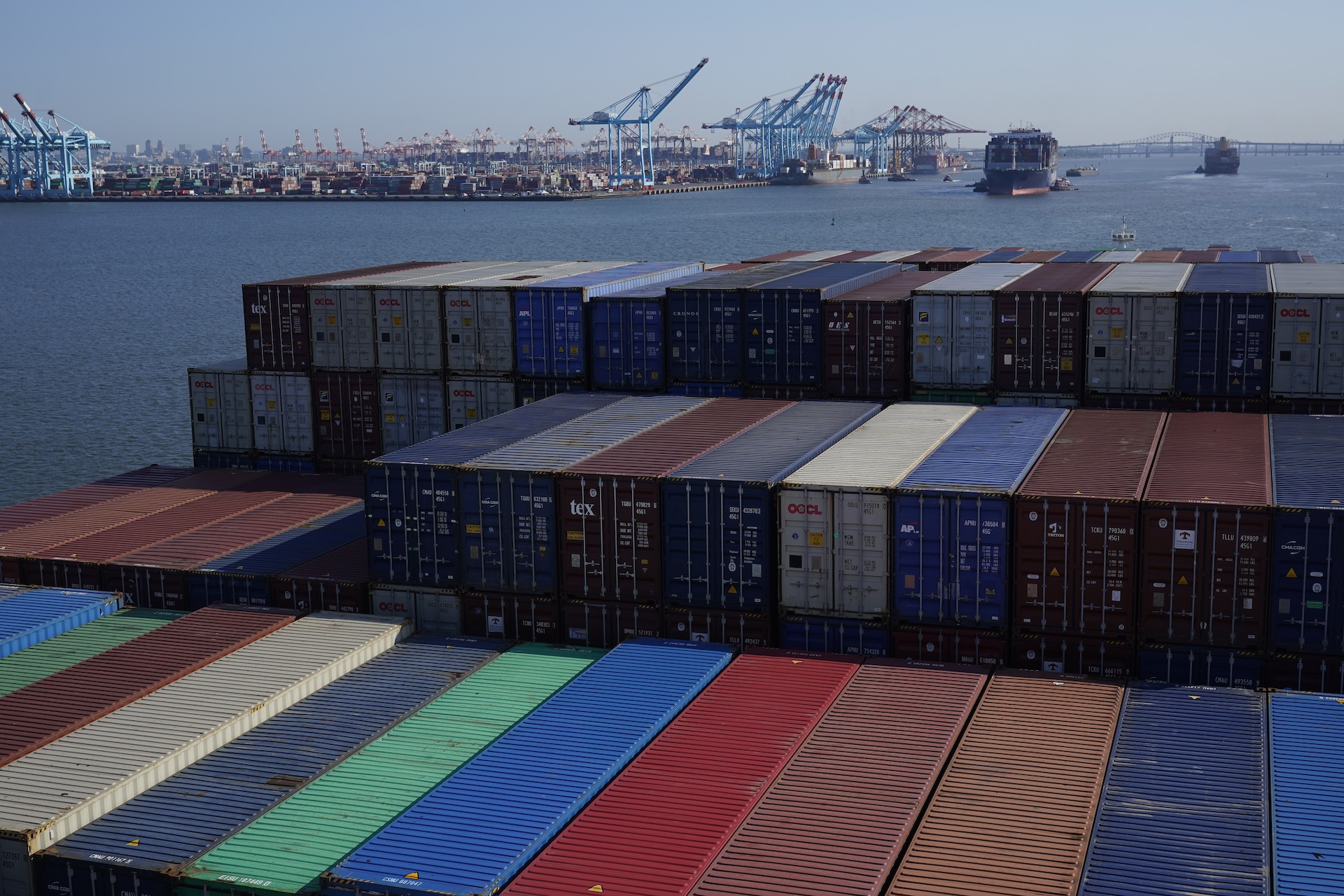
Cargo containers at the Port of New York and New Jersey in Elizabeth, N.J., in June 2021. While investors traded cautiously a day after Donald Trump promised to impose 25 per cent tariffs on all goods from Canada and the U.S., Canadian businesses are bracing for the worst. Photo: AP Photo/Seth Wenig
Call it the calm before the storm. Canada’s market was eerily quiet Tuesday after U.S. president-elect Donald Trump threatened a 25 per cent tariff on all products Canada and Mexico export to the U.S.
It’s a massive tax that economists say would wreak havoc on Canada’s economy. But by late afternoon, the S&P/TSX composite index, which tracks the largest companies on the Toronto Stock Exchange, was virtually unchanged.
Talking Points
- Canada’s stock market was relatively calm Tuesday following president-elect Donald Trump’s plan to impose a 25 per cent tariff on Canadian exports into the U.S.
- While investors wait to see if the levy gets enacted, businesses in sectors expected to be hit hardest are bracing for the consequences
While investors trade cautiously, businesses are bracing for the worst. “It’s deeply disrupting, and it’s certainly troubling for our members and for Canadian businesses,” said Stephen Tapp, chief economist at the Canadian Chamber of Commerce.
It wasn’t a complete surprise. Trump campaigned on a promise to impose broad tariffs on imports into the U.S. A Canadian Chamber analysis from last month found that a 10 per cent tariff on Canadian goods—what Trump initially floated—could trigger a 1.5 per cent decline in incomes, about $1,100 per person each year and a $45 billion hit to the economy. With the larger 25 per cent tariff, the impact could multiply by 2.5, said Tapp, making the per-person impact $2,750 annually.
One possible reason the market is relatively calm is that investors may not expect the levy to pass, said Derek Holt, Scotiabank’s head of capital markets economics. “Imposing tariffs like this will rattle North American supply chains and that is perhaps the best hope for reversing or at least moderating them,” Holt said in a note to investors.
Related Articles

Michael Brown, lead portfolio manager at Toronto-based firm Cidel, agreed that the markets are indicating Trump may just be posturing. “It’s difficult to make big portfolio decisions based on something that might not get enacted as advertised,” he said.
During a talk in Charlottetown Tuesday morning, Bank of Canada deputy governor Rhys Mendes said the central bank is taking a wait and see approach to Trump’s threat. “Something like this would clearly have an impact on both [Canadian and U.S.] economies,” Mendes said. But until the policy is enacted, the bank won’t factor it into its forecasts.
Tapp described the announcement as a negotiating tactic to pressure Canada to concede on rules ranging from digital taxes on large U.S. tech companies, to supply management of the dairy industry. It’s a playbook he used in his first presidential term before negotiating the new North American trade deal with Canada and Mexico. Still, whether or not he follows through with the tariffs, the uncertainty the threat has created will weigh on Canada’s economy, he said.
The loonie fell to a four-year low, briefly dipping below U.S. 71 cents, and economists say it could tumble further. Tapp expects financial markets to suffer amid slow business investment in Canada, as both domestic and foreign investors wait for more certainty.
The industries expected to be hit hardest by the potential tariffs are already bracing for far-reaching consequences:
Energy: The sector was in the crosshairs within hours of Trump’s announcement last night, with Deputy Prime Minister Chrystia Freeland and Public Safety Minister Dominic LeBlanc’s salvo noting that Canada is “essential to U.S. domestic energy supply.”
The TSX Energy index fell more than two per cent, taking one of the hardest hits from investors. Energy represents about 27 per cent of Canada’s exports to the U.S., with exports hitting a record of 4.3 million barrels per day in July. Canadian Natural Resources was among the highest-volume trades of the day on the TSX, with its shares falling nearly two per cent.
Lisa Baiton, CEO of the Canadian Association of Petroleum Producers, estimated that a 25 per cent tariff on oil and natural gas could both cut Canadian production and cause American consumers’ gasoline and energy costs to ratchet higher.
“We need to be eyes-wide-open on the president-elect’s promise,” Baiton said in an email, urging Canada to stop “dithering around with domestic policy” that hurts the energy sector and “move with alacrity to support our most productive industries.”
Thomas Timmins, a partner who leads the energy sector practice at Gowling and represents clients in both traditional and renewable energy, said he remains “optimistic” towards Canada’s trade climate, but the firm is getting calls from companies wondering how the tariffs could impact their cross-border contracts.
“Pronouncements on social media do not make a policy,” he said. “We’re all watching anxiously to see where things go.”
Lumber: Canada’s lumber industry is already in the midst of a longstanding tariff dispute with the U.S. Canadian softwood lumber imports have been subject to U.S. duties since 2017, after U.S. investigations claimed Canada unfairly subsidized the industry. Derek Nighbor, CEO of the Forest Products Association of Canada, said in an interview that it’s unclear whether Trump’s proposed 25 per cent tariff would be imposed on top of existing duties. Regardless, he said Americans will pay the price along with Canadian businesses and workers: “It’s been a tax on U.S. home buyers. It’s driven up the cost of homes.”
Autos: The energy, automotive and heavy-manufacturing sectors were pegged as the most vulnerable to tariffs following Trump’s election, and investors swiftly sold shares of Canadian auto parts suppliers when markets opened Tuesday. Magna shares fell over four per cent in Toronto, Linamar’s stock declined around five per cent and Martinrea’s tumbled over six per cent. Major automaker stocks like Volkswagen and Ford also slipped.
David Adams, CEO of the Global Automakers of Canada, a group that represents companies like Honda, Toyota and Volkswagen, said the new tariffs “will have the unintended consequence” of hurting livelihoods on both sides of the border.
“This is especially true in the automotive industry where Canada and the United States have literally been building vehicles together as an integrated industry since the mid-1960s,” he said in an email. The U.S. and Canada would be more competitive, he said, if they were “facing the vagaries of an increasingly volatile world together.”
Food: Canada and the U.S. have one of the largest agricultural trading relationships in the world. The U.S. imported US$40.5 billion in food products from Canada in 2023, including US$5 billion worth of baked goods, US$4.8 billion worth of canola oil and US$3.6 billion worth of beef and pork. Most of that trade has been duty-free since 1989, under predecessors to the United States-Mexico-Canada Agreement. Agricultural trade between the three nations nearly doubled in the two decades after NAFTA was implemented in 1994—and tariffs threaten to walk that progress back.
Join The Logic’s newsroom tomorrow, Wednesday, Nov. 27 at 2 p.m. ET, for a special virtual event on what U.S. president-elect Donald Trump’s tariff threat could mean for the Canadian economy. Register here.



Loading...
Thanks for sharing!
You have shared 5 articles this month and reached the maximum amount of shares available.
CloseThis account has reached its share limit.
If you would like to purchase a sharing license please contact The Logic support at [email protected].
CloseGift the full article!
You have gifted 0 article(s) this month and have 5 remaining.
Recipients will be able to read the full text of the article after submitting their email address. They will not have access to other articles or subscriber benefits.