TORONTO — Silicon Valley may be in a constant state of battle, with the frontlines shifting from social to cloud to AI over time. But Canada’s largest tech company would rather build alliances. “We never learned this lesson at Shopify that software breeds monopolies,” said COO Kaz Nejatian, speaking at The Logic Summit in Toronto on Monday.
Skip to content

The Interview
‘We reserve the right to wake up smarter tomorrow’: Kaz Nejatian on Shopify after abandoning logistics
‘Our job is to take the things that suck for entrepreneurs, and make them not suck’
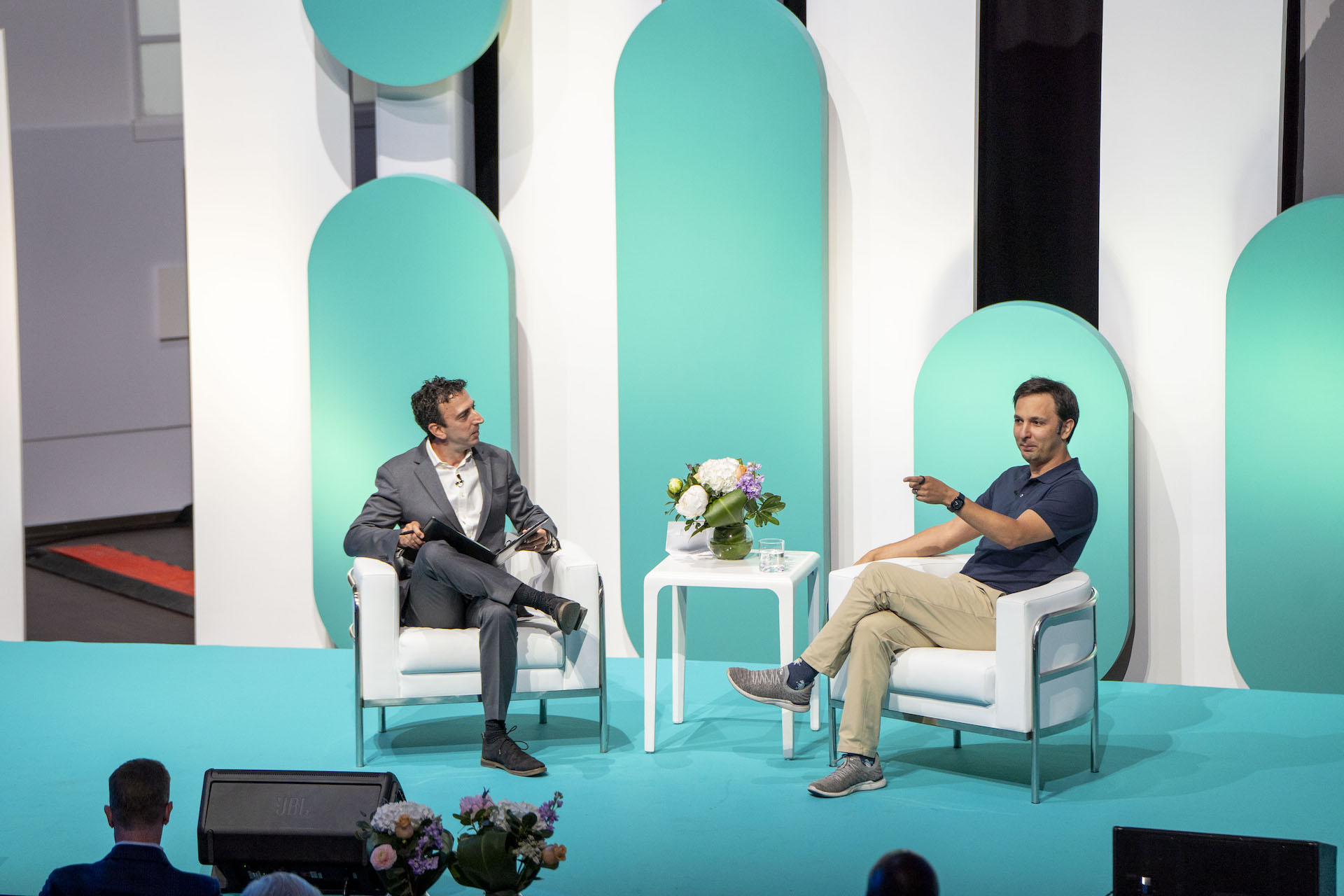
Shopify COO Kaz Nejatian speaks with The Logic’s editor-in-chief David Skok at The Logic Summit in Toronto in June 2023. Photo: Jenna Muirhead for The Logic
TORONTO — Silicon Valley may be in a constant state of battle, with the frontlines shifting from social to cloud to AI over time. But Canada’s largest tech company would rather build alliances. “We never learned this lesson at Shopify that software breeds monopolies,” said COO Kaz Nejatian, speaking at The Logic Summit in Toronto on Monday.
Shopify has expanded far beyond its initial base of small direct-to-consumer e-commerce stores, offering an ever-growing set of technology and services that merchants big and small can use to manage their businesses and finances. “Our job is to take the things that suck for entrepreneurs, and make them not suck,” said Nejatian.
But the Ottawa-headquartered commerce company has also pulled back on some of its expansion plans, including shelving its ambitious push to build a logistics network in the U.S. launched in June 2019. It also cut 20 per cent of its workforce via layoffs and the divestiture.
On stage, the product executive emphasized that the company’s work speaks for itself. “We’re the brand behind the brand,” Nejatian said. Nejatian was promoted to COO last September. The lawyer and startup founder joined Shopify in September 2019 to lead its financial-services product group following a stint at Facebook. He’s also a former Conservative government staffer, working for then-immigration minister Jason Kenney and helping develop the Start-Up Visa.
In an onstage interview with The Logic’s CEO and editor-in-chief David Skok, Nejatian discussed how Shopify approaches building product, why it exited the logistics business, and what it’s like to work for CEO Tobi Lütke.
Related Articles


This interview has been edited for length and clarity.
How did you end up in this business? You started off in policy.
I’ve honestly basically done mostly the same thing for most of my life. My family moved to Canada when I was 12. And like every other immigrant family, we opened up corner stores. I was a 12-year-old kid cashier timing checkouts, to see how long it would take for people to leave the store. One day, I noticed this credit-card terminal that was taking up three per cent of our profit. So I decided to hack it, to figure out how it worked.
I’ve basically done this weird corner of internet and money my whole life, with a tad bit interspersed with trying to get involved in the country’s public policy.
The evolution of Shopify over the last few years—like many companies over the course of this pandemic and now the inflationary period—has been difficult. Where would you say it is today?
Shopify’s an odd company, because, honestly, we’re a collection of nerds that don’t like being that well known. We’re the brand behind the brand. So when Shopify was really hot in the middle of the pandemic, none of us thought we were that hot. And when it was down, none of us thought we were that down.
“We didn’t really learn the lesson that most Canadian companies learn, that it’s OK just to survive. We have a mission.”
We don’t think that much about what some stock picker thinks of the company. Since I’ve joined, the company has been remarkably steady on its core mission, which is to help entrepreneurs have an easier time on the internet [and] to make the internet a better place for independent brands. And look: We’re now the commerce operating system from millions of retailers around the world, growing at a relatively healthy pace, and a proudly Canadian company.
What kind of climate are smaller businesses in this environment facing right now?
Terrible. My mom’s a Shopify merchant—she has a store. And I think it’s been devastating to see what’s happening to small businesses across the world. The cost of acquisition is going up, because of some big changes that are happening to browsers. At the same time, the pandemic effects massively increased the cost of labour for many of our merchants. I was keeping track of it: There was a little while during the pandemic where many of our merchants had fewer than 27 days of cash flow. That was very scary.
Luckily, entrepreneurs are shockingly resilient. They’ve gotten through that. But it’s not easy.
The business has expanded into other areas. One of them was logistics, which you were in and then out. From an executive-leadership perspective, when you’re making decisions like that—to go full in on something with the massive capital costs associated—and then you decide six months later, “Oh, actually, we’re out,” how does that process work at Shopify?
The company isn’t run by professional managers. No one on Shopify’s management team ever worked at McKinsey. It’s not that type of company. We reserve the right to wake up smarter tomorrow. We reserve the right to be wrong yesterday, all the time. We’re not afraid of doing things that seem odd if we think it’s the right thing to do, and I think the company’s investors have learned that we will always do that.
Logistics wasn’t unusual for Shopify, as a move. Shopify was building a payment business before it got out of it. I was building an installment business before we got out of it. Our job is to make these things exist on the internet, not to build them ourselves. In fact, we’re usually better off if [Affirm CEO] Max Levchin builds an installment product than if Shopify builds its own product.
If I said to you today, “What’s the next thing for Shopify?” it is…?
I used to joke around that Shopify’s roadmap is relatively clear from the outside. You can guess it with perfect accuracy. Our job is to take the things that suck for entrepreneurs, and make them not suck; take the advantage away from the big, and give it to the small; make the internet more interesting; make it more independent; make it so you can start, run and grow a business, and build successful companies. If you look at the most interesting companies in the world today, they were started in a basement on Shopify.
“Tobi writes code every day. He’s a builder. It’s 2:30 p.m.—I’m very sure he has shipped code to production today.”
We’re spending a lot of time working on helping merchants connect with their customers, whether it’s through our marketing tools, our advertising tools, our customer-acquisition tools. We’re spending a lot of time helping them manage their money. We’re spending a lot of time helping developers build the next generation of software on the internet.
In the global market, there’s this expectation that Canadian companies are more reserved. Shopify is very clearly arming the rebels. What is it about the DNA of Shopify that makes it uniquely positioned to be more—and you can argue with the premise, of course—brashful than others in the Canadian ecosystem?
I don’t know anyone who would describe me, Tobi and Harley as “brashful.” Honestly, we’re just nerds. I’m much more comfortable behind a keyboard than I am on this stage.
Read More from The Logic:

There is a real part about this where Tobi and I are both immigrants. I came at 12. He came after, when he was in his early 20s. We never learned this Canadian tall-poppy syndrome. My mom is Azerbaijani; my dad is Persian. We yelled.
We didn’t really learn the lesson that most Canadian companies learn, that it’s OK just to survive. We have a mission. Our job is to help every entrepreneur around the world start a business.
The entrepreneurs are doing really good work. It’s hard not to notice the company.
The company has shrunk a little bit over the last few years. There’s a big class-action lawsuit going on right now about the layoffs. Coming out of COVID, as a company that scaled up rapidly, how do you feel you managed that period?
I think this is actually true: I have the only business degree on Shopify’s executive team, and mine’s an undergraduate one, where I spent most of my time at the bar, and not in school. I shouldn’t be giving management advice to anyone.
Shopify works because it’s an incredibly good product built by people who care about the product. Our job is to build the best product in the world, then make money so we can build more of that product—and never reverse those priorities. Did we get things right? Sure, we got lots of things right and wrong during the pandemic. Our goal wasn’t to execute without flaws. When the pandemic hit, our goal was to help our merchants survive.
I literally remember getting a call from Tobi on Monday morning and having to launch a lending product in the U.K. in four days. In four days, we launched a regulated lending product in a country where we didn’t have an entity. Do you make mistakes when you move like that? Of course. But without that, our U.K. merchants wouldn’t exist anymore. So I sleep fine.
[Meta CEO Mark] Zuckerberg and Tobi—you’ve worked for both. What are the similarities? What are the differences? What makes these two men unique?
I think Tobi’s just a unique tech leader compared to anyone, honestly.
How so?
Tobi writes code every day. He’s a builder. It’s 2:30 p.m.—I’m very sure he has shipped code to production today. I don’t know how many other tech leaders do that. I don’t know how many CEOs of oil companies actually go to oil rigs and dig. But Tobi does that every single day. And because of that, he has a much keener sense of the product than every other big company [leader] does.
Shopify is not a very big company. I was talking to a friend of mine the other day who’s working at a bank and just got a promotion: “Oh, I’m now on Level X.” I’m like, “What the fuck is that?” He was surprised. Everyone at the bank knew what level they were on.
That’s how most tech companies run, too—it’s just a thing you’re trying to climb. That’s not what we do. Our job is to build products, and Tobi builds products every day. We had a—actually, I’m not going to tell, because we’re about to launch a product on this. We have a very interesting product we’re about to launch in a couple of weeks, and Tobi wrote most of the code in that product.
I’m not going to ask how the other engineers may feel about that. But: Zuckerberg.
I think Mark Zuckerberg will go down as among the best founders of our generation, and Facebook will go down as one of the best companies that have been created. It’s really easy to dunk on Facebook, without realizing that they provide a free means of communication to billions of people around the world, whose families are closer, who found spouses, who keep in touch with their friends. How much value has that given to the world for free?
Sure, they made mistakes. But I think this is one of those things where it’s really easy to throw stones at glass houses. Most of the developing world is on WhatsApp, a product that’s not monetized—for free.
As part of the techlash, there’s a sense of co-op-etition versus the zero-sum game of tech. There’s something in the water about, “I win and others don’t.” Because of Shopify’s relationship with places like Affirm and Facebook, how do you view Shopify’s role in the tech landscape? Do you see it as a zero-sum game?
I don’t, and we don’t. We never learned this lesson at Shopify that software breeds monopolies.
We have 700 payment partners—Stripe, PayPal, all of them. I think there’s just a very bad lesson that got created early on the internet, because creating was so hard that you had to create most of the stack yourself, whereas we’re very happy to win and help other people win. I don’t really think of Max Levchin as a competitor. I’m having dinner with him later. I don’t think he thinks of us as a competitor.



Loading...
Thanks for sharing!
You have shared 5 articles this month and reached the maximum amount of shares available.
CloseThis account has reached its share limit.
If you would like to purchase a sharing license please contact The Logic support at [email protected].
CloseGift the full article!
You have gifted 0 article(s) this month and have 5 remaining.
Recipients will be able to read the full text of the article after submitting their email address. They will not have access to other articles or subscriber benefits.
Photo: Jenna Muirhead for The Logic
Most Popular This Week




In-depth, agenda-setting reporting
Great journalism delivered straight to your inbox.
News
National Bank CEO warns AI alone won’t give banks a lasting edge
Briefing
Canada and Ontario commit over $5B to support tariff-hit steel sector
Hackers will see cars as major targets in next 3 years, 83% of car-tech workers say
EA shutting down Edmonton studio BioWare
Best business newsletter in Canada
Get up to speed in minutes with insights and analysis on the most important stories of the day, every weekday.
Exclusive events
See the bigger picture with reporters and industry experts in subscriber-exclusive events.
Membership in The Logic Council
Membership provides access to our popular Slack channel, participation in subscriber surveys and invitations to exclusive events with our journalists and special guests.





