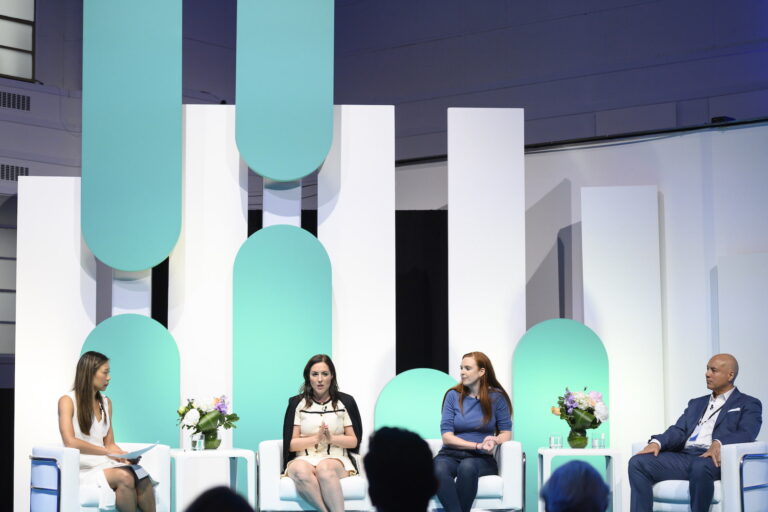
TORONTO — The federal government is promising faster processing to founders seeking to move to Canada under a program for startups, and more flexibility to work while they wait for approvals. Immigration Minister Sean Fraser announced the entrepreneur-focused measures at The Logic Summit in Toronto on Monday, ahead of unveiling a new federal strategy later this week to attract tech talent.
Skip to content



News
Ottawa changes startup immigration program to make it faster and more flexible
Immigration Minister Sean Fraser rolling out new strategy to attract tech talent
Immigration Minister Sean Fraser speaks at The Logic Summit in Toronto on June 26. Photo: Christopher Katsarov Luna for The Logic
TORONTO — The federal government is promising faster processing to founders seeking to move to Canada under a program for startups, and more flexibility to work while they wait for approvals. Immigration Minister Sean Fraser announced the entrepreneur-focused measures at The Logic Summit in Toronto on Monday, ahead of unveiling a new federal strategy later this week to attract tech talent.
“This is going to get the talent that we need in Canada to continue to build the businesses that are going to hire people for the next generation,” he said.
Talking Points
- The federal government is changing the Start-up Visa program to give founders more flexibility to work as they wait for permanent residency, and to prioritize applications backed by investors and certain incubators
- The measures are part of Immigration Minister Sean Fraser’s new Tech Talent Attraction Strategy to bring in workers for the innovation economy
While it has “visa” in the name, the Start-up Visa (SUV) is primarily a permanent-residency program. To apply, founders must secure investment from one of 26 designated venture capital funds or eight angel networks, or be enrolled in one of 42 incubator programs.
To help them come to Canada and begin working on their startups sooner, the program allows entrepreneurs to get temporary work permits while Immigration, Refugees and Citizenship Canada (IRCC) is processing their applications; the department projects the current turnaround time at three years.
Fraser acknowledged that’s too long. “Think about what three years looks like for a tech entrepreneur who has an opportunity to go virtually anywhere in the world,” he said. The changes announced Monday are a response to industry feedback, he added: “We kept hearing from people that we have this program with incredible horsepower that’s just not being deployed correctly.”
Under the new measures, Ottawa will offer “open” permits, allowing founders to work for firms other than their own startups. While firms in the VC or angel streams need to have committed funding, the minimum sums are relatively small, at $200,000 and $75,000, respectively. The open permits are meant to allow founders to earn income from a day job while they build out their technology or business.
Read More from The Logic Summit:

The government is also extending the duration of the temporary documents from one year to three, aligning them with the permanent-residence waiting period, and expanding eligibility to everyone on a startup’s founding team, not just essential personnel.
The SUV measures are part of Ottawa’s broader Tech Talent Attraction Strategy as companies continue to seek workers with technical skills, despite recent rounds of layoffs. Firms in the innovation economy have been avid users of the Global Talent Stream, a fast-track program for bringing in skilled foreign workers to fill in-demand engineering and development roles.
Fraser will announce additional programs targeting foreign workers in the sector at the Collision conference in Toronto on Tuesday.
Post-pandemic, “workers are more mobile than they’ve ever been before,” Fraser said, noting that “whoever wins the race for talent is going to set themselves up for success for the next generation.”
Related Articles

The IRCC is also re-organizing its SUV application queue, prioritizing founders whose startups are backed by a venture capital or angel group. Entrepreneurs enrolled in one of the 10 incubators that are also part of the Canada’s Tech Network collective will receive similar priority. The select list of incubators includes Invest Ottawa, Toronto Metropolitan University’s DMZ and Platform Calgary, but not high-profile accelerators designated under the SUV like the Creative Destruction Lab, Founderfuel and Techstars Canada.
The department is pledging unspecified future measures later in the year to speed up permanent-residence processing times for all applicants under the SUV. As with other immigration programs, wait times ballooned during the pandemic. Archived versions of the IRCC site show the department was advertising processing periods of 12 to 16 months in September 2019, less than half the current duration.
The then-Conservative government announced the SUV in May 2013, targeting foreign tech workers in Silicon Valley with billboard ads urging them to “pivot to Canada.” But uptake was initially slow, with just 666 people receiving permanent residence via the program between 2014 and 2018. Venture capitalists and policy experts cited the low quality of early applications, saying investors had little incentive to act as de facto immigration application centres by sifting through them.
Volumes had begun to rise before COVID-19 struck: IRCC granted 558 people permanent residence through the SUV in 2019 and 201 in pandemic-impacted 2020, with more than three-quarters tied to incubators, according to documents The Logic obtained via access-to-information.
The program’s most prominent alumnus is Kitchener, Ont.-based ApplyBoard, an international-student recruitment platform that in June 2021 raised $375 million at a then-claimed valuation of $4 billion. But incubator executives and immigration lawyers have expressed concern about the program to The Logic, saying such success stories are few and far between and that some organizations licensed to support startups’ applications charge founders high fees.
The government is anticipating a further uptick in demand. In November, Fraser tabled a new plan allocating up to 19,000 permanent-residence spots between 2023 and 2025 under the business category which includes the SUV. That’s an increase of 7,500 over the first two years compared to the previous allotment.
Also on Monday, Fraser announced that the IRCC is once again meeting its service standard for the Global Skills Strategy, which promises to process work-permit applications for some skilled foreign workers in two weeks. While startups and multinationals continued to use the program during the pandemic, executives and immigration lawyers complained of significantly longer wait times.



Loading...
Thanks for sharing!
You have shared 5 articles this month and reached the maximum amount of shares available.
CloseThis account has reached its share limit.
If you would like to purchase a sharing license please contact The Logic support at [email protected].
CloseGift the full article!
You have gifted 0 article(s) this month and have 5 remaining.
Recipients will be able to read the full text of the article after submitting their email address. They will not have access to other articles or subscriber benefits.
Photo: Christopher Katsarov Luna for The Logic
Most Popular This Week


In-depth, agenda-setting reporting
Great journalism delivered straight to your inbox.
Commentary
Carmichael: Canadian ignorance about India is a strategic weakness
Briefing
Aritzia shares pop after earnings rise 204%
First Nation in Alberta goes to court over fast-tracked oil pipeline
Chinese EV maker Geely Auto Group to launch in Canadian market in 2027
Best business newsletter in Canada
Get up to speed in minutes with insights and analysis on the most important stories of the day, every weekday.
Exclusive events
See the bigger picture with reporters and industry experts in subscriber-exclusive events.
Membership in The Logic Council
Membership provides access to our popular Slack channel, participation in subscriber surveys and invitations to exclusive events with our journalists and special guests.