Shopify’s stock opened this week trading down 66 per cent from its all-time high, a fall that has wiped nearly US$150 billion from its market cap since mid-November. While the Ottawa-headquartered firm has benefited from the pandemic-induced shift to online shopping, its prospects for long-term growth may depend on the success of new offerings like small-business banking, and its big bet on logistics.
Skip to content



Why Axis
Despite Shopify’s stock-market wipeout, analysts see a path for long-term growth
Shopify CEO Tobi Lütke at the company's Unite developer conference in June 2021. Photo: Unite | Screenshot
Shopify’s stock opened this week trading down 66 per cent from its all-time high, a fall that has wiped nearly US$150 billion from its market cap since mid-November. While the Ottawa-headquartered firm has benefited from the pandemic-induced shift to online shopping, its prospects for long-term growth may depend on the success of new offerings like small-business banking, and its big bet on logistics.
The bulk of Shopify’s business comes not from the core store-management software the company offers its clientele of independent and established brands and retailers, but from the add-ons to that basic platform. More than two-thirds of its total revenue in 2021—roughly US$3.27 billion—came from the fees it charges for “merchant solutions,” services like payment processing, shipping labels and cash advances.
Talking Point
Shopify is spending significant sums to build out its new fulfillment network, and launching small-business banking and cross-border selling services. To keep growing, the commerce platform will need to keep expanding its suite of merchant solutions and getting clients to use them, analysts say.
That business “outpaces subscription by a healthy margin,” Ken Wong, director at investment firm Guggenheim Partners, told The Logic. Merchant-solutions revenue grew 115.9 per cent year over year in 2020 and 61.8 per cent in 2021, while software-related receipts rose by 41.5 per cent and 47.7 per cent, respectively. The company expects the former to increase at more than twice the pace of the latter this year.
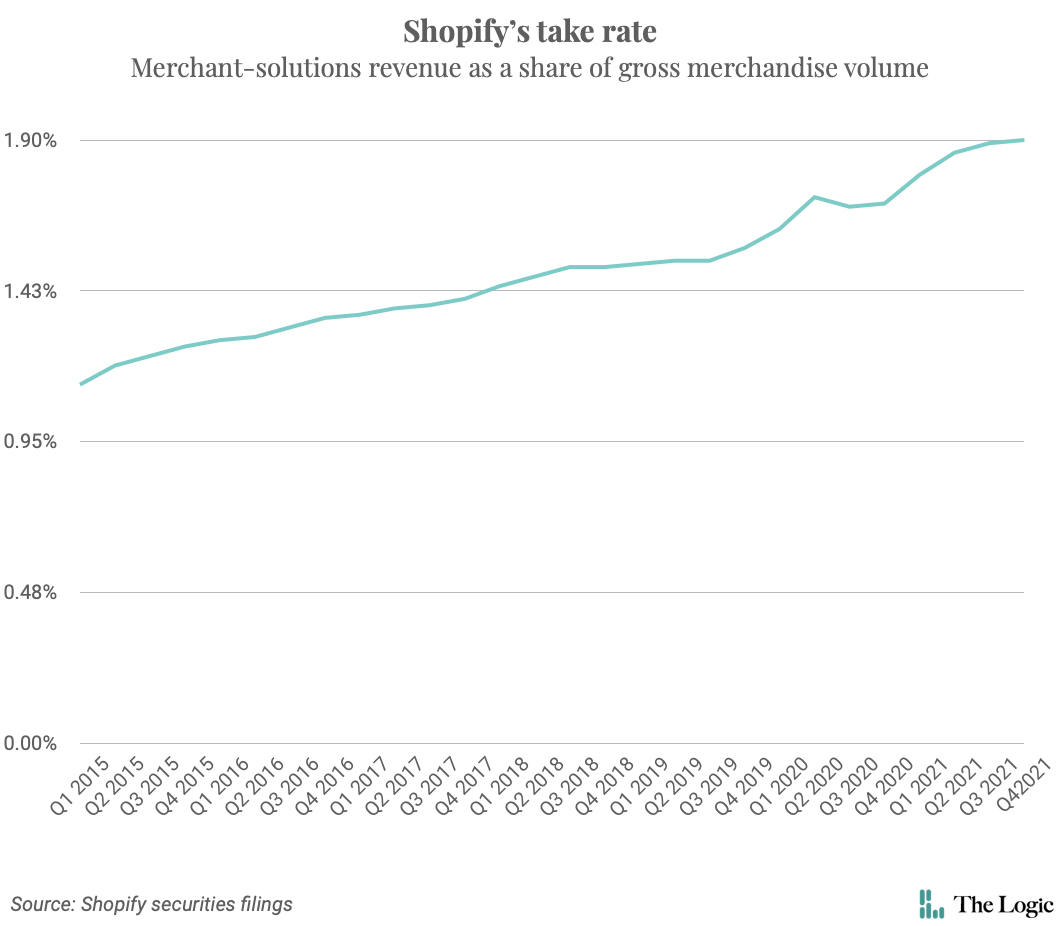
Shopify’s cut of its clients’ sales has also steadily increased, as more stores have started using its add-on offerings and as it has added more of those offerings. In the fourth quarter of last year, its take rate—the effective share the company earns of transactions via its technology—rose to 1.9 per cent of its merchants’ US$54.1 billion in gross merchandise volume (GMV), a measure of total orders. “That’s the highest it’s ever been, and that’s got to be the impact of some of these newer services,” said Mark Mahaney, head of Evercore ISI’s internet-research team and a longtime tech analyst. But “there’s still plenty of room for upside in that particular metric.”
The Shopify Fulfillment Network (SFN), announced in June 2019, is the firm’s biggest and most expensive bid to boost its take rate. The service is designed to handle logistics and delivery on behalf of U.S. and Canadian merchants, combining order-management and inventory-forecasting software with robot-filled warehouses. Every merchant Shopify signs up to the service “is going to generate a meaningfully larger revenue [for the firm], just because of the sheer cost of fulfilling an order relative to anything else [for which] you charge a customer,” said Wong.
Investors have watched the roll out of SFN closely, and they haven’t always liked what they’ve seen. The company originally said it would work with existing warehouse operators, but in February announced it would shift to running more of its own stockrooms, after reportedly cancelling contracts with some third-party firms. Shopify has budgeted US$1 billion in capital expenditures across 2023 and 2024 to lease and equip those facilities.
SFN is moving “out of the prototype phase and into the build phase,” president Harley Finkelstein said on a February earnings call. But about halfway through the firm’s original five-year plan for SFN, “the investor perception is that they’re behind schedule,” said Wong, citing a lack of revenue disclosures for the service as a contributing factor.
In one of Shopify’s rare major acquisitions, in September 2019 it bought 6 River Systems, a Waltham, Mass.-based robotics firm, for US$450 million. The “shiny, city-on-the-hill vision was to leverage the 6 River know-how in warehousing” for SFN, said an ex-6 River employee, whom The Logic agreed not to name because they continue to work in the sector. The two firms have been working since the acquisition to develop the technology to run and integrate facilities. As of last year, “the build-out was behind where expectations were internally.”
Shopify executives have faced “a natural learning curve” in fulfillment, said the former employee. In e-commerce, “the ability to spin up very interesting websites and mobile sites and all the bells and whistles [around them] is relatively easy—it’s all bits and bytes.” But warehousing and delivery has physical constraints. Large retailers like Walmart and Amazon went through “a lot of trial and error, and capital” to build their networks.
While Shopify continues to recruit engineers by the hundreds, its more hands-on approach to SFN requires different competencies, Mahaney told The Logic. “To run fulfillment centres, you’re buying ops [and] logistics talent, and then you’re managing hourly employees,” he said. “We don’t know whether they can do that; I’m not sure they know.”
Shortly after Shopify announced SFN, potential logistics partners told Guggenheim that the service’s margins were likely to be slim, even once it reached full scale, according to a note for investors the firm published. The new asset-heavy approach will reduce that further. “There’s not an efficient way to remove the picking and packing and the human element [or the cost of] owning warehouses and robots,” said Wong, noting Amazon has disclosed margins for fulfillment in the low- to mid-single digits.
Meanwhile, Shopify is rolling out other products with significant growth potential. In January, it opened its banking service Balance up to most U.S. merchants. The program sees Shopify partner with chartered financial institutions, which open small-business accounts and issue spending cards for Shopify merchants, via San Francisco-based Stripe’s Treasury service.
Balance “has the potential to be quite significant,” Atlantic Equities partner Kunaal Malde told The Logic. Shopify isn’t charging its clients an account fee, but will make money via the fees that will be generated when they spend. A business that accepts a credit or debit payment is typically charged a percentage of the sale, which is split between the company that enables the transactions as well as a network like Visa or Mastercard and the financial institution that issued the card. The last of those receives the biggest cut. Balance allows Shopify to “get issuer-type economics,” said Malde.
That could add up over time. U.S. retailers have an average net margin of 2.65 per cent, while it’s 7.26 per cent for online-only retailers, according to data compiled by researchers at New York University’s Stern School of Business. That means they’re spending close to what they’re making. “Almost one-for-one, you could have as much volume on Balance as Shopify’s GMV, over the very long term,” said Malde, although he noted many merchants have existing bank accounts and cards, and the product is unlikely to be “needle-moving in the next one to two years.”
Balance will also give Shopify more insight into its clients’ businesses, said Wong. “The more data they have on these merchants, the better they are equipped to upsell them.” Merchants who want access to Balance or its cash-advance service are typically required to use Shopify Payments, so the growth of those add-ons will also drive the adoption of the firm’s biggest revenue driver.
The company is also continuing to market its updated point-of-sale (PoS) system and offer it in new countries. And in September 2021, it launched Markets, a suite of tools for cross-border selling; in February, Shopify said it expects the service to contribute to merchant-solutions revenue growth this year.
All that adds up to a lot of add-ons to build and roll out in the coming months and years. Shopify has been “a phenomenally successful company, in stock, to date,” said Mahaney. “If it can continue to be, it’s because it’s going to invest aggressively and correctly in a series of additional growth areas.”



Loading...
Thanks for sharing!
You have shared 5 articles this month and reached the maximum amount of shares available.
CloseThis account has reached its share limit.
If you would like to purchase a sharing license please contact The Logic support at [email protected].
CloseGift the full article!
You have gifted 0 article(s) this month and have 5 remaining.
Recipients will be able to read the full text of the article after submitting their email address. They will not have access to other articles or subscriber benefits.
Photo: Unite | Screenshot
Most Popular This Week




In-depth, agenda-setting reporting
Great journalism delivered straight to your inbox.
News
Tech firms want AI models to create better versions of themselves
Briefing
Dozens of Canadian researchers join chorus of scientists calling for a global AI oversight
TC Energy strikes deal with Indigenous groups for ownership stake in Coastal GasLink pipeline
Canada’s Tailscale taps Google Moonshot alum to lead sovereign AI push
Best business newsletter in Canada
Get up to speed in minutes with insights and analysis on the most important stories of the day, every weekday.
Exclusive events
See the bigger picture with reporters and industry experts in subscriber-exclusive events.
Membership in The Logic Council
Membership provides access to our popular Slack channel, participation in subscriber surveys and invitations to exclusive events with our journalists and special guests.