CALGARY — Alex Pourbaix has had a front row seat for the transformation of the energy sector. A former executive at TransCanada (now TC Energy), he was one of the company’s most prominent advocates for the Keystone XL oil pipeline during the Obama years—a deeply controversial project that became an inflection point and a symbol of the intensifying movement against fossil fuels.
Skip to content


The Interview
Cenovus’s Alex Pourbaix on the energy transition
The executive chair of the Calgary energy giant talks about tech, Alberta’s halt on renewables and red tape
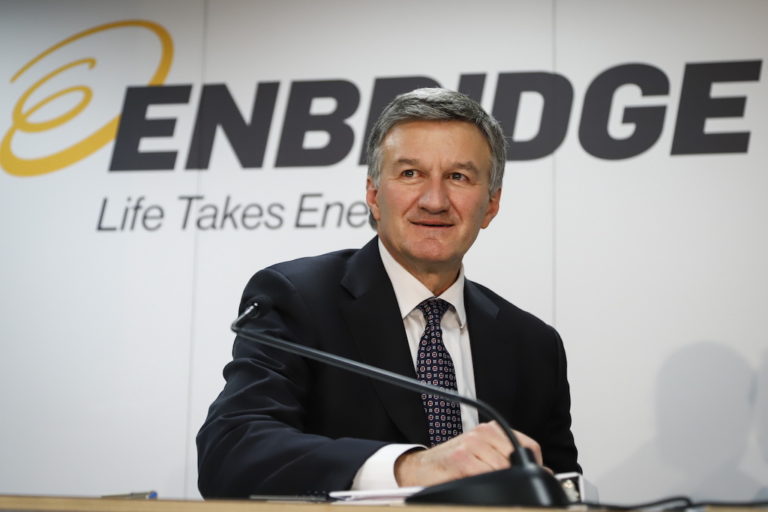
Alex Pourbaix, now executive chair of Cenovus Energy, pictured here as CEO in Ottawa in April 2023. Photo: The Canadian Press/Sean Kilpatrick
CALGARY — Alex Pourbaix has had a front row seat for the transformation of the energy sector. A former executive at TransCanada (now TC Energy), he was one of the company’s most prominent advocates for the Keystone XL oil pipeline during the Obama years—a deeply controversial project that became an inflection point and a symbol of the intensifying movement against fossil fuels.
In late 2017 he became CEO of Calgary-based Cenovus Energy, one of the country’s largest oil and gas producers, taking the job just six months after Cenovus’s colossal $17.7-billion takeover of ConocoPhillips Canada. Years later he was tasked with absorbing the company’s subsequent $3.8-billion acquisition of rival oil producer Husky Energy.
Talking Points
- As the former CEO and current executive chair of one of Canada’s largest oil producers, Alex Pourbaix has been at the forefront of the energy transition debate
- While oil companies are investing in technologies to offset emissions, he believes fossil fuels will remain in the energy mix for decades to come
But unlike his early years as an oil exec, Pourbaix’s position at Cenovus—he stepped down as CEO in April and now serves as executive chair—has become decidedly more focused on lowering emissions and the energy transition.
Pourbaix and the CEOs of other major oil-sands giants like Suncor Energy and Canadian Natural Resources have proposed a $16.5-billion carbon-capture and -storage (CCS) project in northern Alberta. It is one of the largest planned carbon-sequestration hubs in the world, and could eventually store up to 12 million tonnes of CO2 per year.
Cenovus has independently made its own efforts to drive down emissions. The company has an ownership position in Burnaby, B.C.-based Svante, a leader in carbon capture and storage technology, and an investor in General Fusion, the Richmond, B.C.-based company attempting to build a breakthrough nuclear-power device. Through Evok Innovations, the venture capital fund it launched alongside Suncor in 2016, Cenovus plans to invest $70 million over 12 years in an effort to scale up clean technologies.
Pourbaix spoke to The Logic about Canada’s failure to permit major energy projects, Alberta’s surprise moratorium on renewables and Occidental’s US$1.1-billion takeover of Canadian CCS company Carbon Engineering.
Related Articles

This interview has been edited and condensed for length and clarity.
You were a very prominent figure on the Keystone XL when the oil pipeline became a flashpoint in U.S. politics. What was that like?
It was obviously and ultimately very, very frustrating, but I took a few lessons from it. I think the first lesson I took was that our industry—the energy sector—did not realize maybe as quickly as we could have the debate that was emerging on the use of oil and gas and particularly energy infrastructure.
The other thing that Keystone really demonstrated to me was the growing challenge of developing, constructing and operating energy infrastructure. We have a huge problem in this country—and it’s no different in the U.S. The regulatory process makes it incredibly easy for opponents of necessary infrastructure projects to delay [development]—and if you can delay indefinitely, in essence you can deny these projects from going ahead.
That opposition is not just to pipelines. It’s to high-voltage power lines, it’s to highways, it’s to rail. It has gotten to the point in this country—and frankly, I would say in North America generally—where it has almost brought the development of infrastructure to a halt. And we are not going to be able to continue with our prosperity if this country cannot build infrastructure, and I think right now we have no solution for that. It is an incredible challenge and tragedy for the country.
Just yesterday I was in a town a few hours south of Calgary, where I talked to some of the landowners who oppose big wind turbines, and there was some commonality between that and what I used to hear about [opposition to] oil pipelines. To your point, it just seems like we don’t quite have a clear way out of this.
It goes to the issue that I think a lot of people are starting to realize about renewable energy, and one of the great advantages of oil and gas is they are incredibly concentrated forms of energy. Renewables, by their nature, are the exact opposite. They’re very diffuse.
“We are not going to be able to continue with our prosperity if this country cannot build infrastructure, and right now we have no solution for that.”
So if you want to advance large-scale renewable projects, you need to cover increasingly large areas of the countryside, and that starts conflicting directly with other land uses. In Canada we haven’t seen much of that; it’s been common in Europe for quite some time. But people are starting to appreciate that if we intend to significantly ramp up renewables, there is very much a land-use issue associated with that.
In Alberta there’s this seven-month moratorium now on renewables. What do you make of that?
I think that policy is a wise thing to do. I believe Alberta has one of the highest percentages of renewables by nameplate capacity of any province right now. As I understand it, we have something like 25,000 megawatts of renewable projects in the queue. And the challenge is that you cannot have a grid that is comprised entirely of renewables, because renewables are not reliable.
If you look at either of the last few winters, we’ve had periods where production from our renewables sector basically went to zero for several days on end when the temperature was -30 C or -35 C in the province. I would just observe that even if we had 10 times more renewables, if the environmental conditions were such that they all went to zero, what is the point? They’re not adding to our energy security and our reliability.
Cenovus seems pretty involved with Evok Innovations, you’re an equity shareholder of Svante, you’re invested in General Fusion. Do you see Cenovus as part technology company?
These investments in Evok and General Fusion and Svante—that is all really coming from this goal of finding new technology and new opportunities to drive down our GHG emissions.
If you look at our company, we’ve reduced our emissions intensity by about 25 per cent per barrel over the last 15 years. We have a goal to reduce our absolute Scope 1 and 2 emissions across our operations by 35 per cent by the end of 2035. These investments are really important to us.
We are right now piloting Svante’s technology at one of our thermal assets in Saskatchewan. So we’re doing this with the view of eventually commercializing these technologies and using them in our everyday operations.
Do you think the success or failure of the energy transition is ultimately a question of technology?
It absolutely is. I’ve been pretty clear in my view, and I think renewables have a role in the energy transition. I [also] think it is very naive to think that renewables are going to be able to take the place of oil and gas anytime in the next several decades. So we have to have an all-of-the-above strategy, and that includes decarbonizing our production of oil and gas.
“Companies like mine have to be very, very cautious when acquiring technologies that are really cutting edge. We are committed to reducing emissions this decade.”
One thing I’m very passionate about is nuclear energy. I sat on the board of Bruce Power for probably the better part of 15 years, and my message on that is if Canada wants to achieve in any way, shape or form to move towards net zero, nuclear has to be a huge part of that. In Western Canada, that is probably going to come in the form of small modular reactors. That’s something we’re very interested in as a company.
I wanted to get your thoughts on how a big technology company—Carbon Engineering—was recently bought out by Occidental Petroleum for over US$1 billion. What’s been the industry’s reaction to that?
Longer term, I think there’s probably a significant opportunity to extract carbon just from the atmosphere but I think we’re probably at least a couple of decades from rolling that out on a large-scale basis.
Right now I think the technology has merit, but it’s really energy intensive. You’re trying to extract a molecule that represents like four molecules out of 10,000—that’s what CO2 represents. You’re trying to extract that incredibly diluted stream of CO2 from the atmosphere.
Was it a missed opportunity for Canadian energy companies, given that an American company ultimately bought Carbon Engineering?
Companies like mine have to be very, very cautious when acquiring technologies that are really cutting edge. We are committed to reducing emissions this decade, next decade, in the decade after. We’ll always look at those further-out technologies, but we have to be focused on technologies that can help us right now.
An example of that is Svante. We’re right now working with Svante on projects we’re going to be able to deploy in the next decade.
Do you believe in the long-term viability of carbon offset markets? That’s something I don’t hear Canadian oil companies talk about as much as, say, Houston-based companies.
This is just a personal view, but we took a very close look at the offset market and the carbon credit market, and my observation about it is that globally if we’re going to move to a net-zero economy, I suspect that carbon offsets are going to have to play a meaningful role. So I’m a believer in offsets.



Loading...
Thanks for sharing!
You have shared 5 articles this month and reached the maximum amount of shares available.
CloseThis account has reached its share limit.
If you would like to purchase a sharing license please contact The Logic support at [email protected].
CloseGift the full article!
You have gifted 0 article(s) this month and have 5 remaining.
Recipients will be able to read the full text of the article after submitting their email address. They will not have access to other articles or subscriber benefits.
Photo: The Canadian Press/Sean Kilpatrick
Most Popular This Week




In-depth, agenda-setting reporting
Great journalism delivered straight to your inbox.
The Big Read
Beacon is building an AI empire by fixing Main Street’s software
Briefing
Inovia raises US$200M for new VC fund as it eyes AI’s impact
43% of eligible Albertans voted ahead of Monday’s referendum
AI chip company Tenstorrent raises US$1.5B, valuing it at US$6.2B
Best business newsletter in Canada
Get up to speed in minutes with insights and analysis on the most important stories of the day, every weekday.
Exclusive events
See the bigger picture with reporters and industry experts in subscriber-exclusive events.
Membership in The Logic Council
Membership provides access to our popular Slack channel, participation in subscriber surveys and invitations to exclusive events with our journalists and special guests.







