Who wouldn’t secede from their neighbours if they could? Sure, maybe the people living right next door are cool. But somewhere on your floor or down the block there’s somebody who keeps strange hours, thinks odd thoughts or gives you grief about your lawn. To make the hypothetical case a bit more pointed, maybe your dispute with the neighbours is over COVID vaccination status or the merits of the Ottawa trucker convoy. Meanwhile on Slack or Signal you’re in constant contact with people who agree with you about everything you value. Why not just draw a border around the people who agree with you and shut everyone else out?
Skip to content

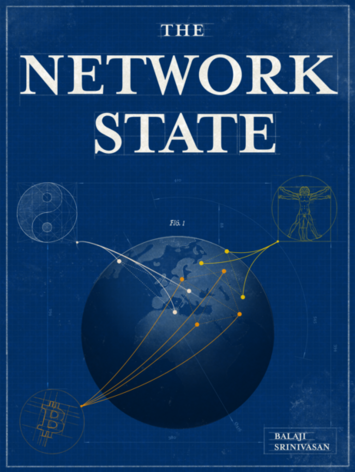 Photo: The Network State | Handout
The Big Read
Wells: Can networks supplant nations? A Silicon Valley radical makes the case
CEO Balaji Srinivasan speaks onstage during TechCrunch Disrupt SF 2017 in September 2017 in San Francisco, California. Photo: Steve Jennings/Getty Images for TechCrunch
Who wouldn’t secede from their neighbours if they could? Sure, maybe the people living right next door are cool. But somewhere on your floor or down the block there’s somebody who keeps strange hours, thinks odd thoughts or gives you grief about your lawn. To make the hypothetical case a bit more pointed, maybe your dispute with the neighbours is over COVID vaccination status or the merits of the Ottawa trucker convoy. Meanwhile on Slack or Signal you’re in constant contact with people who agree with you about everything you value. Why not just draw a border around the people who agree with you and shut everyone else out?
Related Articles


This is what Balaji Srinivasan advocates in his book The Network State. Srinivasan is a Silicon Valley angel investor and founder, whose career has featured stops at Counsyl, Bitcoin, Ethereum and Andreessen Horowitz. He’s a prominent, if radical, thinker in that world. His book has been blurbed by Mosaic co-creator Marc Andreessen, Coinbase CEO Brian Armstrong and Canadian Ethereum inventor Vitalik Buterin.
Srinivasan has also formed a mutual admiration society with Peter Thiel, the co-founder of PayPal and Palantir technologies who’s donated millions to congressional candidates in Donald Trump’s circle and who has written that he “no longer” believes “freedom and democracy are compatible.” At the beginning of the Trump presidency, Thiel advocated unsuccessfully for Srinivasan to become head of the Food and Drug Agency under Trump. My point here isn’t to establish guilt by association, but rather to show the extent of Srinivasan’s estrangement from the assumptions of U.S. progressives.
Anyway, he’s serious about this network-state idea. Connect people online, give them a shared sense of mission and federate the land they occupy—“an archipelago of crowdfunded physical territories”—into entities with “large enough population, income, and real-estate footprint to attain a measure of diplomatic recognition.” Actual countries, in short, stitched together from living rooms and the ether.
The part about diplomatic recognition is crucial. Srinivasan’s principle is “land last—but not land never.” His network states would not be virtual. They’re not chat groups. While “you could feasibly start this kind of country from your computer,” they would need to end as real places, places substantial enough that existing countries and the United Nations would have to acknowledge their existence formally.
Why bother? And how do you go about such a thing? Srivinasan does a better job of answering why than how. New countries, built around new social contracts, beckon “[f]or the same reason we want a bare plot of earth, a blank sheet of paper … Because we want to build something new without historical constraint.” His motive would have been familiar to the Plymouth Pilgrims: the old world is decadent, so find me a new one. He has been thinking out loud about seceding from the United States for nearly a decade. He spends part of The Network State canvassing other possible frontiers—the high seas, outer space—before settling on this hybrid, a networked archipelago of Swiss cheese holes, as the most practical solution.
It’s still not very practical. Srinivasan’s attempts to address the “how” question—a few pages at the beginning of his book, and a few at the end—are so unpersuasive I doubt he even finds the question interesting. Srinivasan makes no mention of “territorial integrity,” the right of existing countries to defend their border or territory. In a discussion of “self-determination,” the ebook (apparently a print version will be available later) links to a Wikipedia entry that has this to say: “According to the Helsinki Final Act of 1975, the UN, ICJ and international law experts, there is no contradiction between the principles of self-determination and territorial integrity, with the latter taking precedence.”
This means the right of existing countries to defend their existence takes precedence over the right of new countries to be new. I studied this stuff for a decade while covering the debate over Quebec secession. I can tell you anyone who mentions self-determination without discussing territorial integrity is blowing smoke.
Concretely, it means this: If I sign up to the Independent Global Republic of People Who Agree With Balaji, can Canada or a Canadian province still tax me? Can they send the police to arrest me? Will my children be Canadian? Are government ministries obligated to send me the benefits to which my Canadian neighbour is entitled? There’s wiggle room on all of those questions at the margin—it’s not a problem if some people living in Canada aren’t Canadian, or if some are tax-exempt or vote in Italian elections or whatever. But the problem comes when the exemptions stack up and are multiplied across defined populations and territories. If the answers to all the questions I asked here are “Yes” for the new network’s followers, then the Balaji Republic doesn’t exist. If the answers are all “No” for thousands of Canadian residents with combined properties in the multiples of square kilometres, then the Canadian state will not view the Balaji Republic with less alarm than its predecessor viewed the Fenian raids, and depending on the scale of the networked land-last incursion, not more gently either.
Srinivasan’s response to criticism is typically to say, well, they laughed at the Wright Brothers too. Sure. But the Wright Brothers had an airplane, and their argument was with gravity. Sooner or later, Network Staters’ argument would be with states. Those states would respond the way states do, with a range of tools that would start with press releases and progress through subpoenas to police visits and armies. It’s possible, lately pretty easy, to envision a future in which states’ capacity to defend themselves collapses. But Srinivasan is not advocating the violent chaos that implies. He discusses the possibility of a “Second American Civil War” (“Bitcoin seizure could be the trigger event”), but merely as one hypothetical future among many. Violent conflict is not his project. But that makes his book a thought experiment, and to the extent it’s about disrupting statecraft, a flimsy one.
Fortunately it is about more than statecraft. Srinivasan has three things to offer here: a project, whose weakness I have already described; a grudge; and an analysis.
The grudge is against woke-ism generally, and against The New York Times specifically, at length and with sometimes breathtaking vigour. “Why are tech companies being lectured by media corporations on ‘diversity?’” he writes. “After all, if you know a bit more history, you’ll know that the New York Times Company (which originates so many of these jeremiads) … literally profited from slavery, blocked women from being publishers, excluded gays from the newsroom for decades.”
This is all fair. There follows, as often in this book, a leap. “Once you know this history … you’re outside the matrix. You’ve mentally freed your organization.… You don’t need to take lectures from them, from anyone in their employ, or really from anyone in their social circle—which includes all establishment journalists.”
I learn, without surprise, that Srinivasan quarreled at length with a Times journalist over some online dispute that’s so intricate I’m content to just put it in a link and let you puzzle it out. He has come to believe there is, or can be, a history in which every question is settled. To him that’s the blockchain. “A cryptographically verifiable macrohistory … the log of everything that billions of people choose to make public: every decentralized tweet, every public donation, every birth and death certificate, every marriage and citizenship record … all digitally signed, timestamped, and hashed in freely available public ledgers.”
Have you ever been in an argument that ended with somebody triumphantly pointing at the timestamp on a text message? I have. It didn’t feel like a model for utopia.
So put me down as unpersuaded on Srinivasan’s project and unmoved by the grudge. But his analysis of the real world is useful in other ways. Even if social networks can’t give us new countries, they are obviously powerful tools for finding and connecting the like-minded. As such, they’re a challenge to the sort of consensus that once only religions or states could promulgate and enforce. Think of your Zoom book club, or the “Lackey Slack” that connects Waystar Royco underlings on Succession, or the global online support and funding network for the February “Freedom Convoy.” The network offers powerful tools for finding your people and deciding what you’re going to do with them. And because people connected by the network can do things in the real world (short of secession), the network does offer at least a potential challenge to state authority.
Another Srinivasanian leap: the capital-N Network, he says, is “the next Leviathan,” a societal organizing principle as powerful as God or the State, and already in conflict with them. God still has His moments, as on 9/11 or in some discussions of social policy. But these days most of the big fights are between State and Network.
Here, suddenly, Srinivasan offers useful tools for understanding conflicts as wicked and headline-grabbing as the federal Liberals’ attempts to regulate online streaming; occasional disputes between independent, often combatively ideological, journalists and the Parliamentary Press Gallery; and Pierre Poilievre’s performative affection for Bitcoin. (Poilievre and Srinivasan don’t follow each other on Twitter, and I can find no evidence either knows of the other. But I suspect if they met they would have much to discuss.)
In a conflict between State and Network that “will shape this century,” Srinivasan says the Network already has several advantages. Encryption permits groups to organize “outside state control.” Bitcoin, the Network’s currency, is “money the State can’t easily freeze, seize, ban or print.” Social networks “change the nature of community. Your community is your social network, not necessarily the people who live near you.”
So who’s your Leviathan? For Srinivasan, “People of the State” gain prestige, wealth or power when the State’s ambit grows. So they “start by thinking about capturing a piece of the state. To win an election, to influence legislation via a non-profit, to write an article that has ‘impact’ in the sense of impacting policy … to make something that was previously discretionary either mandatory or forbidden.” In contrast, Srinivasan’s “People of the Network” lose when the State grows. Or they would—if they didn’t have their Network connections, which offer growth potential beyond the State’s reach. My gloss: Srinivasan is contrasting John Ibbitson’s Laurentian Consensus with—well, with Pierre Poilievre’s voter base.
This all made me think of Stephen Harper’s use of the terms “Somewheres” and “Anywheres” in his 2018 book Right Here, Right Now. Harper borrows the terms, with credit, from David Goodhart, the founding editor of Britain’s Prospect magazine. “Anywheres” are cosmopolitans—consultants or academics, Harper wrote, who “can wake up in New York, London or Singapore and feel at home,” who “attend (or aspire to attend) the Davos conference,” are “motivated by climate change” and “unequivocally pro-free trade.” “Somewheres,” of course, are the opposite. “Maybe you are a manufacturing or retail worker, or even a small businessperson … your work can be, and is being, disrupted by import competition and technological change.” You might, for instance, be a trucker.
Here we see a big and fascinating shift. Many of Srinivasan’s “People of the Network” are, culturally, Harper’s Somewheres. They’re the people who don’t buy the ruling establishment’s cultural assumptions and don’t reap its benefits. But at some point along the line, they became hypercharged by going online. Suddenly at least some of the Somewheres are more anywhere than the Anywheres.
Why? Maybe two reasons. In Canada, the Somewheres’ “somewhere” didn’t offer a sufficiently powerful base—landlocked parts of the resource-producing West and semi-rural Central Canada. And the Anywheres might not be as exquisitely mobile as an envious Harper once thought: outside the range of their transit passes, most of the country is a mystery to them. Most significant for our purposes, the People of the State are severely hobbled online, stuck with technology from another century.
Nor are all of Srinivasan’s People of the Network on the political right. He identifies a strain of “Left-Libertarians” who “truly aren’t primarily loyal to the Democrat party or even the institutions that are upstream of it, but to their community online—which increasingly diverges from the party line.” Here, at last, I understand why some friends and readers were so excited when I left my day job at Maclean’s to start a Substack newsletter. I had, all unwittingly, become a floor-crosser in what Srinivasan calls “the escalating conflict between State and Network, between Dollar and Bitcoin, between establishment journalists and decentralized media, between the American government and the global internet.”
Back to Poilievre, whom Srinivasan didn’t even know he was writing about. By campaigning against State, Dollar and establishment journalists, the upstart Conservative leader plants his flag with what used to be small-town Canada and is now an unruly digital vanguard. As always, it’s important to say that having an organizing philosophy is not at all the same as being sure of winning. Theories aren’t votes. But deep in the craziest book I’ve read this year were some ideas for making sense of the political phenomenon I’ve been pondering all year. When life becomes a funhouse, sometimes it’s the funhouse mirror that offers the most helpful view.
Paul Wells is a journalist and author based in Ottawa. He writes a Substack newsletter and is host of The Paul Wells Show. He has written for Maclean’s, the Toronto Star, the National Post and the Montreal Gazette and is a frequent commentator on French- and English-language television and radio. His book The Longer I’m Prime Minister won the Shaughnessy Cohen Prize, the John W. Dafoe Book Prize and an Ottawa Book Award.



Loading...
Thanks for sharing!
You have shared 5 articles this month and reached the maximum amount of shares available.
CloseThis account has reached its share limit.
If you would like to purchase a sharing license please contact The Logic support at [email protected].
CloseGift the full article!
You have gifted 0 article(s) this month and have 5 remaining.
Recipients will be able to read the full text of the article after submitting their email address. They will not have access to other articles or subscriber benefits.
Photo: Steve Jennings/Getty Images for TechCrunch
Most Popular This Week




In-depth, agenda-setting reporting
Great journalism delivered straight to your inbox.
Commentary
Carmichael: Being boxed in will help Canada focus on what matters
Briefing
Rio Tinto gets nearly $165M in additional federal funds for Quebec aluminum
U.S. to lift tariffs on some Canadian products crucial to Maine: Collins
Carney warns of tech dependence after Starlink disruptions in Ukraine
Best business newsletter in Canada
Get up to speed in minutes with insights and analysis on the most important stories of the day, every weekday.
Exclusive events
See the bigger picture with reporters and industry experts in subscriber-exclusive events.
Membership in The Logic Council
Membership provides access to our popular Slack channel, participation in subscriber surveys and invitations to exclusive events with our journalists and special guests.






