In the fall of 2022, the CEO of Denmark’s largest grocer introduced Danes to a new type of store that he deemed a win-win for his business—a chain squeezed by rapidly rising electricity costs—and for customers feeling the pinch of inflation. Per Bank welcomed Danes to Basalt in a video posted on LinkedIn, walking around a barebones room surrounded by pallets on the floor, stacked with boxes of non-perishable goods. There were no refrigerators or freezers in sight.
Skip to content

 Salling Group opened Basalt in October 2022, growing the ultra-discount chain to 10 stores before announcing it would close them seven months later. Photo: Per Bank | X
 Parallels between Salling Group's businesses and Loblaw's, pictured, helped make Bank the top candidate in the Canadian retailer's executive search. Photo: Nathan Denette/The Canadian Press
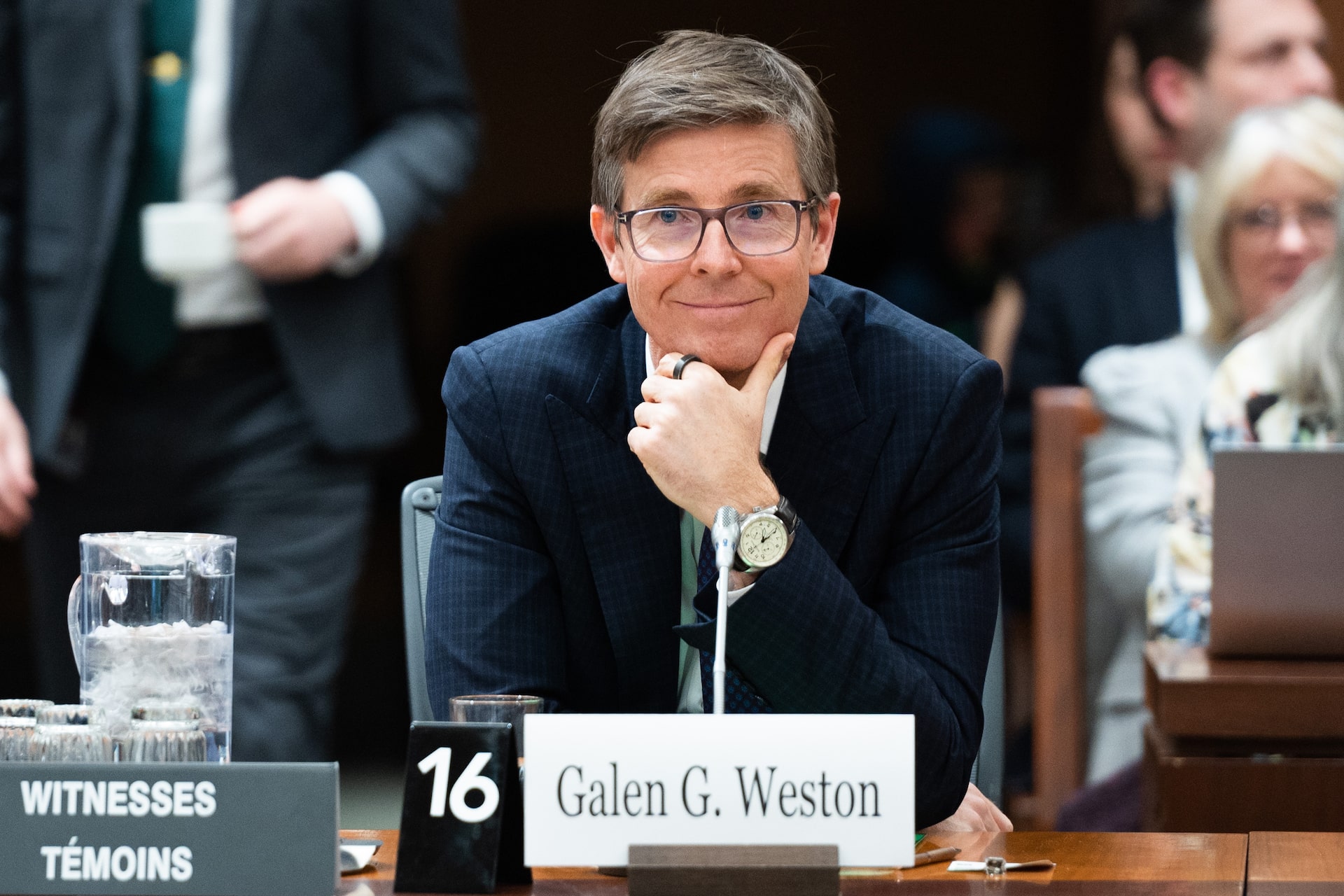 Bank will report to Weston, the fourth-generation leader of Loblaw’s holding company George Weston, who expects a "high level of alignment" between the two. Photo: The Canadian Press/Spencer Colby

The Big Read
Running the risks at Loblaw
‘Controlled impatience’ helped Per Bank win the grocery giant’s top job. Will he get the space to use it?
Per Bank who last led Salling Group, Denmark’s largest grocer, will take on the CEO role at Loblaw next year. Photo: Salling Group/Handout
In the fall of 2022, the CEO of Denmark’s largest grocer introduced Danes to a new type of store that he deemed a win-win for his business—a chain squeezed by rapidly rising electricity costs—and for customers feeling the pinch of inflation. Per Bank welcomed Danes to Basalt in a video posted on LinkedIn, walking around a barebones room surrounded by pallets on the floor, stacked with boxes of non-perishable goods. There were no refrigerators or freezers in sight.
The stores “cut out everything superfluous” to keep costs down, the company said. Across 10 locations, customers could pick up pasta, flour, bread, oatmeal and other basics at an average of 15 per cent less than other discount chains charged. The concept tested how low prices could go, and whether Danes would endure some inconvenience to keep their grocery bills down.
Talking Points
- Loblaw has announced Per Bank, a retail executive who most recently led Denmark’s largest grocery chain, will take the helm at the family empire starting next year
- Bank became the favoured candidate in a global search due to his experience running a family-controlled company, a partnership which Loblaw’s Galen G. Weston said requires “high level of alignment” between him and any CEO
Bank has a reputation as a risk-taker, happy to greenlight new initiatives but quick to scrap them if they fall short of his expectations. So it went with Basalt. Danes, it turned out, didn’t love the idea of buying their dry grocery items at one location, then going elsewhere for milk, cheese and everything else. About seven months after the first store opened, Salling Group announced Basalt would close.
That fast-forward approach to risk-taking is partly why Loblaw selected Bank as its next CEO, starting next year. After two years under the direction of Galen G. Weston, Canada’s largest grocer arrived at a crossroads, with a key executive about to retire. Loblaw needed a leader who could walk the tightrope between working with the scions behind a family company, and growing a business in a sector experiencing rapid technological changes and notoriously low margins.
In Bank, Loblaw landed one of a handful of grocery executives who answered its job description. After announcing the appointment in April, Weston lauded Bank’s “controlled impatience” in a call with analysts. It’s a quality the Dane’s friends and former colleagues know well. Mette Maix, the CEO of Rosendahl Design Group, who worked with Bank for over a decade at Salling and two other grocers, described a methodical leader who researches ideas and runs scenarios before committing to them. “Then, if it didn’t work,” she said, “he will be the first to admit it.”
Bank checked off a lot of Loblaw’s other boxes. In Salling Group, he led a family-owned grocer whose business model is strikingly similar to Loblaw’s: both operate multiple types of stores; both own private-label brands; and both say they emphasize customers and profits in all they do.
Bank’s experience as a grocery executive, though exclusively in Europe, is extensive. An engineer by education, he moved into the retail business in the late 1990s after several years at Danfoss, which creates energy-efficient technology. He was CEO at both Coop Danmark and Tesco Hungary, before taking the top job in 2012 at Salling Group, a 1,700-store empire controlled at the time by the Danish shipping company A.P. Moller-Maersk.
Related Articles


Herman Salling, the son of the company’s founder, had partnered with Maersk to fund a rapid expansion after his father died, maintaining a 32 per cent stake through the Salling Foundations. But Dansk Supermarked would return to family ownership under Bank’s leadership. In 2014, the foundation started to buy back shares, regaining full ownership in late 2017 and adopting the name Salling Group.
Despite his reputation for testing bold ideas, Bank is likely to start with a more measured approach. He’s the type of leader who visits stores frequently, listens to his new colleagues and obsesses over numbers, say those who know him. “He wouldn’t be a guy who would get up on a press conference on the first week he has the job and tell you how he’s going to revolutionize the company,” said Bruno Christensen, a retail consultant in Denmark who has followed Bank’s career for years, but also knows him as a friend. “That’s not his style.”
One of his first tasks, in fact, may not look like the work of a CEO at all. Bank, who did not respond to an interview request for this story, has told his new colleagues he wants to spend days working in each of the store formats that Loblaw operates in different parts of the country. He’ll ring up orders on the cash register, decorate cakes, stock shelves and fulfill whatever other tasks that its retail and warehouse workers do daily.
It’s a practice he’d seen in action during his time at Tesco, whose Hungarian arm he led for two years starting in 2009. The U.K.-headquartered grocery giant has a tradition of acquainting executives and managers with the retail side of the business by assigning them to work in it, said Iglodi-Csato Judit, whom Bank hired as Tesco Hungary’s communications director.
She remembers panicking a bit behind the cash register during her time on the floor, afraid to push the wrong buttons. But Bank embraced the experience, carrying on the practice beyond the mandated period. “He spends time on the shop floor every day,” she said—a feat he manages in part by being a morning person, known for holding meetings as early as 6 a.m., Iglodi-Csato recalled: “He would turn up at seven in the morning in the other side of the country because he wanted to see what was going on there.” The early mornings come in part from his desire to spend time with his family, and making it home in time for dinner with his wife and kids, said Maix.
Dorte Wimmer, director of Retail Institute Scandinavia, said Bank is a diligent numbers person, and predicted he will spend time in his new role taking stock of the business, identifying and analyzing revenue drivers. “He looks at market share every morning, and he knows it by heart,” said Wimmer, who followed Bank’s career and Salling Group’s growth for years.
“He would turn up at seven in the morning in the other side of the country because he wanted to see what was going on there.”
Maix, who would visit stores with Bank several times a year, said he would walk in knowing about the last couple of years of each location’s development, and the salary percentages across different store formats. Her advice for anyone at Loblaw working with him: “Know your numbers, because he will definitely know them.”
But he’s also described as someone who listens to and trusts his team. Maix said he would often come to her to discuss how to provide a better product selection or reduce costs. “He would even ask, ‘What is the right price for cream for Christmas?’” she said. “And then we would discuss it a long time.”
Bank leans particularly hard on the knowledge of others when he enters a new job in a new country. When he started as CEO of Tesco Hungary—moving his family and learning enough of the language to engage store staff with short phrases—he relied on the expertise and language skills of Iglodi-Csato and other locals. Denmark to Hungary, she added, is likely “even a bigger cultural difference” than Denmark to Canada.
Bank rose to the top of a five-person shortlist from Loblaw’s global search for a new executive, which started last year. Officially, the company was looking for a chief operating officer, but was open to finding a CEO for the right fit. Bank “was the clear standout,” said Weston.
Weston—the fourth generation of his family to lead Loblaw’s holding company George Weston Limited—was forthright about one key piece of Bank’s background: “He has extensive experience working for a controlling family and understands what that relationship needs to be in order for a partnership to be successful.”
What Weston described as Salling’s “quite remarkable” parallels with Loblaw helped tip the scales in Bank’s favour. Both have “an outsized cultural and financial place” in their respective countries, Weston said—meaning a big firm in a small nation. Both operate multiple banners, from discount to higher-end markets, and describe their strategic missions in similar terms. (Loblaw’s is to help Canadians “Live Life Well”—a trademarked phrase—while Salling’s is to “improve everyday life.”)
Yet behind their marketing rhetoric, both Salling and Loblaw embrace the grinding calculus of the notoriously low-margin grocery trade. Each touts affordable pricing, yet achieves that in no small part by leaning on the companies from which they source products. Salling and Bank are known for “pushing the suppliers quite hard,” said Wimmer, who has had personal experience with those tactics in her previous role with Unilever, the owner of more than 400 brands including Ben & Jerry’s, Dove and Knorr. (Canada’s supermarket giants have agreed to address their relationship with suppliers in an upcoming grocery code of conduct; a final draft was open for consultation by industry insiders in May, and it is expected to be implemented in 2024.)
Accordingly, much of Bank’s innovation in past roles focused on efficiency and the battle for market share. His tests at Salling included a cashierless checkout with connected shopping carts, similar to Amazon Go store technology, and some e-commerce experimentation. A few years ago, the company merged thousands of its private-label products under one Salling brand that now sells canned food, deli meats and kitchen supplies. Comparing it to Loblaw’s President’s Choice, Christensen described the label as “very successful.”
At Loblaw, though, Bank’s latitude for risk-taking may be limited—at least to start with. Weston and chief financial officer Richard Dufresne expect him to stick to Loblaw’s long-term strategy whose focuses include investing in digital retail, payments and rewards, and connected health care. And while Weston has applauded Bank’s decisiveness, his messaging on the CEO’s independence has been mixed.
On one hand, he has emphasized that Bank’s title will be CEO and he will report to the board, unlike prior Loblaw leaders who served as president and reported to Weston. “There’s important symbolism in that,” he said. But he also stressed the need for a “high level of alignment” between himself and any chief executive, saying Bank will have the space to “tweak and adjust and make important decisions.” The takeaway, Weston said, is that “this is not a sharp left turn. This is about evolution and building on the platform that’s been established.”
Galen G. Weston stressed that Bank will report to the board rather than to him, saying, “There’s important symbolism in that.”
Loblaw’s path to a new CEO has been circuitous. The firm currently doesn’t have one; it’s led by Weston, the president and chair. Sarah Davis, who rose through the executive ranks over the course of over a decade, becoming president in 2017, was a potential Weston successor. Two years after her appointment, Loblaw expanded her remit, including giving her responsibility for the company’s management board. Meanwhile, Weston dropped CEO from his title, becoming executive chair.
Then, one year into the COVID-19 pandemic, during which Loblaw saw supersized growth, the company announced a management shakeup that would see Weston return to a leadership role. Davis retired in May 2021 and Weston took over as president. At the same time, Loblaw appointed Sawyer as chief operating officer and made Dufresne, then CFO at George Weston, CFO of Loblaw, too.
On the call announcing Bank’s appointment, an analyst questioned Weston on the “number of transitions” in Loblaw’s corner suite, and how the retailer can maintain its momentum through another change, this time with Bank. Weston acknowledged that Loblaw has failed to make past executive transitions “work quite right,” adding, “there is nobody with more focus on preventing that.”
Bank is set to replace Sawyer, Weston explained, a retail executive whom Loblaw lured out of retirement knowing they’d only have him for a short time. Weston portrayed Bank as a younger version of the Loblaw lieutenant, and predicted the Dane will see “long tenure in his visit.”
It was a striking choice of words given the company’s recent history—and one the head of the country’s pre-eminent grocery dynasty hastened to amend, adding, “or his move to Canada.”



Loading...
Thanks for sharing!
You have shared 5 articles this month and reached the maximum amount of shares available.
CloseThis account has reached its share limit.
If you would like to purchase a sharing license please contact The Logic support at [email protected].
CloseGift the full article!
You have gifted 0 article(s) this month and have 5 remaining.
Recipients will be able to read the full text of the article after submitting their email address. They will not have access to other articles or subscriber benefits.
Photo: Salling Group/Handout
Salling Group opened Basalt in October 2022, growing the ultra-discount chain to 10 stores before announcing it would close them seven months later.
Parallels between Salling Group's businesses and Loblaw's, pictured, helped make Bank the top candidate in the Canadian retailer's executive search.
Bank will report to Weston, the fourth-generation leader of Loblaw’s holding company George Weston, who expects a "high level of alignment" between the two.
Most Popular This Week




In-depth, agenda-setting reporting
Great journalism delivered straight to your inbox.
Commentary
Carmichael: Being boxed in will help Canada focus on what matters
Briefing
Rio Tinto gets nearly $165M in additional federal funds for Quebec aluminum
U.S. to lift tariffs on some Canadian products crucial to Maine: Collins
Carney warns of tech dependence after Starlink disruptions in Ukraine
Best business newsletter in Canada
Get up to speed in minutes with insights and analysis on the most important stories of the day, every weekday.
Exclusive events
See the bigger picture with reporters and industry experts in subscriber-exclusive events.
Membership in The Logic Council
Membership provides access to our popular Slack channel, participation in subscriber surveys and invitations to exclusive events with our journalists and special guests.






