VANCOUVER — Earlier this summer, a truck without a driver left Loblaw’s Brampton, Ont., headquarters and travelled about eight kilometres on public roads to a nearby store, in what the autonomous-vehicle startup Gatik is billing as the first fully driverless delivery in Canada.
Skip to content


News
The autonomous trucks hauling Loblaw’s groceries are going truly driverless
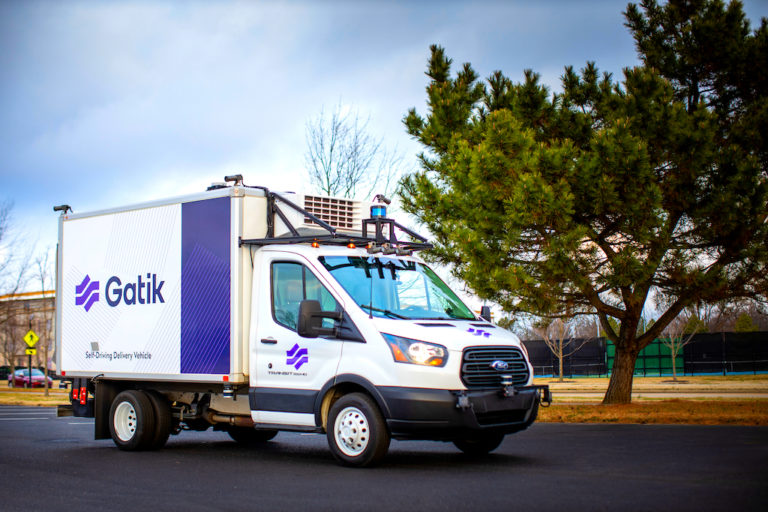
A Gatik driverless delivery truck. The company will begin operating a fleet of five delivery trucks to deliver online grocery orders between Loblaw’s warehouses and its stores. Photo: Gatik/Handout
VANCOUVER — Earlier this summer, a truck without a driver left Loblaw’s Brampton, Ont., headquarters and travelled about eight kilometres on public roads to a nearby store, in what the autonomous-vehicle startup Gatik is billing as the first fully driverless delivery in Canada.
“Today, we’re operating fully driverless on one route,” said Gautam Narang, CEO and co-founder of Gatik, in an interview with The Logic. The Mountain View, Calif.-based startup is developing technology to provide autonomous delivery in the so-called middle mile of logistics, or the stage before goods move to customers’ homes.
Talking Point
In August, a Gatik autonomous vehicle made what the startup says is Canada’s first fully driverless delivery for Loblaw. Gatik has been powering autonomous-vehicle deliveries on five routes in Ontario for the retail giant, but has now removed the safety driver from one of them.
Retailers, specifically grocers, have been rushing to automate their e-commerce fulfillment by adding robotics to warehouses and investing in autonomous vehicles. Loblaw-affiliated Wittington Ventures co-led Gatik’s US$25-million Series A and later participated in its US$85-million Series B, while Sobeys’s e-commerce partner Ocado invested in a Series B raise by Oxbotica, an autonomous-vehicle software startup. Grocers have entered into partnerships to deploy the vehicles, at various scales, to fulfill deliveries.
Related Articles

For Loblaw, removing drivers from vehicles helps improve the customer experience “in terms of being able to deliver the goods and services they need where and when they need them,” said David Markwell, chief technology and analytics officer. The partnership also helps the company stay at the forefront of innovation and better its operating process. Under its agreement with Gatik, operating the automated trucks costs the same as running its own fleet with drivers. “Then over time, the economics will improve,” he said.
Gatik, which also has an office in Toronto, first deployed a single autonomous vehicle with a safety driver for Loblaw in January 2020. That November, after a 10-month pilot, the companies announced a multi-year partnership in which the startup would operate five autonomous vehicles with a safety driver on five different routes in an effort to automate Loblaw’s middle-mile deliveries.
This past August, Gatik removed the safety driver from one of those routes after the Ontario Ministry of Transportation granted it permission to do so. The ministry did not respond to questions, but pointed to its 10-year pilot program that it started in 2016 allowing participants to test autonomous vehicles. In 2019, it amended the program to allow participants to test driverless vehicles with “either a passenger on board or a remote operator monitoring the vehicle’s operations,” among other restrictions. Ministry spokesperson Aruna Aundhia did not say whether there were any traffic accidents connected to the program, but directed The Logic to the province’s freedom-of-information request page “for any additional information.”
But Gatik said its safety record is unblemished. The company received a special permit from the ministry in April, Narang said, after sharing data about its technology and undergoing an assessment. Loblaw also commissioned a third-party firm to assess the technology through both a physical-safety and a cybersecurity lens, he said. Loblaw conducted the assessment voluntarily, said Markwell. The final report made “a few, small operating improvements,” which Markwell declined to describe, but said were implemented.
The fully driverless route runs from a Real Canadian Superstore at Brampton’s Hurontario Street Steeles Avenue West to Loblaw’s headquarters in Brampton, where the headquarters staff can then pick up their own personal online shopping orders. Gatik’s “technology can handle all the complex urban scenarios,” said Narang, such as traffic lights and lane changes. Still, the company is attempting to minimize risk and exposure. So the driverless-delivery route takes more right turns than left, for example.
While Gatik has removed the safety driver on the one route, there is now a passenger in the vehicle and a car that follows behind it. Neither is a regulatory requirement, said Narang, but the company decided to use both out of caution and after consulting with regional emergency services, where officials expressed concern over how they would interact with the vehicle should it be pulled over. Gatik expects to remove both the passenger and chase car in the coming weeks, said Narang, though they may reappear intermittently depending on weather conditions. “It’s a function of basically taking baby steps toward fully driverless operations,” he said.
Gatik has taken similar steps in the U.S. In November 2021, the company announced it had removed the safety driver from a delivery route for Walmart in Bentonville, Ark. It has run more than 1,000 fully driverless trips in the state so far, said Narang, without the vehicle being pulled over. To date, a passenger remains onboard for those trips.
Over the coming months, Gatik plans to remove the co-pilot on its remaining four Loblaw routes. From there, Loblaw plans to scale slowly. “The goal is to continue to grow the number of vehicles and the types of scenarios,” said Markwell. The grocery giant doesn’t foresee using driverless vehicles for long-haul deliveries or those from a store to a customer’s home, due to the size of vehicles it is using (Ford Transit 350 box trucks) and the available technology, he said, as well as safety. Its plans are also limited by geography. Currently, Gatik only has permission to deliver without drivers in Ontario, though Markwell said Gatik is “actively working on a set of provinces.”
Gatik is first focused on expanding its presence in Ontario, both as a company and for its customers. The firm, which does not have an exclusive agreement with Loblaw and operates with more than 10 Fortune 500 customers across Canada and the U.S., first set up an office in Toronto to be near the talent graduating out of nearby universities. It plans to create 200 jobs in Canada by 2025, Narang said. It wants to add to Loblaw’s driverless routes in Ontario, and later expand to other provinces.
The startup intends to grow by adding density—more customers and trucks—in areas where it already operates, and to reduce the time between deploying vehicles with safety drivers to operating them fully autonomously. “The plan is to continue expanding our fully driverless operations with a regular cadence,” Narang said.



Loading...
Thanks for sharing!
You have shared 5 articles this month and reached the maximum amount of shares available.
CloseThis account has reached its share limit.
If you would like to purchase a sharing license please contact The Logic support at [email protected].
CloseGift the full article!
You have gifted 0 article(s) this month and have 5 remaining.
Recipients will be able to read the full text of the article after submitting their email address. They will not have access to other articles or subscriber benefits.
Photo: Gatik/Handout
Most Popular This Week




In-depth, agenda-setting reporting
Great journalism delivered straight to your inbox.
Commentary
Carmichael: Canadian ignorance about India is a strategic weakness
Briefing
Aritzia shares pop after earnings rise 204%
First Nation in Alberta goes to court over fast-tracked oil pipeline
Chinese EV maker Geely Auto Group to launch in Canadian market in 2027
Best business newsletter in Canada
Get up to speed in minutes with insights and analysis on the most important stories of the day, every weekday.
Exclusive events
See the bigger picture with reporters and industry experts in subscriber-exclusive events.
Membership in The Logic Council
Membership provides access to our popular Slack channel, participation in subscriber surveys and invitations to exclusive events with our journalists and special guests.