Listen Now
0:00
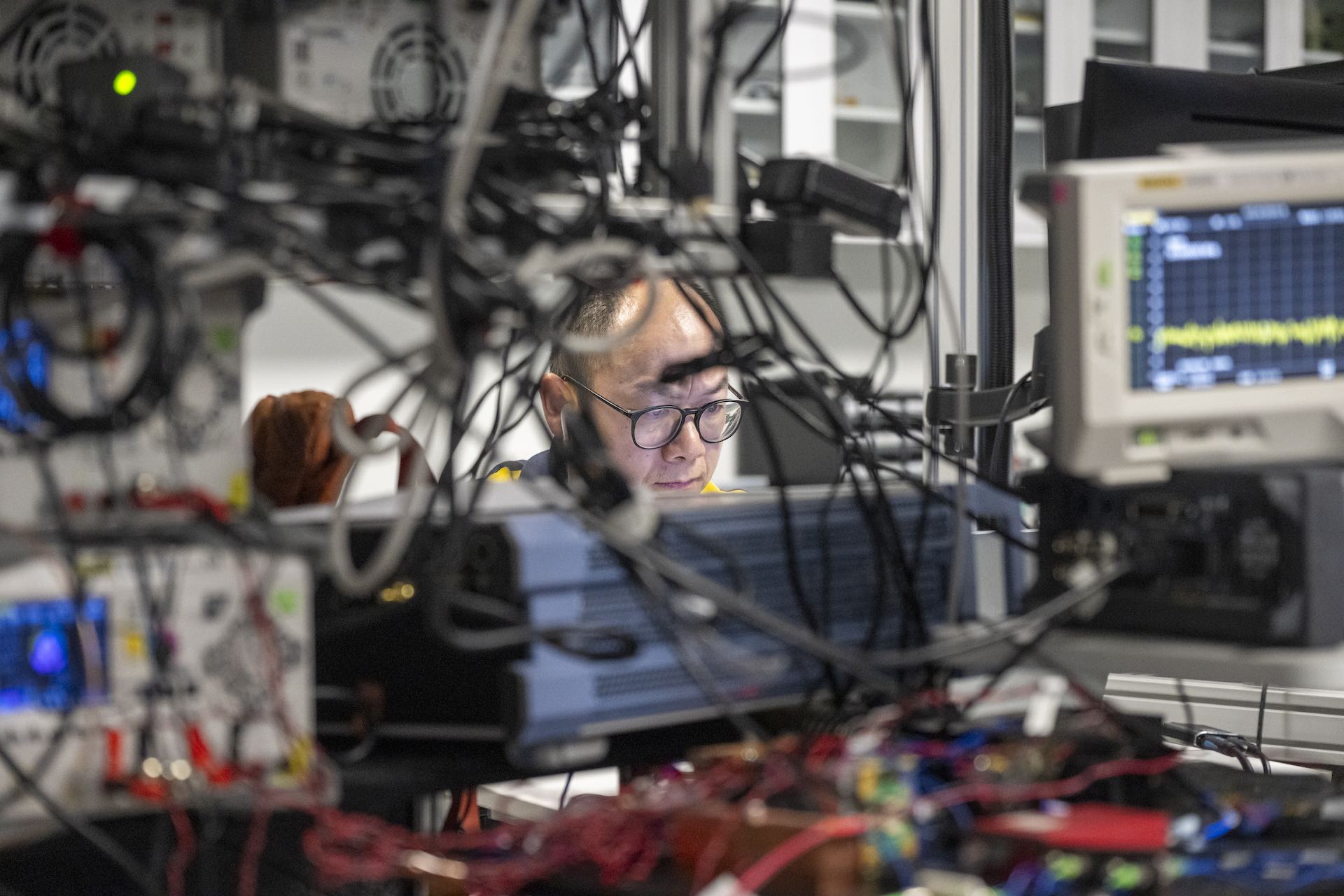
In a tan hoodie with his company logo on the breast, a few days’ growth of whiskers on his face, Marc-Antoine Lemonde is practically the stereotype of a startup chief technology officer—a job he never imagined would exist in his field as he trained for it.
Barely 10 years ago, Lemonde was finishing a doctorate in theoretical physics at McGill University. In quantum optomechanics, specifically—a field whose very name barely makes sense if your science education ended in high school.
“When I was a PhD student, there was no option for me to be on staff [at a tech company],” Lemonde says.
Talking Points
- Quantum and AI are moving so fast that some of the boldest startups have theoretical physicists on staff and put blackboard breakthroughs into practice in as little as a few weeks
- Basic science research usually gets public funding on the expectation that it’ll lead to tangible benefits—including profitable businesses—eventually, but sometimes that shift happens much faster than anybody expects
He went on to not one but two postdoctoral positions, in Austria and then Singapore. That’s the well-worn path toward a professorship.
But now Lemonde is an executive at Nord Quantique in Sherbrooke, Que., which is racing to solve the problems that stand between humanity and a functioning quantum computer. A former student, Nord Quantique co-founder Julien Camirand Lemyre, lured him back to Quebec from Asia to lead a theory team.
Quantum error correction is one of those key obstacles. The very nature of quantum computing—quantum anything—is that it deals with the smallest imaginable amounts of energy and is incredibly fragile. It’s really hard to keep it from being jarred into uselessness by, say, a stray photon. A quantum computer will have to be able to handle a certain amount of that.
Related Articles
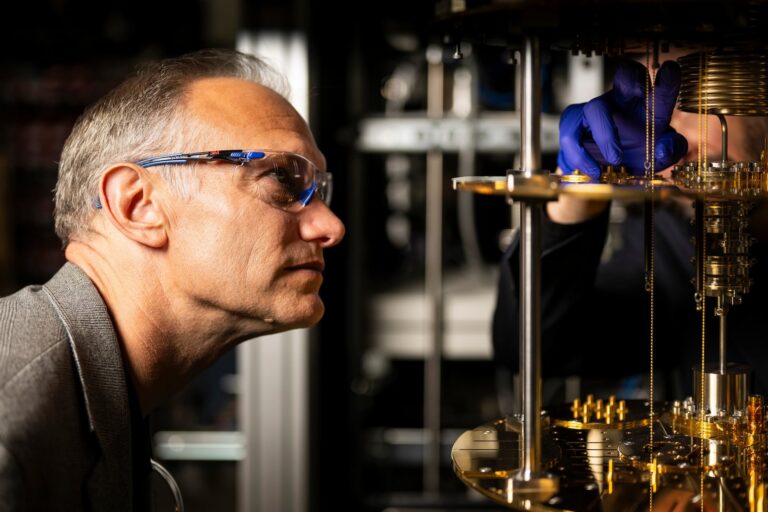
Lemonde recounts reading a theoretical paper about one approach to quantum error correction involving bosonic codes (a method that addresses, among other issues, those stray photons). He went to work on it with the company’s lead experimental physicist, racing some of the biggest firms in tech.
“We worked a bit more than 40 hours a week,” he says. “We just drove very hard, and we could make, in a couple of months, a demonstration showing quantum error correction on a single qubit that was beating, at that time, Google.”
The result is a physical component that looks a bit like a metallic USB key and can be made by ordinary machining. “You can hold it in your hand,” Lemonde says.
In this narrow but important field, the lag between blackboard and prototype has shrunk to a matter of weeks. “The gap went really small, really quick,” Lemonde says.
The possibility that there might be a practical application someday for very abstract research is the conventional argument for backing so-called foundational science. What’s happened with quantum computing suggests a different one: “someday” can arrive suddenly.
A usable quantum computer’s calculating power could lead to light-year leaps in drug development and materials science, financial and economic simulations and (worryingly) code breaking. Pharma companies and banks aren’t doing quantum research for fun.
The field of artificial intelligence went through this spectacularly. In recent memory, it was, at best, a promising niche. Then OpenAI let everyone play with ChatGPT. Even if current trillion-dollar valuations for OpenAI and Anthropic are bubbly, the technology isn’t going to vanish.
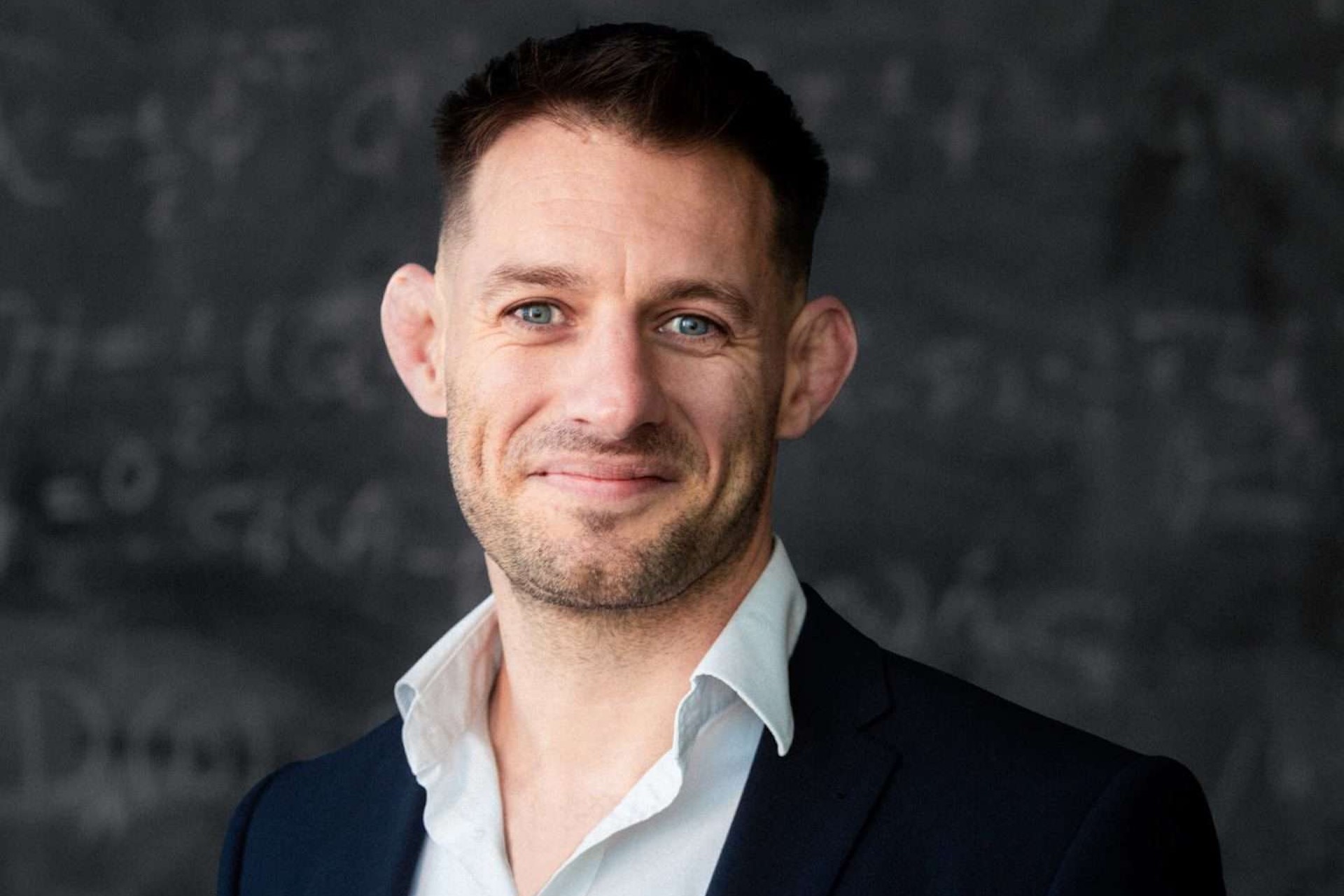
Like Lemonde, Christian Weedbrook pursued quantum physics with no real thought of going into business with it. Now he’s a chief executive and the company he founded, Xanadu, is in the race with Nord Quantique and others toward a practical quantum computer.
“I started my PhD in 2005,” he says. “There were really no quantum companies around then, so it didn’t even occur to me.”
Like Nord Quantique, Xanadu has theoretical quantum physicists on its staff, working on core problems like error correction.
“We see breakthroughs and results there monthly,” Weedbrook says. “That is a huge thing. Error correction is really the final frontier for us.”
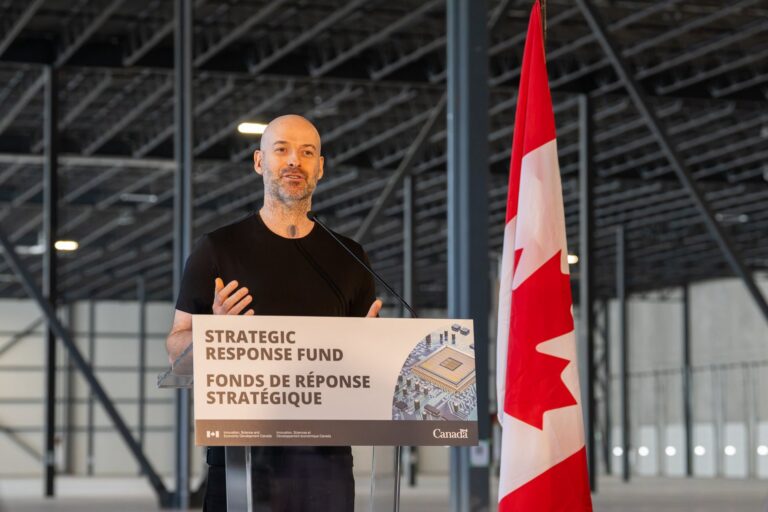
Canada’s early investment in quantum research has paid off, Weedbrook says; there’s a reason why Xanadu is based in Canada and about half its roughly 400 staff are Canadian. (Additional public funding for individual companies, including Xanadu and Nord Quantique, is also surely a factor.)
“We’ve been able to leverage the money that has gone into fundamental science,” Weedbrook says. As hard as Xanadu and others are working on commercializing quantum science, he adds, “there’ll still be breakthroughs [in] quantum computing from academia, looking at places that we don’t have the time to look at.”
At the Perimeter Institute for Theoretical Physics in Waterloo, Ont., some of the scholars might be forgiven for feeling a little envy at the speed with which someone like Lemonde gets to put an idea into practice.
Katie Mack, for instance, studies the origin and end of the universe, and phenomena like dark matter. She was a star recruit for the institute in 2022. Her research is big and important stuff, in a deep philosophical sense, but there’s nothing you could found a startup on.
“I work in theoretical cosmology. That’s a long path. That’s like 100 years,” Mack says.
Consider how long it took to find a world-changing use for a theoretical breakthrough by one of her best-known intellectual forerunners.
Global positioning systems depend on ultra-precise measurements of how long it takes radio waves to travel to receivers on Earth, like smartphones. GPS satellites move so fast and are so high up, where gravity is weaker, that the people who build them have to apply Albert Einstein’s theories of relativity to compensate. If they didn’t, the satellites’ clocks would go out of kilter almost immediately.
Einstein worked out the math by 1916; when he died in 1955, there weren’t even satellites yet. The first prototype GPS satellite went up in 1978, and it was 15 years more before the system was fully functional.
Technological history is full of these stories. The promise of usefulness in some distant cloudy future, and a more philosophical desire to find things out for their own sake, are what fund Mack’s work. Nobody’s even directly observed dark matter, so how would you conceive of commercializing ideas about it?
Mack has no complaints. She has an academic chair at Perimeter named after Stephen Hawking and funding from the Canadian Institute for Advanced Research. “I got my grant and I’m working with my students and it’s going fine,” she says.
She does worry about those young scholars, though.
Mack supervises graduate students as an adjunct professor at both the University of Waterloo and York University. She sees them struggle. “There definitely is an issue with student funding. We definitely are suffering on that,” she says.
Some head for well-paid jobs in the private sector, Mack says. An academy-to-industry pipeline is a good thing, she emphasizes, but it does mean that some potential stars don’t stay long enough to push the limits of their disciplines.
“If we want to train students to be competitive in these fields, to get that level of expertise, we need to be able to support them as students,” she says. Cuts to international student permits have hurt, too.
“Here we think a little bit different. We’re trying to solve problems more than answering interesting questions.”
The path to practical applications for Mack’s work isn’t obvious. But not long ago, theoretical quantum physics seemed just as far from commercialization. It can change in a moment.
“In the nature of what we do, it’s impossible to predict that,” says Marcela Carena, the Perimeter Institute’s executive director and a theoretical particle physicist. She has seen it happen herself, though, when discoveries at the extreme edges of disparate-seeming fields overlap in surprising ways.
Think of what you could learn from a library of books. Each book has words in it that convey knowledge, but there’s also meaning in how the books are arranged—which ones are shelved together and which are far apart, which shelves are overflowing and which are sparse—that you wouldn’t get from just reading all the books themselves.
Quantum computing uses both local and global storage, both the contents of the books and how they’re stored, and applying both principles together might be a way to solve the error-correction problem.
Carena says the same idea has applications in AI chatbots. Those generate language by predicting what should come next based on the words that have come before—in essence, they’re trained only by reading the books in the library.
“They learn piece by piece, predicting each part from its neighbour,” Carena says. “If information is stored globally, it’s very hard for these AI chatbots to learn information.”
They have trouble when context is as important to a message as its plain content. Try using sarcasm on ChatGPT or Claude and see how well it understands what you really mean.
Finding these crossover points and trying to apply insights from one field to others is part of the point of piling all these theoretical physicists into one institute. “This doesn’t ship a product, but it’s exactly what foundational physics does,” Carena says. “It can be revolutionary.”
In his job as Nord Quantique’s CTO, Lemonde is trying mightily to combine the theoretical and experimental and produce something practical. He is trying to ship a product.
“When a new person comes in and I do the onboarding of a post-doc or a PhD student, I’m like, ‘Here we think a little bit different. We’re trying to solve problems more than answering interesting questions,’” he says.
But he believes fundamental and goal-oriented research enrich each other.
That’s how you get from a paper on bosonic codes to a device that puts the paper’s insights to work in a couple of months, he says. “There’s a lot of magic happening.”