Listen Now
0:00
OTTAWA — The federal government has wildly overshot the mark as it’s tried to reduce the number of foreign students entering Canada, auditor general Karen Hogan reported Monday.
And it’s in danger of setting up its new system for paying public servants to fail the way the last one did, her office found in a separate audit.
Fewer applicants and shrinking approval rates
Hogan’s report on study permits for students from abroad puts numbers on a problem Canadian colleges and universities have been blaring warnings about for many months: collapsing international enrolments are wrecking their finances and suggest that Canada is repelling the globe’s best brains.
Related Articles


In early 2024, then-immigration minister Marc Miller cut study permits, saying he was targeting shady schools that weren’t delivering real education. The government still expected to admit hundreds of thousands of foreign students a year.
Instead, in the first nine months of 2025, the Immigration Department approved just 50,370 applicants.
The audit report said about 26,000 applications were in the department’s pipe at that point, but even if every one of those was approved, admissions would be far short of the department’s target of 255,360.
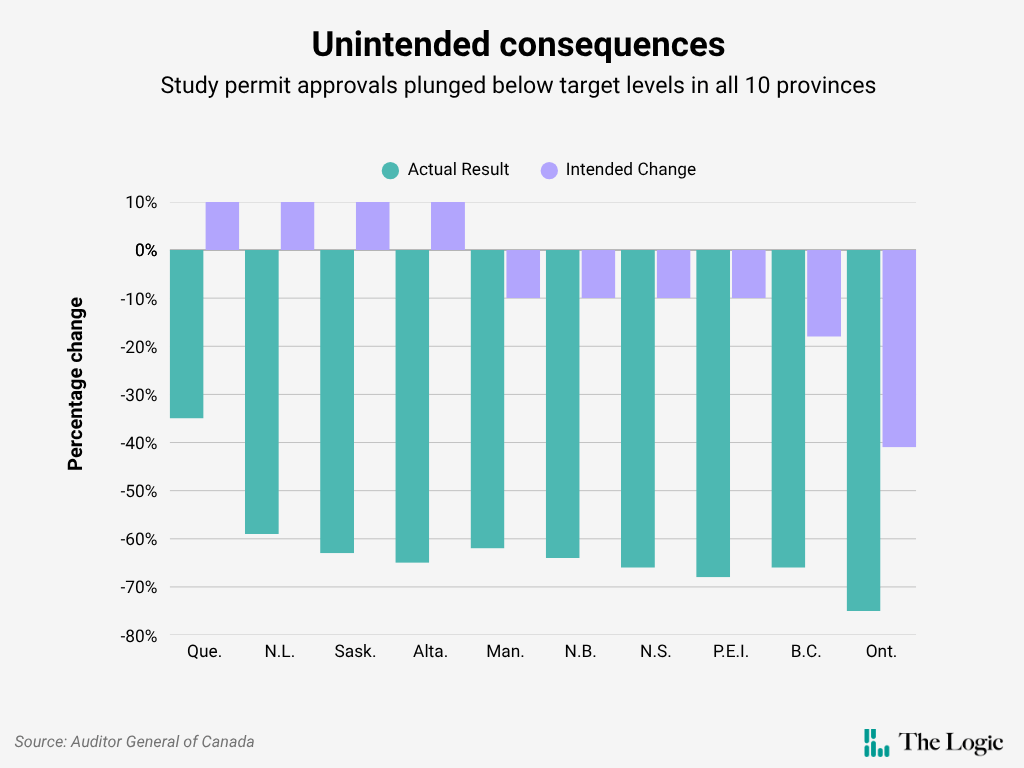
Besides getting far fewer applications for student spots, the Immigration Department is approving fewer of the ones it gets, the audit report said. Approval rates went from 58 per cent in 2023, to 41 per cent in 2024, to 38 per cent in 2025 (as of September).
The reasons are a mystery even to the people handling the applications: “We found that the department did not know why its approval rates were lower than projected,” the report said. The auditors found that stricter paperwork checks and tougher financial requirements weren’t factors.
Not enough yet, says minister
Immigration Minister Lena Metlege Diab said the government is in fact trying to push the number of foreign students and temporary workers down further, to curb growth, ease pressure on housing and strengthen oversight in the system.
“The measures are working, but more can be done,” she said in a statement on Monday.
Provinces oversee education systems and are responsible for using their allotted quotas of students, she said. Schools need to recruit, and factors like housing also matter, she said.
Few investigations
The auditors also warned that the Immigration Department hasn’t followed up on assessments suggesting some people had been admitted to Canada with fraudulent applications. Three internal reports they looked at found 800 successful applicants with bogus material in their paperwork—710 of them claimed to have gone to overseas schools that didn’t exist or sold fake credentials.
“We found that the department did not consider acting in any of the 800 cases,” the audit report said. Of those people, 105 were approved for permanent residency.
The department is funded to look into about 2,000 cases a year where students are suspected of violating the terms of their permits; the auditors found more than 153,000 students were flagged by their own schools as potentially non-compliant in 2023 and 2024.
New pay system
The auditor also found the government had failed to learn from mistakes that contributed to the multibillion-dollar Phoenix pay system debacle, which led to some public servants being overpaid, others underpaid, and some not paid at all.
Ottawa is now working on replacing IBM’s decade-old Phoenix platform with a new system, Dayforce, at an estimated cost of about $4.2 billion—though the auditor expects the real cost will be higher. It’s a massive undertaking, not least because the federal government’s pay structure is notoriously complicated.
Among the lessons the government was supposed to have learned: the need to standardize and simplify pay rules before bringing in a new system. Collective agreements with retroactive pay, temporary salary bumps for people who fill in for high-level positions and a host of other customizations required manual workarounds, which only made delays and errors worse. All told, the government must accommodate 150 different collective agreements across more than 100 government departments and agencies.
Already making compromises
The auditor found most of those anomalies still exist, in part because the government hasn’t agreed with public-sector unions on how simpler rules should work. As a result, the government is asking for tweaks and options to Dayforce similar to those that helped derail Phoenix. The Procurement Department requested three customizations, called “cloud extensions,” to help the platform work even if the complicated rules stay in place, at an extra cost of $4 million per year.
Meanwhile, the government is still dealing with the backlog of pay issues caused by Phoenix. As of Sept. 30, there were 233,653 cases still to be addressed, and 155,217 of those had languished for more than a year. The auditor said by the time she finished her investigation, it did not look like the government was going to meet its goal of clearing that backlog before March 2026.
If those backlogs aren’t cleared before the new platform comes online, Hogan warned, the government risks undermining the system before it even starts.