Not long after the Dallas Mavericks beat the Minnesota Timberwolves to clinch a spot in the NBA Finals, star guard Luka Doncic joined the television crew on the in-arena set.
The usual post-game banter followed, and then Charles Barkley, a fixture on Turner Sports’ NBA broadcasts for more than two decades, told Doncic to enjoy the finals. “We’re going to miss you,” Barkley said. “We’re done after tonight.”
Talking Points
- The NHL’s next national broadcast package for Canada could upend decades of tradition, as new entrants like streaming services push aside incumbent players
- Recent deals in other sports suggest agreements like the exclusive 12-year pact the NHL reached in 2013 with Rogers are things of the past
- The CBC’s ability to participate is in doubt, as it’s gone a decade without revenue from “Hockey Night in Canada” games it airs under the terms of the Rogers deal
Doncic was responding with a popular sentiment among basketball fans after reports that Turner will not be part of the NBA’s next national television contract, which begins after next season. That could mean the end of Inside the NBA, Turner’s signature panel featuring former players Barkley, Kenny Smith and Shaquille O’Neal and hosted by Ernie Johnson. “You ain’t done yet,” Doncic said. “We’ve got to figure out something.”
That the NBA television landscape wouldn’t include the beloved Inside the NBA group would have been unimaginable until recently, as Turner and Disney-owned ESPN have been the two pillars of the league’s national broadcasts for decades. But new players have arrived in the form of Amazon, which has reportedly bought part of the NBA’s broadcast package for its Prime Video streaming service; and Comcast, which would broadcast games on NBC and Peacock, its own streaming service. Disney would retain a package for its ABC network and ESPN cable channel, but pay more for fewer games. While the league has said nothing is finalized, multiple outlets have reported the same framework of a deal worth US$76 billion that has been called a “defining moment for media and sports.”
Canadians will likely see a similar tectonic shift in the sports television landscape play out at home when the National Hockey League determines its next national broadcast package for this country—the current one expires in two years—potentially ending more than 70 years of tradition. New entrants in the form of streaming services are emerging, while existing partners may not want to match the inflated prices the new bidders could bring. And, as with Inside the NBA, a well-established brand could be at risk. In the case of “Hockey Night in Canada,” it’s been a mainstay on Canadian televisions since the early 1950s.
Streaming services are not just a potential future partner of the NHL in Canada, they’ve already arrived. This spring, Rogers Communications announced it had sold the Monday night portion of its national broadcast package to Amazon for the next two seasons, beginning in October. The games, which do not include the Stanley Cup playoffs, will be the first hockey games on Prime Video, after it became the U.S. home of the NFL’s Thursday Night Football broadcasts in 2022.
Richard Deitsch, who hosts the Sports Media podcast, says that in recent years the streaming services have generally started small with their live-sports broadcasts before expanding.
“I think Amazon would be a significant player for the upcoming Canadian NHL rights,” says Deitsch, who also writes about sports media for The Athletic and formerly worked on-air for Sportsnet. “It doesn’t mean it’s definitely going to happen, but I think they’re not investing in this unless they’re serious about it heading forward.”
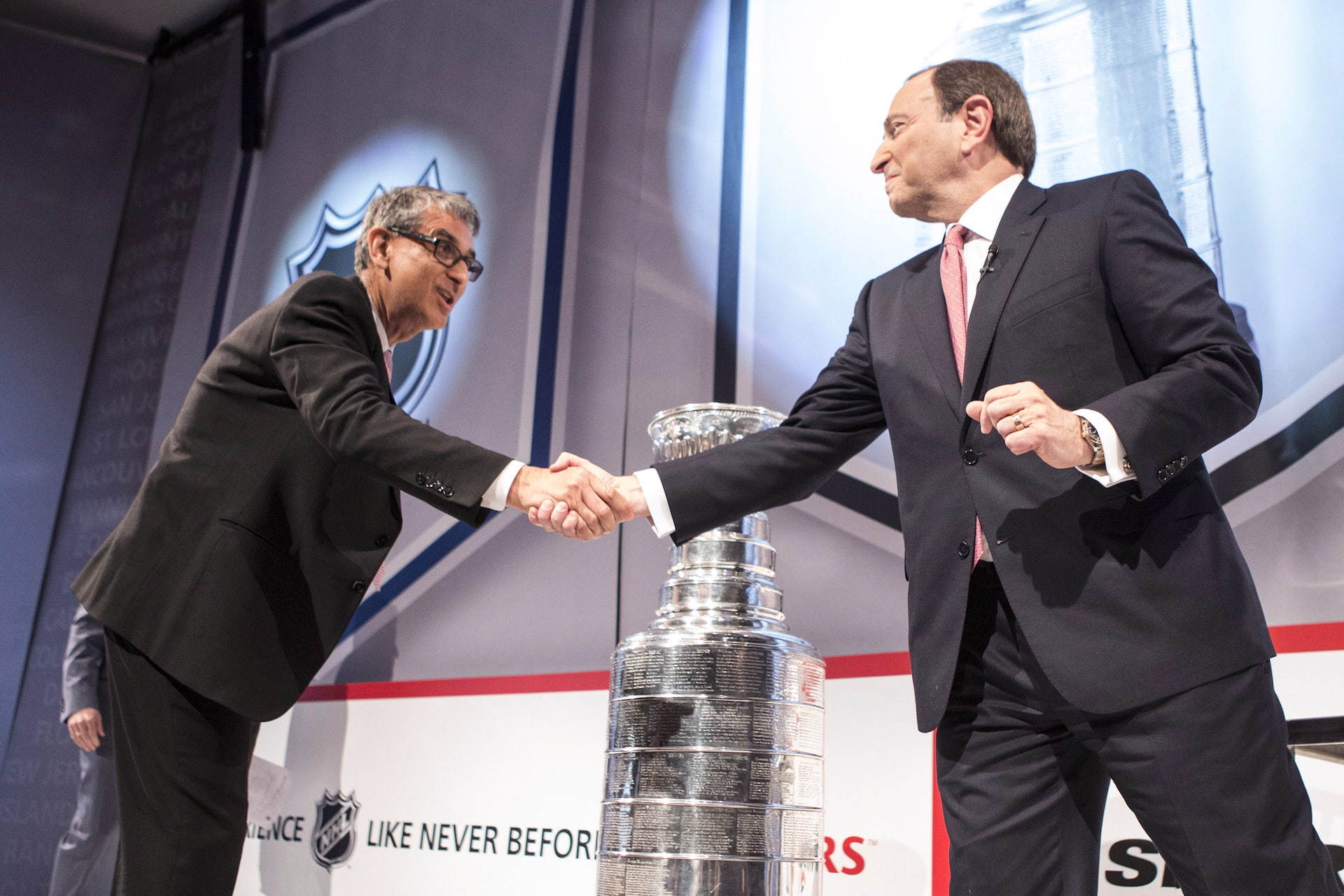
The last NHL deal for Canada was also a sea change, but in a different way. In 2013, Rogers shocked its competitors by scooping up the entire NHL national package in a 12-year, $5-billion deal that left long-time NHL partners TSN and the CBC out of the picture. Rogers subsequently agreed to sub-license part of its package to the CBC, in an unusual deal in which Rogers produces and owns the broadcasts but uses the public broadcaster’s airwaves. That move kept “Hockey Night in Canada,” which began when the CBC launched its television network in 1952, alive as a Saturday night staple, even if it was no longer a CBC production. (Rogers also sold all its national French-language rights to TVA Sports in Quebec.)
NHL Commissioner Gary Bettman, right, and then-Rogers CEO Nadir Mohamed at the November 2013 announcement of a deal giving Rogers national broadcast rights to NHL games. Photo: The Canadian Press/Chris Young
Outsiders have long speculated that Rogers has lost money on its NHL deal, particularly since Canada’s seven NHL teams, most notably the Toronto Maple Leafs, have failed to go on extended playoff runs in the nine seasons before this one. An audience of more than five million viewers watched Toronto lose to Boston in Game 7 of the first round last month; in the following round, a Game 7 between two Canadian teams, Vancouver and Edmonton, drew only 3.2 million. Edmonton’s charge to the Stanley Cup final this season should both increase ratings in Canada over recent years, but also serve as an example of what Rogers has missed.
John Shannon, a former Rogers on-air personality and executive producer of “Hockey Night in Canada” on CBC, says the Rogers-NHL deal meant more to the communications firm than just TV ratings, pointing to all the branding that was on show in that Vancouver-Edmonton series.
“That round of the playoffs was Rogers Arena versus Rogers Place on ‘Hockey Night in Canada’ brought to you by Rogers,” says Shannon, now the co-host of the Bob McCown Podcast. “I think those things matter corporately.”
A spokesperson for Rogers Communications said the company “plans to pursue a renewal of its rights to broadcast NHL games,” and referred The Logic to recent public comments from chief executive Tony Staffieri.
“That round of the playoffs was Rogers Arena versus Rogers Place on ‘Hockey Night in Canada’ brought to you by Rogers. Those things matter, corporately.”
In May, the CEO told a Toronto business audience that the next NHL contract is “something we’re very interested in and something we will chase and certainly expect to be at the table.” But Staffieri declined to say whether they would pursue the entire package or look to partner with a streaming service like Amazon. “We’ve got a ways to go before I can answer that,” he told a Canadian Club luncheon.
The shift to streaming, though, is something for which traditional broadcasters are prepared. Rogers this week announced multi-year deals with NBCUniversal and Warner Bros. Discovery to be the Canadian home of television brands including Bravo, HGTV and the Food Network. The company said it would bring such content to viewers “on their platform of choice” and that the deals showed Rogers “can compete with foreign streamers.”
Deitsch doesn’t expect Rogers to try to go it alone again in an NHL deal, especially as it has cut costs across its TV and radio operations in recent years.
“The trend with all this stuff is to have multiple media-rights partners for major leagues,” he says. The NFL has added Amazon and Netflix to its traditional linear-network partners, CBS, Fox and ESPN. The NHL’s last U.S. deal moved from one partner in NBC to ESPN and Turner Sports. “And so it would not surprise me at all if the NHL has some kind of deal where it’s split up between, you know, a streamer, maybe two streamers and two traditional linear networks,” Deitsch says.
By the end of Rogers’s deal with the NHL, an estimated 50 per cent of Canadian households will not have a cable or satellite TV subscription. The year it was announced, 86 per cent did.
Such an arrangement could prove difficult for the CBC, which has now gone a decade without the significant revenue brought in by “Hockey Night in Canada” and could face a budget crunch if Pierre Poilievre’s Conservatives win the next federal election. Shannon notes that the CBC’s value to Rogers when the last deal was struck was its presence in any Canadian home with a television, but with the changing way television is consumed, that may not mean as much.
Brahm Eiley, president of Convergence Research, says his firm estimates that by the end of the current NHL deal in 2026, half of Canadian households will not have a paid television subscription with a cable or satellite provider, down from 58 per cent at the end of last year. (The year before the deal was announced, a CRTC report pegged the percentage of Canadian households with such a subscription at 86 per cent.) “That being said, the majority of traditional TV viewers watch sports, so we would not discount this audience too soon,” Eiley says.
Those trends raise questions over whether CBC’s linear reach, and “Hockey Night in Canada,” would be a necessary part of the NHL’s next equation.
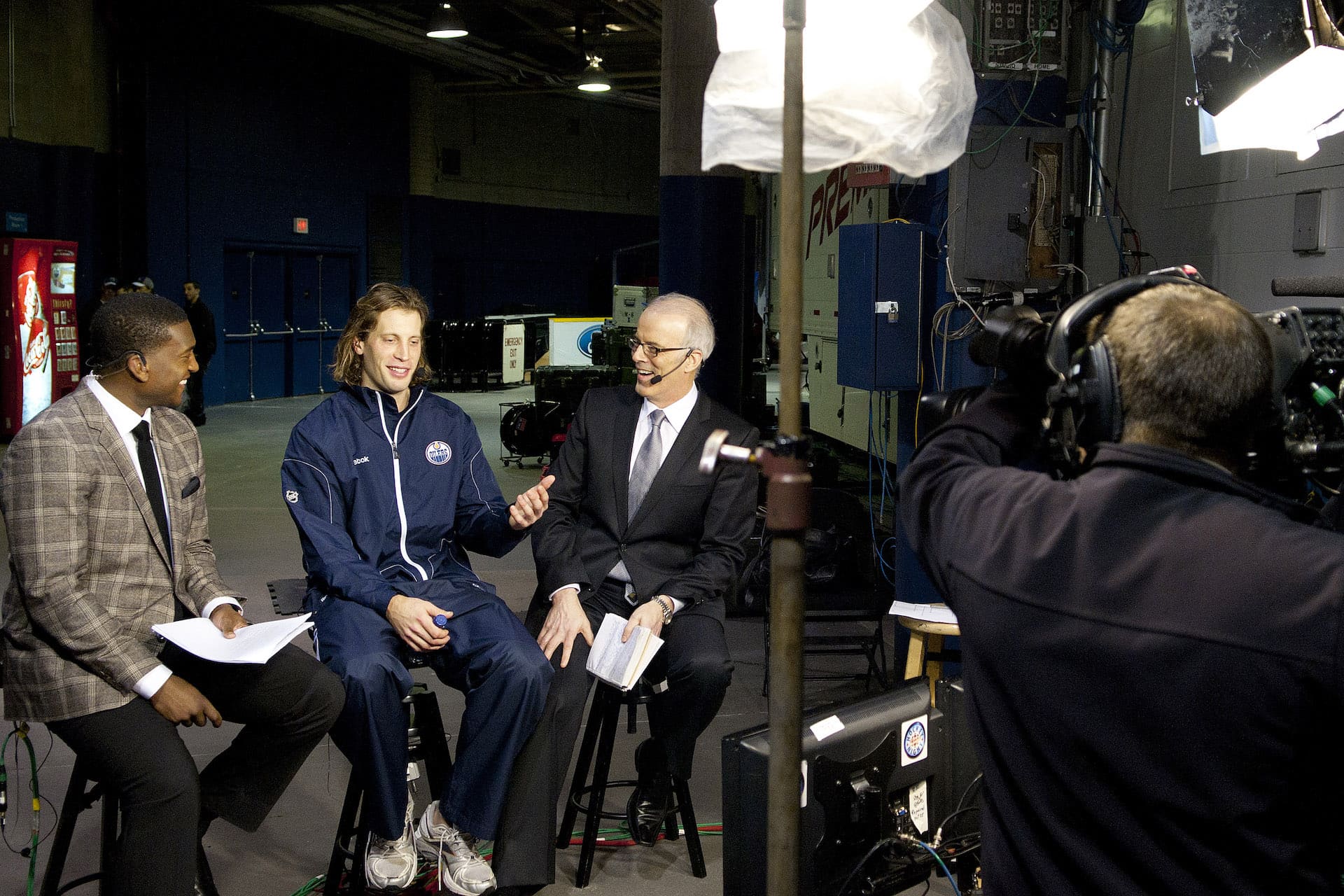
Kevin Weekes, left, and Scott Oake of "Hockey Night in Canada" interview Oilers defenceman Tom Gilbert at Rexall Place in Edmonton, in January 2011. Photo: Getty Images/NHL/Dylan Lynch
“Do I think there’s going to be national games on Saturday nights and a doubleheader? Yeah, I do,” Shannon says. “But is the first game of the doubleheader going to be on Rogers and the second game of the doubleheader gonna be on Bell, or is it going to be on Amazon? I don’t think we know. I think everything’s up for grabs.”
Asked if the CBC hopes that “Hockey Night in Canada” can continue in some form as part of the next NHL deal, spokesman Chuck Thompson declined to speculate. “Through a great partnership with Sportsnet that extends to the end of their current agreement with the NHL, CBC is happy to be in a position to carry regular season games on Saturday nights and all four rounds of the playoffs,” Thompson said. “It’s a privilege.”
It’s a privilege that is currently time-limited. Will there be a place at the NHL table for the CBC two years from now? Will too many other bidders squeeze them out?
Deitsch says that even though sports rights are moving inexorably toward streaming, he hopes the next NHL deal will keep some games on the services where Canadians are used to finding them. “Anybody who’s buying that product knows how important it is to people watching.”
A potential window into the future arrived at the end of the NHL’s third playoff round earlier this month, when the Edmonton Oilers beat the Dallas Stars to advance to the Stanley Cup final. Scheduling conflicts meant the CBC could not broadcast some of the games, leaving them only on Rogers’ Sportsnet, which requires a subscription. Critics, including Conservative MPs, blasted the public broadcaster for not airing the hockey playoffs. One newspaper headline said the CBC had “failed a nation.”
That opprobrium came when the CBC was just without a couple of NHL playoff games. It’s fair to wonder what the reaction would be if it didn’t have any.