At the 2018 Winter Olympics in Pyeongchang, South Korea, a couple of Canadian visitors sat at a restaurant table in the quiet mountain town.
It became apparent that much of the Korean clientele was distracted by something. There was a strange vibe to the place, with gasps and cheers occasionally breaking out, the kind you might hear in a sports bar, except the place didn’t have any televisions.
The Canadians eventually figured it out. It was curling. The locals were watching the South Korean women’s team, which would go on to win Olympic silver, livestreaming it on their phones. They were living and dying with every rock.
“That is a great story,” says Nic Sulsky, years later, when it is relayed to him over the phone. “That’s fucking amazing.”
Talking Points
- A group comprised of businesspeople and former athletes recently announced it has purchased the Grand Slam of Curling, a made-for-TV tour of elite teams that Rogers Media acquired in 2012
- The Curling Group aims to integrate a niche game cherished by Canadians into the modern sports ecosystem driven by streaming and legalized gambling. It will start by ramping up the real-time data gathering and odds-making now common in other pro sports.
He has good reason to be pleased by an anecdote about curling’s global reach. Sulsky is the chief executive of the Curling Group, a new entity that last month announced the purchase of the Grand Slam of Curling and has ambitious expansion plans for the series.
“One of our priorities is absolutely to bring the Grand Slam of Curling to curling fans all over the world,” Sulsky says.
It’s an unusual purchase, with a company formed for the purpose of taking over an existing sports property, but it might also be a deal of the future. A changing broadcast landscape, the rise of digital services with content libraries to fill and the explosion of legalized gambling in North America mean that niche sports properties could have significant room to grow. That’s the bet that Sulsky and partners are making, anyway. As it happens, he has experience with making wagers.
The Grand Slam was born out of a dispute almost 25 years ago between the best men’s curlers in Canada and the sport’s national governing body over issues such as the schedule and compensation. The made-for-TV tour of elite teams had been owned since 2012 by Rogers Media, which broadcasts its events on its Sportsnet properties.
Sulsky, in his former role as the chief commercial officer of PointsBet, a legal sportsbook, knew curling from that company’s partnership with Curling Canada. He was talking to some Rogers people last summer about the Grand Slam of Curling and, as he puts it, just asked the question: “‘Could the Grand Slam of Curling be acquired? Like, could you sell it?’” Sulsky says. “And they said, ‘That’s a really interesting question’.”
From left to right: Players at the WFG Masters in December 2023; Chinami Yoshida, a player on Team Fujisawa from Japan, at the Co-op Canadian Open in January 2024; The Princess Auto Players’ Championship at Toronto’s Mattamy Athletic Centre in April 2024. Photo: Grand Slam of Curling/Anil Mungal
One that eventually brought the sale announced last month. Rogers and Sportsnet will remain the exclusive broadcaster of the Grand Slams in Canada, but Sulsky and team, which includes gaming executive Mike Cotton; former NFL player Jared Allen; and a pair of Olympic curling gold medallists in Jennifer Jones and John Morris, will try to take the property global.
“The best way to do that is through creating relationships with both broadcast and digital sports distributors all around the world,” Sulsky says.
It’s a rapidly changing environment. In addition to linear broadcasters with sports-only channels around the world, a host of sports-heavy digital streaming services have launched in recent years, like Dazn and FuboTV. Canadian viewers might know those as the homes of Premier League and Champions League soccer in this country, but they have all kinds of niche programming: darts, surfing, sumo wrestling, poker and even bare-knuckle fighting. ESPN, Fox and Warner Bros. Discovery also announced plans for a streaming-only sports giant in February.
“Innovation and technology has provided not just curling but a lot of new sports with the opportunity to get wider distribution,” Sulsky says.
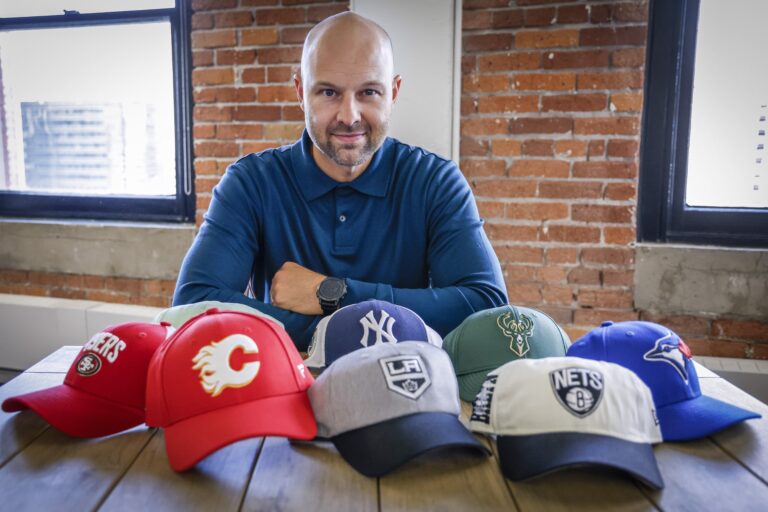
Sulsky says a lack of real-time data means sports fans don’t often bet on curling—something he and his group plan to change. Photo: Cole Burston for The Logic
He calls curling an “Olympic sport that blows up every four years” outside of Canada. “So there is global interest in the sport. We don’t have to explain to people what curling is,” he says. “People have heard about curling regardless of whether they understand the rules or know the ins and outs.”
What people do not do, at least not much, is bet on curling.
“There’s no gambling on curling, because there’s no data,” Sulsky says.
No gambling isn’t strictly accurate. Legal sportsbooks, whether government-run in most provinces or those in Ontario’s open, regulated market, do take wagers on major curling events, but they are limited to the “core” markets: pre-match money lines, totals, point spreads. But curling is a high-event sport, with 16 rocks thrown in each of 10 ends (or eight, for Grand Slam games). There is the potential for a steep increase in betting markets, a veritable parlay bonanza, which is where data comes in.
“Sportsbooks need real-time data,” Sulsky explains. “There’s no actual data and odds projections for a sports-betting operator to integrate and leverage.”
That sets curling apart from professional leagues like the NHL and NFL, which had such things in place long before sports betting was legalized in the United States and Canada—think of the data that feeds sports tickers, scoring apps or fantasy sites. The Curling Group plans to partner with a third-party provider that would build that out.
Given that the Grand Slams were once formed out of a power tussle between curlers and the sport’s governing body, one might expect Curling Canada to be regarding these developments with unease. But, no.
“I was excited for the idea,” says Nolan Thiessen, chief executive of Curling Canada. “And I was excited for the athletes.”
Where Curling Canada are the stewards of the grassroots, amateur side of the sport, Thiessen sees an opportunity for someone else to foster what he calls “the advanced professionalization” of the game. “Creating a space where it’s aspirational for athletes to want to play, that’s a good thing,” he says. While an elite few curlers in Canada, primarily those who receive funding through the country’s high-performance program, can treat the sport as a full-time job, an expanded professional tour could mean more curlers would not have to work other jobs when they’re not training and playing. “That can be beneficial to us,” Thiessen says.
As for the potential increase in gambling, Thiessen says the organization is aware of both its importance to the growth of the sport and the risks it brings.
“The biggest thing with sports is that you have to have a reason to care,” he says. “And if someone’s got five bucks down, it’s a reason to care.
“But the flip side of the coin is not one we are going to ignore.”
Curling Canada has a match-manipulation policy, and its elite curlers are not allowed to bet on the sport or have others bet on their behalf. Sanctions for such breaches would be determined by a disciplinary panel.
Where Thiessen and Sulsky are in particular agreement is in the potential for curlers to benefit from an expanded, international Grand Slam series.
Many of the best in the sport are “charismatic, relatable, fun, smart, attractive, elite athletes,” says Sulsky, adding, “That, to me, screams opportunity.”
“These people are so marketable. And it shouldn’t be just Brad Gushue in one Montana’s commercial,” he says.
The Grand Slam schedule for 2024–25 will continue as planned before the sale. It begins in October in Charlottetown. Sulsky says changes will already be evident.
“I’m not a caretaker,” he says.