
Listen Now
0:00
Everybody wants in on the data-centre business. The tech industry’s insatiable appetite for processing power for its AI ambitions is driving a boom in the construction of AI infrastructure.
Canada wants in, too, with policymakers touting their provinces as the place to build and businesses racing to secure the land, energy and financing for increasingly large data-centre projects. Still, talking points and proposals aren’t infrastructure.
So The Logic set out to find all the data centres operating in Canada, and the ones that are still in the works. We parsed public and private databases, regulatory filings and a lot of corporate hyperbole to figure out what’s actually happening on the ground, and what’s just speculation.
We found 309 data centres in total, mostly clustered in Canada’s major urban centres and power-generating regions. Many are legacy facilities, set up to store data for software firms or connect telecom networks. There are also big, obvious signs of the AI boom.
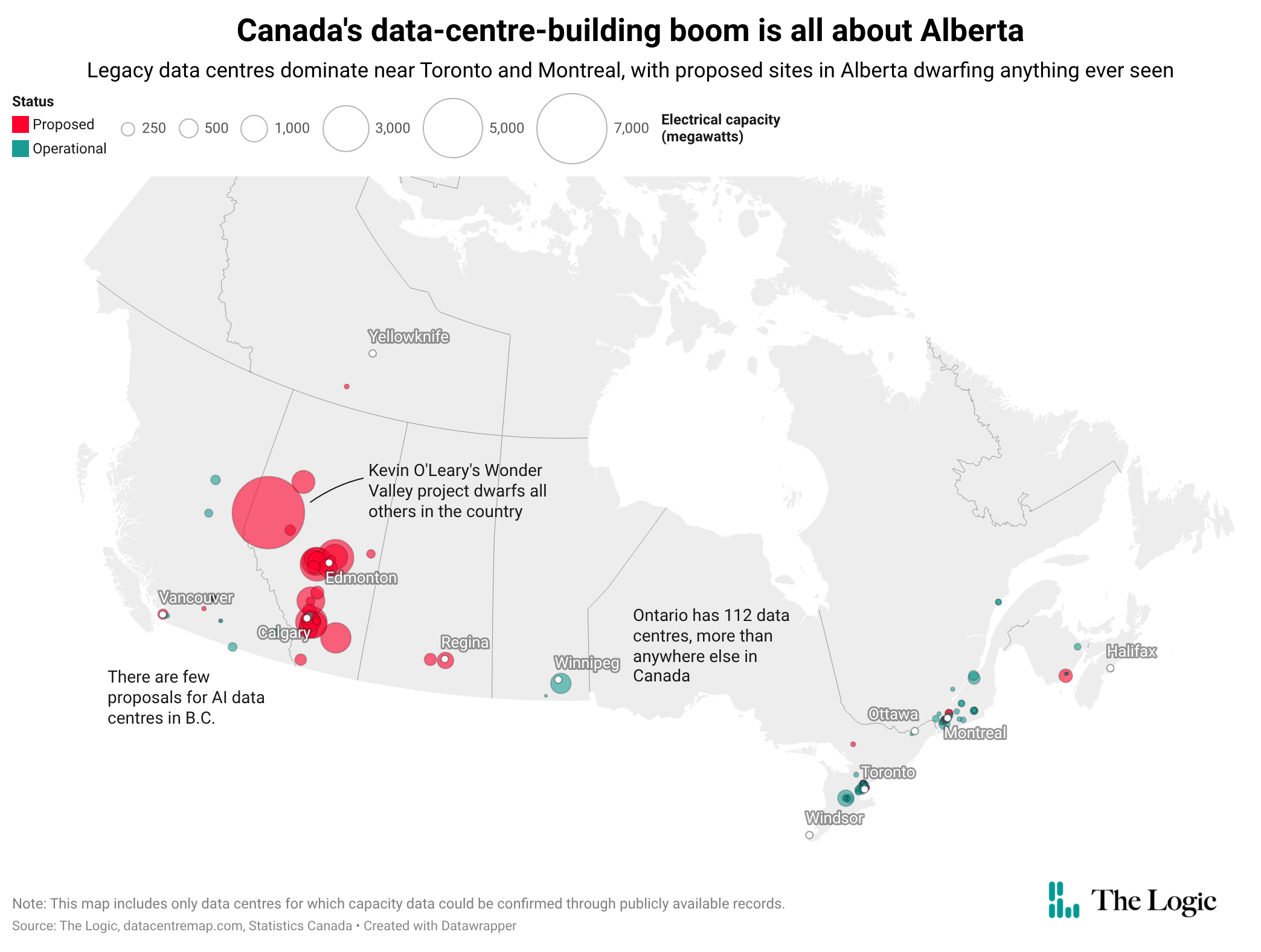
Many of the proposed AI data centres in Canada are gargantuan in scale. AI systems process a lot more information than regular applications, so the data centres built to train and run them tend to be a lot larger. Proposals for new AI-focused facilities tend to measure their capacity in the hundreds of megawatts or even gigawatts, compared to single- or double-digit megawatts for existing facilities. That’s also why energy availability and grid health have become such hot topics among local communities and policymakers.
Talking Points
- Many of the proposed AI data centres in Canada are gargantuan in scale. While legacy data centres near Toronto and Montreal count their capacities in megawatts, proposed sites in Alberta are would be hundreds of megawatts or even gigawatts in scale
- Not every province of Canada can or will be an AI powerhouse. Atlantic Canada and the Prairies don’t yet have the local demand to justify major data centres, while the North presents major logistical barriers to constructing data centres at scale.
AI data centres can cost between $19.5 million to $33.5 million per megawatt, with most of that down to buying IT equipment, according to an October 2025 analysis by the federal innovation department. Specialized chips, in particular, are a huge expense.
“Conventional data centres remain important, but the proliferation of AI has made AI data centres key pieces of digital infrastructure, with countries investing heavily,” the innovation department analysis stated. “Countries that build AI data centres in the near-term are more likely to remain competitive in the global AI ecosystem.”
Many policymakers talk about AI infrastructure and local AI benefits as if they’re linked—you build one to boost the other. Yet it’s rarely that cut and dry. The provinces are taking different approaches to the data-centre opportunity. Alberta has natural gas to burn, while Quebec is planning new dams to boost its hydro power supply. Both provinces are courting data-centre developers, but they’ve also imposed limits and higher fees on the electricity flowing to new facilities. Bell wants to turn British Columbia’s hydro power into AI power, but the province plans to make new facilities compete for energy capacity.
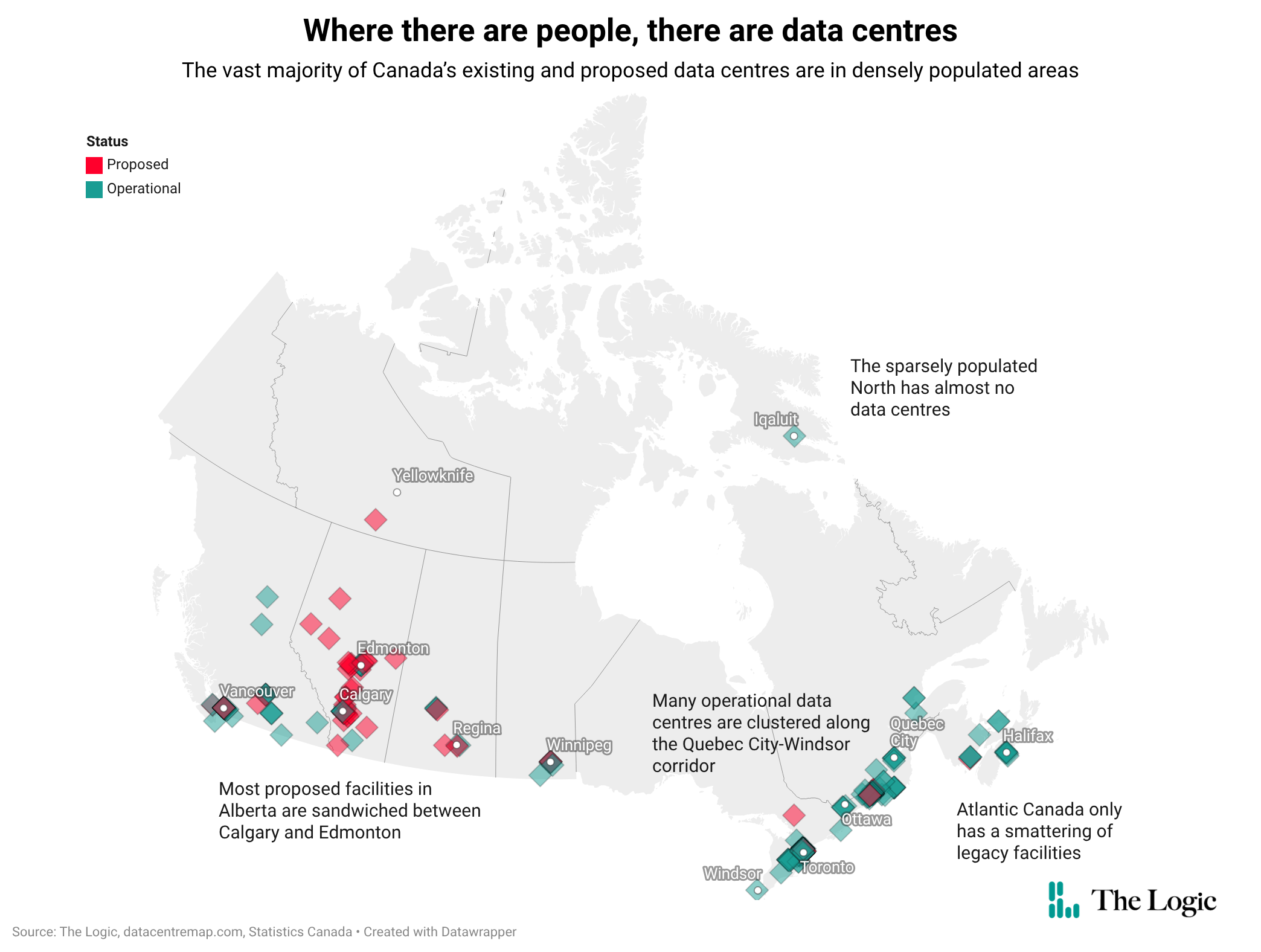
Not every province can be an AI powerhouse. Atlantic Canada and the Prairies don’t yet have the local demand to justify major data centres, and don’t have as many researchers and startups as Canada’s major tech hubs.
Related Articles
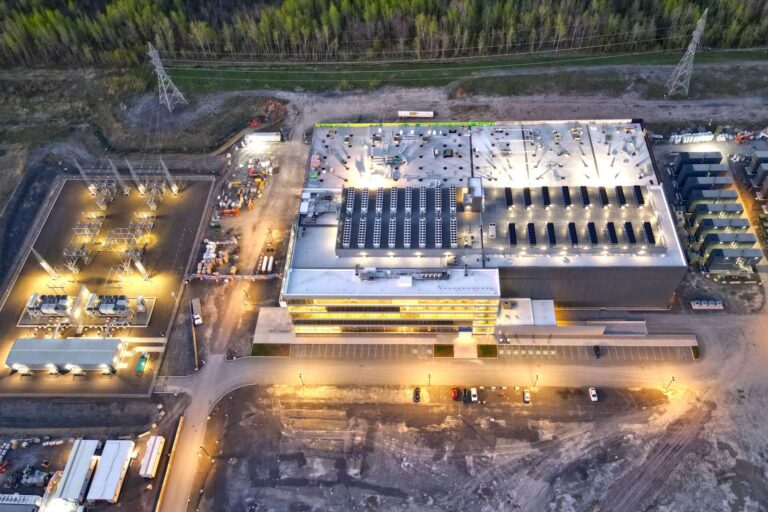
Big projects, wherever in the country they’re located, come with big risks. Institutional investors, celebrity deal makers and new entrants have proposed a host of data centres totalling gigawatts of capacity. Few have yet announced which clients will use them. Such facilities only really get financed when they have an investment-grade client—a threshold very few tech companies meet—and are generally constructed and designed to the specifications of their tenants.
Energy, not climate, is the advantage—and the constraint. Starting in early 2024, then-finance minister Chrystia Freeland and then-prime minister Justin Trudeau touted Canada’s cold climate as a strategic advantage for the AI building boom. It’s true that data centres get very hot. But the places that are coldest in Canada are in the North, and the country has yet to get reliable broadband or power to those regions.
A bigger advantage is the ability to access cheap, reliable energy. That’s why local power policy will be the real make-or-break factor for Canada’s data-centre ambitions. – Murad Hemmadi
Alberta
Alberta’s aggressive pitch to become a global leader in AI data centres has drawn vastly more interest than the province can handle. The Alberta Electricity System Operator (AESO), the agency overseeing its electrical grid, reported last September that it had 33 proposals, totalling about 20.7 gigawatts worth of power consumption, in hand.
Many of those, in the agency’s view, were half-baked—just 15, or 4.8 gigawatts’ worth, were really viable, it judged. In the end, the AESO signed off on three projects, totalling 1.2 gigawatts.
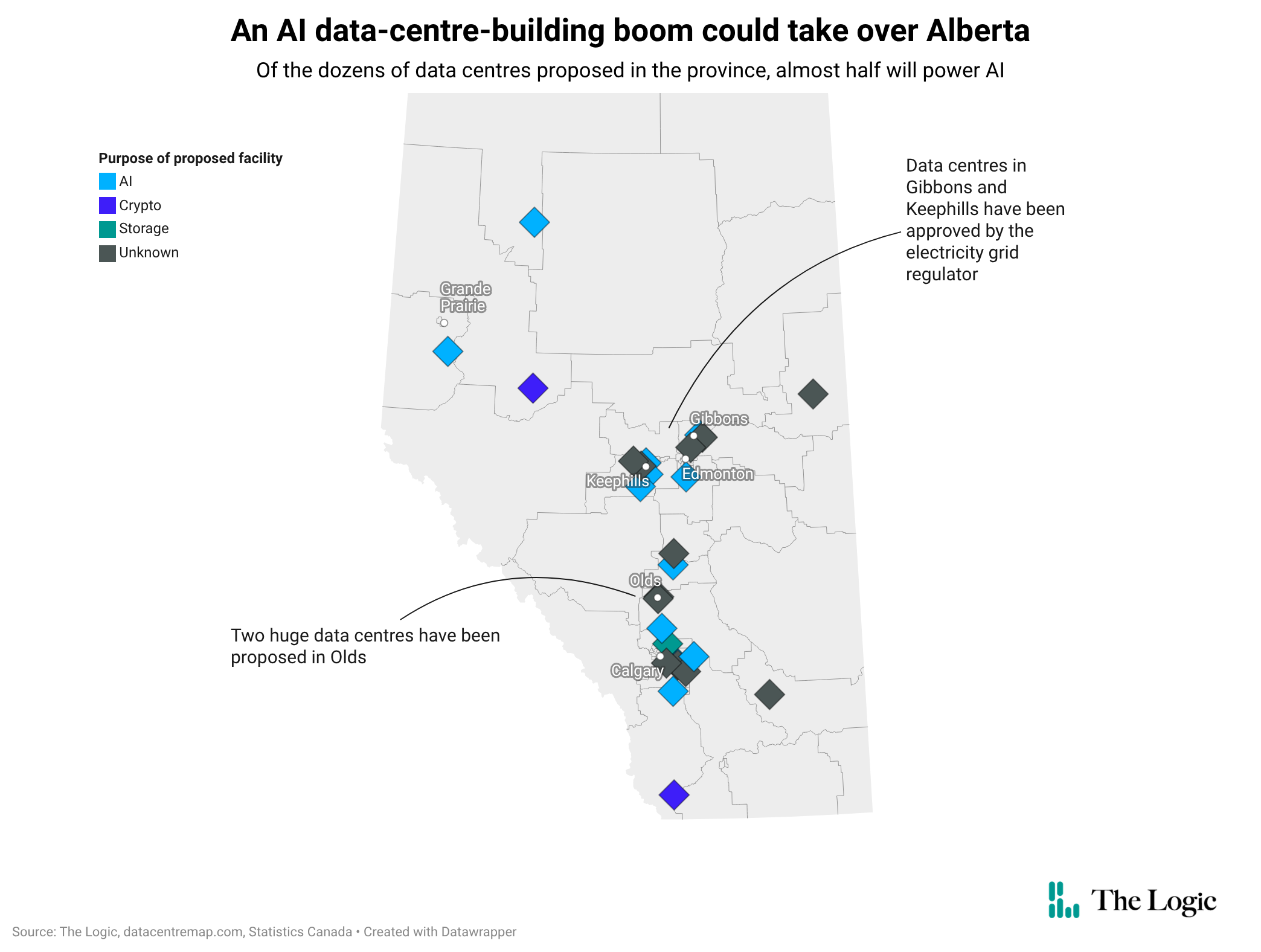
Furthermore, although Alberta wants data-centre operators to run them with their own power plants, the stack of applications came with less than five gigawatts of proposals for associated electricity plants.
Those are also only the projects that need connections to the provincial power grid and were advanced enough to file applications by last summer. The splashiest, the Kevin O’Leary-backed Wonder Valley near Grande Prairie, isn’t among them.
Not making the cut now doesn’t mean a proposal is dead; the AESO is starting another round of approvals, so the gold rush is still on.
Olds
Different would-be developers have different approaches to staking claims. Synapse, which is proposing to build a one-gigawatt data centre in rural Olds, is working with local authorities and holding public information sessions to answer residents’ objections and questions.
The Alberta Utilities Commission rejected Synapse’s application in early March for incompleteness, but it can try again and the company said it intends to.
The site is currently farmland; Synapse had promised the facility could open as soon as the middle of 2026. It would not necessarily start at full power—the company’s concept is a campus with 10 centres of 100 megawatts each, totalling two million square feet, powered by its own natural-gas power plant.
Synapse has filed paperwork with the municipal government and it has some heft behind it, with founder Jason Van Gaal having previously launched a Montreal data-centre business, called Root, that sold to U.S.-based Compass in 2019.
West of Red Deer
Meanwhile, the biggest application on the AESO’s list, a 1.9-gigawatt proposal in the Caroline planning area west of Red Deer, confounds leaders in the two closest counties, Clearwater and Ponoka.
Ponoka’s chief administrator Peter Hall said in an email that the data centre is proposed for Clearwater, while Clearwater’s economic development officer Jerry Pratt said he’d never heard of it.
For scale, a data centre of this size would consume as much energy as comes out of Alberta’s biggest current power plant, the Genesee natural gas station.
Yet The Logic was unable to find any information about it other than the one line on an AESO spreadsheet of proposed projects and didn’t include details of it in our analysis for this story. Other sketchy applications got the same treatment. – David Reevely
British Columbia
Data centres have been big business in B.C. since the heyday of cryptocurrency mining. Demand was so high in the early 2020s, in fact, that the province paused approving requests from new mining operations starting in late 2022. At the time, BC Hydro was already servicing seven crypto data centres with six more about to come online. Meanwhile, 21 more crypto projects were requesting access to electricity, asking collectively for enough energy to power about 570,000 homes.
That 18-month pause was never lifted and became a permanent ban in late 2025. At the time, the provincial government said cryptocurrency mines use a disproportionate amount of energy and have “limited economic benefit.” In response, some companies pushing crypto mining in B.C. have now shifted to AI.
B.C. has taken a somewhat more positive view of AI. These data centres, the government claimed in October, “can offer tremendous potential” for innovation and data sovereignty, as well as contribute to making the province’s industries more competitive and productive.
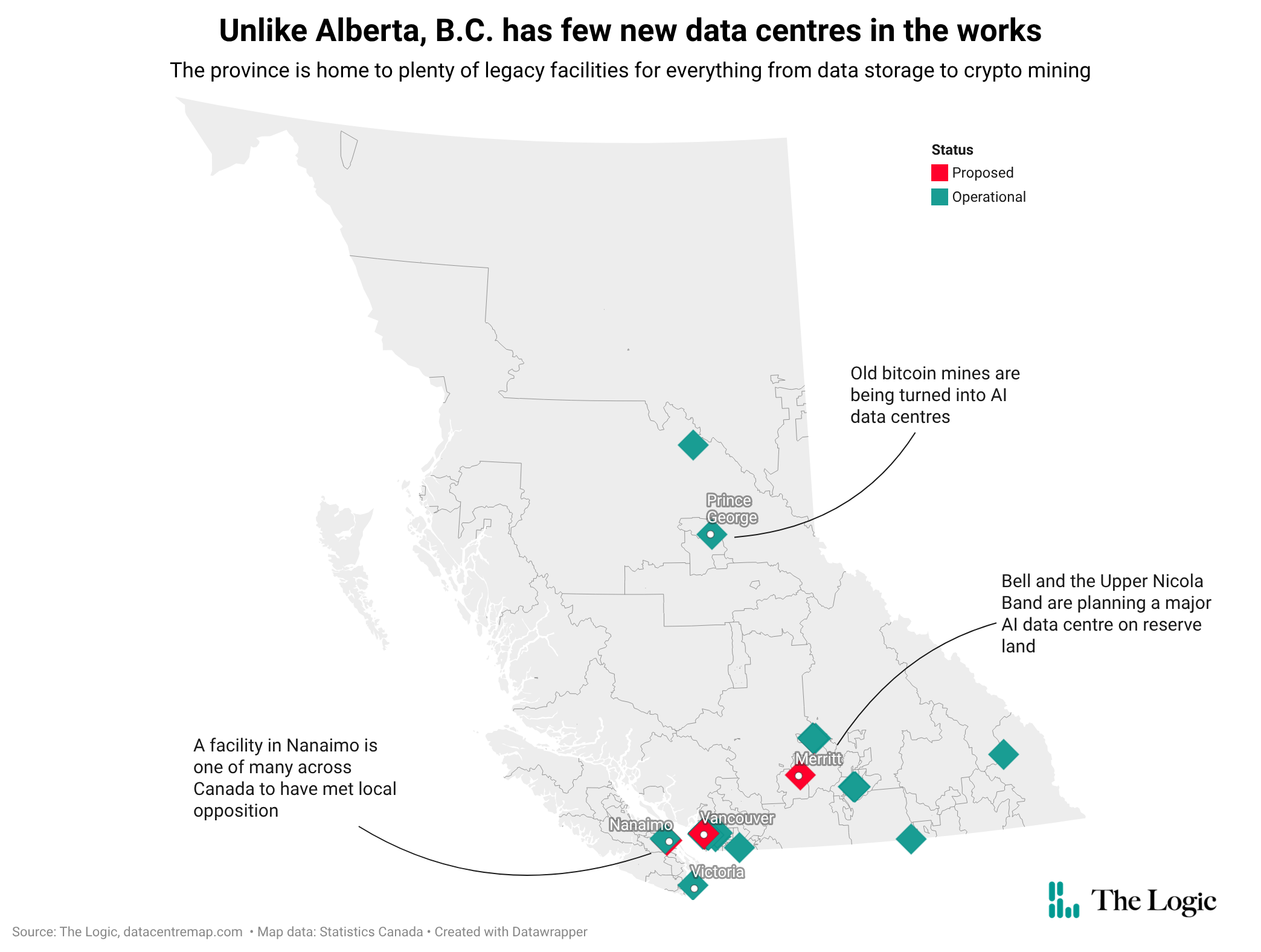
In January, the province made clear that AI data-centre projects would have to compete for power. Under a new set of rules, all data-centre projects in the province approved over the next two years will have to compete for 400 megawatts of power.
Not everyone is happy with B.C.’s decision to put a cap on the data-centre-building boom. The Electrical Contractors Association of B.C., for example, argues that construction jobs will be lost due to the cap on electricity for new data centres, as it will likely result in fewer facilities being built.
Still, new projects are progressing. Telecom giant Bell announced in May it would build six AI data centres in the province. The first is already running, with a second slated to open in a matter of weeks and a third by the end of the year.
Nanaimo
A proposed new data centre in Nanaimo, on Vancouver Island, has become the face of public opposition to data centres in the province. The 18,000-square-metre facility located on the outskirts of the city encountered heavy opposition from residents and environmental activists as the owners asked the city for rezoning approval. Concerns abounded about the centre’s water usage—a common complaint against all data centres, AI or not. A petition against the project has garnered more than 43,000 signatures. Still, Nanaimo city council approved the rezoning, even as protestors shouted over officials during a public meeting. In March, Nanaimo issued a development permit to the numbered Ontario company behind the project.
Merritt
The second of Bell’s six planned centres in B.C. will sit on Indigenous land. The Upper Nicola Band held consultation meetings with its members, soliciting feedback on Bell’s desire to build one of the data centres on up to 150 acres of land near the city of Merritt. The band, said Chief Daniel Manuel in a video posted in June, was looking for support to enter negotiations around the lease of the land and the business opportunity that it could provide.
The band claimed there would be “no unusual environmental effects” from the data centre, which was expected to create around 2,000 construction jobs and about 200 positions once it opened. The band expected rent for the land to bring in the greater of either an undisclosed fixed monthly amount or five per cent of revenues. The centre would also grow the band’s tax base. The members voted in favour of the proposal in July.
It’s one example of how some First Nations in Canada are capitalizing on the surging demand for data centres. Some have opted to take ownership stakes, while others have taken the same approach as the Upper Nicola. – Aleksandra Sagan
Saskatchewan and Manitoba
The data-centre-building boom is yet to reach Manitoba and Saskatchewan—even as policymakers signal interest in attracting new digital infrastructure. With relatively small populations and less-concentrated demand, the two provinces are unlikely to see the same rush to build AI data centres as elsewhere in Canada.
In 2024, the Canada Energy Regulator identified eight data-centre facilities in Manitoba: seven of them located in Winnipeg and one in Winkler. Most are relatively small operations focused on storage, telecom infrastructure or colocation services rather than the large hyperscale facilities needed to train and power large AI models.
Manitoba Premier Wab Kinew has increasingly pitched the province as a potential destination for future AI infrastructure, describing it as an economic opportunity for the province. Speaking to reporters in October last year, Kinew said Manitobans would “see servers and data centres in Manitoba,” and later argued that large-scale tech investments are ultimately an “energy play”—an area where the province believes it holds an advantage.
Cold winters and low-carbon electricity are often cited as advantages for power-hungry computing facilities that must operate continuously while keeping equipment cool.
Things are similarly muted in neighbouring Saskatchewan. The province currently has just six data centres, spread across Saskatoon, Regina, Moose Jaw and White City. Most, like Manitoba’s, are conventional data centres rather than large-scale AI-focused facilities.
That will soon change. Bell plans to build a 300-megawatt data centre in Saskatchewan that will be occupied by AI compute firms Cerebras and CoreWeave. The $1.7-billion facility south of Regina, part of its national “AI Fabric” initiative, will occupy a roughly 160-acre site and be powered by a new SaskPower substation. Construction is set to begin later this year.
At the same time, Mike Moroz, Manitoba’s innovation and technology minister, has said the province will launch public consultations to help shape future AI policies, focusing on stronger data-privacy protections and potential age limits for access to AI tools. – Chaimae Chouiekh
Ontario
While it may have the most data centres of any Canadian jurisdiction—112 in total, over a third of the facilities The Logic located around the country—Ontario’s compute stock isn’t growing as fast as other large provinces’.
The provincial government has touted the sector as an opportunity to boost investment and job creation, particularly in northern and rural communities. It estimates data centres will generate 13 per cent of Ontario’s additional electricity demand by 2035. Last June, it said developers that offer “real local, strategic and economic benefits” will get priority for grid connections.
To date, however, Ontario hasn’t seen the rush of proposals for AI data-centre megaprojects that’s underway elsewhere. Smaller campuses have popped up. Urbacon Data Centre Solutions, which is based in Toronto, has five facilities up and running in Richmond Hill, Ont., with plans for a sixth. All built they’d have a combined capacity of just 148 megawatts. Denver-headquartered Stack Infrastructure, meanwhile, has three data centres in Toronto’s east end totalling 56 megawatts.
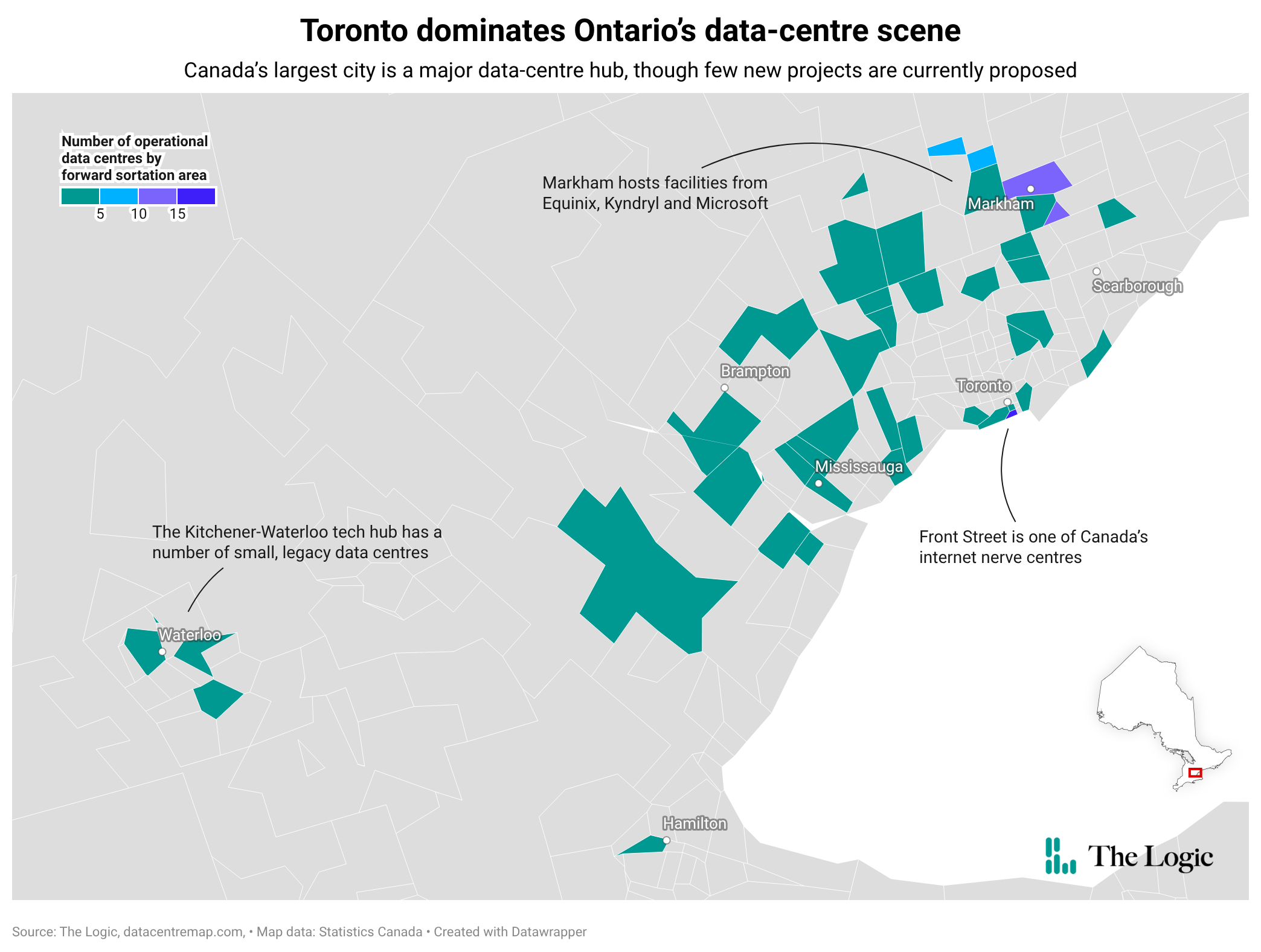
The two firms are among the newer entrants to the market, and both say their Canadian sites are well-suited to host AI hardware. Still, their campuses are a fraction of the scale of projects that developers have proposed in Alberta, some of which count their capacity in gigawatts. Few data-centre operators have made tangible plans to set up in the rural and remote areas of Ontario.
At least one megaproject outside a major urban centre may be on the way, though. As The Logic first reported last July, QScale, headquartered in Lévis, Que., has explored building a large data centre in Ontario at an estimated cost of up to $4 billion. It’s considering setting up in Wilmot Township, just west of Kitchener, Ont.
Ontario’s existing data centres are mostly used for storage, running software applications, or connectivity. Of those, 15 are actually just banks of servers located in the same building on Toronto’s Front Street, a so-called “carrier hotel” where the networks of telecoms, financial services firms and cloud services providers meet. Japan’s KDDI bought the facility in June 2024.
Kitchener-Waterloo
CoreWeave and OVHcloud—two of the most prominent of a new batch of compute firms called neoclouds—recently moved in next to each other near the tech hub of Kitchener-Waterloo. Each firm now has a data centre within a facility run by St. Louis, Mo.-based Ascent. CPP Investments and Deutsche Bank have jointly lent $450 million to upgrade and expand the facility, a former BlackBerry site.
OVHcloud, headquartered in Roubaix, France, got there first, opening its data centre in March 2024 and promising to spend $145 million over eight years there. CoreWeave, based in Livingston, N.J., turned on its facility last August. Toronto AI firm Cohere is the data centre’s anchor tenant, backed by $240 million in funding from the federal government. – Murad Hemmadi
Quebec
With abundant, cheap, renewable energy, Quebec would seem to be a natural spot to build the data centres needed to power the AI boom. In 2016, Hydro-Québec launched an initiative to attract data centres to the province, touting access to land and financial assistance in order to facilitate their establishment. Quebec is home to nearly 60 existing data centres, many of which are used for data storage, our analysis found.
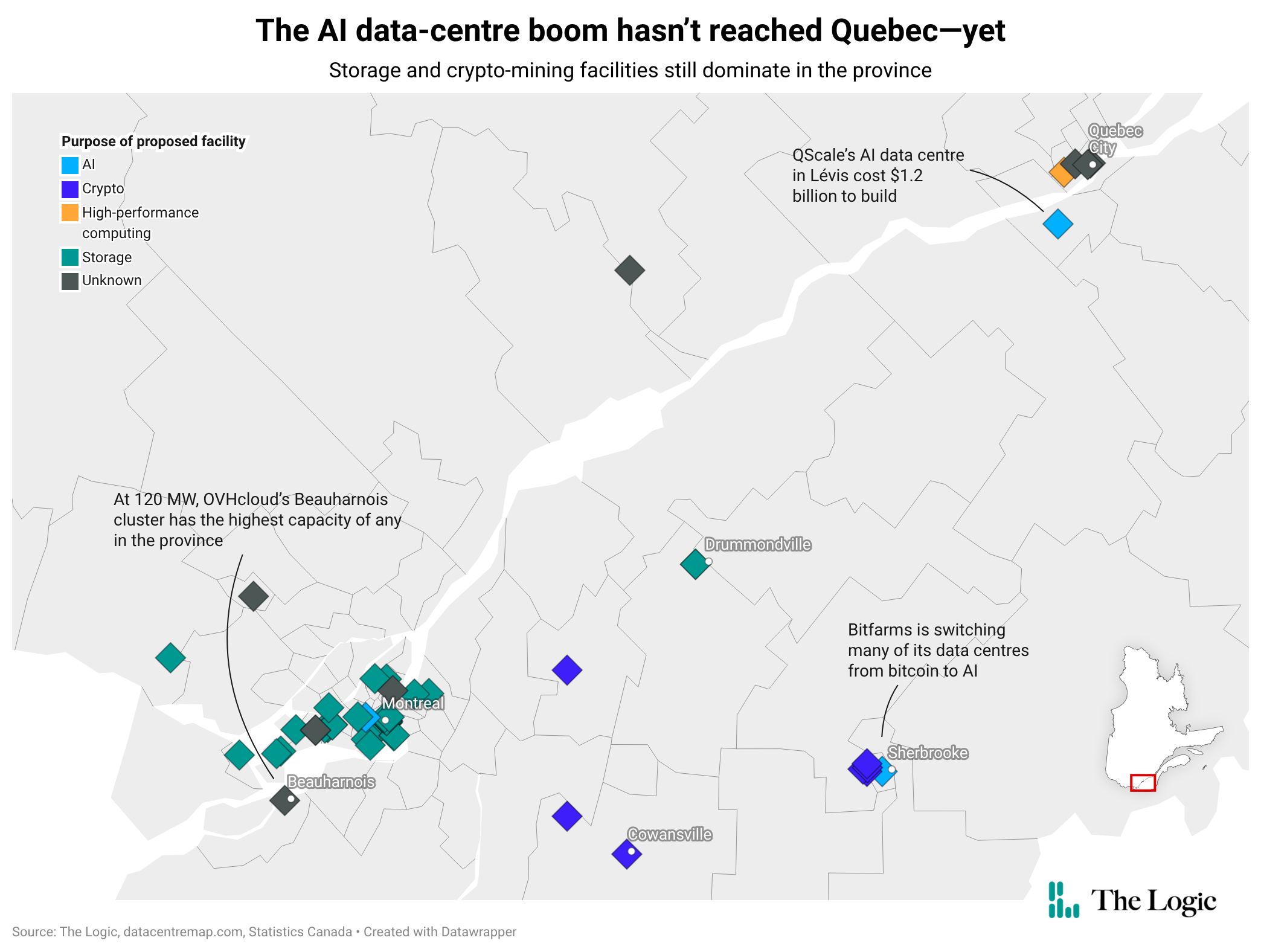
Yet by ceasing to issue permits for crypto data centres in 2018, then saying it was no longer trying to attract data centres to the province in 2022, Hydro-Québec has spooked the data-centre sector as a whole, said Eliot Ahdoot, president of the construction wing of Montreal-based AI infrastructure firm Hypertec.
“It was the exact wrong timing,” Ahdoot said of the moratorium. “If we had opened the doors when AI started to grow massively, you could have had large-scale infrastructure in Quebec.” Instead, he added, the province put the brakes on.
Hydro-Québec wants to double electricity rates for large data centres starting mid-2026 to reflect “the value of renewable energy” and to account for the costs associated with high electricity demand. Given the expected sevenfold electricity demand increase in Quebec from data centres, to more than one gigawatt by 2035, the utility likely also wants to fully profit from its position as the arbiter of some of the most expansive and comparatively affordable renewable energy sources in North America.
Montreal
Known as the “most connected building in Montreal,” 1250 Boulevard René-Lévesque West houses the core node of the Montreal Internet Exchange, a key piece of infrastructure opened in 2013. Known as QIX, the exchange has helped lower latency times—which is crucial for the efficient operation of AI data centres. QIX has also ensured that internet traffic originating and ending in the country doesn’t have to cross into the United States on the way.
Also of note in the city is Enovum’s MTL1, launched in 2021 and purpose-built to house AI and high performance computing operations. It became an early favourite for those in the field who are wary of relegating their intellectual property to the cloud. In some ways, it was practicing the principles of AI sovereignty before it became a buzzword. – Martin Patriquin
Atlantic Canada
Not every corner of the country is experiencing a data-centre boom. In Atlantic Canada, the facilities are few and typically small, older builds. Many of the centres are run by telecommunications companies, like Bell, Rogers and Eastlink, built to keep local internet and phone networks running, and to store data for nearby organizations. In general, these aren’t the sprawling campuses being built elsewhere to run massive cloud computing and AI workloads.
There’s an exception in New Brunswick, however, where a dense network of unused fibre-optic cable has captured the attention of Calgary-based Beacon AI and Texas power company VoltaGrid. The pair has proposed a 190-megawatt data centre to host large-scale cloud and AI computing near Saint John.
The proposed centre, slated to open next year, has drawn backlash from locals, echoing debates playing out in other communities facing new data-centre projects. In Saint John, some residents and politicians have raised concerns about noise, emissions and the strain the facility could place on New Brunswick’s electricity system, and question whether the promised jobs and economic benefits will materialize. – Catherine McIntyre
The Territories
Canada’s territories present both an opportunity and a challenge for building out data centres. For some, the Arctic region in general is an appealing location for data centres. In Sept. 2025, Arctida, a Russian NGO investigating the Russian Arctic, estimated the Arctic hosted 32 data centres across Iceland, Russia, Sweden, Finland, the U.S., Norway and Denmark. The Arctic is a potential draw due to its cooler temperatures, meaning data-centre operators need to spend less on cooling. Some Arctic data centres could also potentially benefit from access to greener energy sources such as hydro or geothermal power. The Northwest Territories, for example, could generate much cheaper geothermal energy, according to a report from Cascade Institute, a research centre out of Royal Roads University in Victoria, B.C.
Despite such apparent advantages, the data-centre-building boom is yet to reach Canada’s North. The territories are sparsely populated compared to the rest of the country, while construction logistics and costs are often prohibitively complex and expensive. Perhaps most importantly, the North doesn’t have widespread access to reliable high-speed internet. A government-commissioned report into the feasibility of data-centre construction in the Yukon found that the lack of fibre-optic links in the region was an “absolute red flag.” – Aleksandra Sagan
All maps by Xavi Richer Vis for The Logic













