Listen Now
0:00
Canadians are skeptical of AI data-centre projects, a new poll by Abacus Data has found, even as most people agree that having more of them is essential for the country’s global competitiveness.
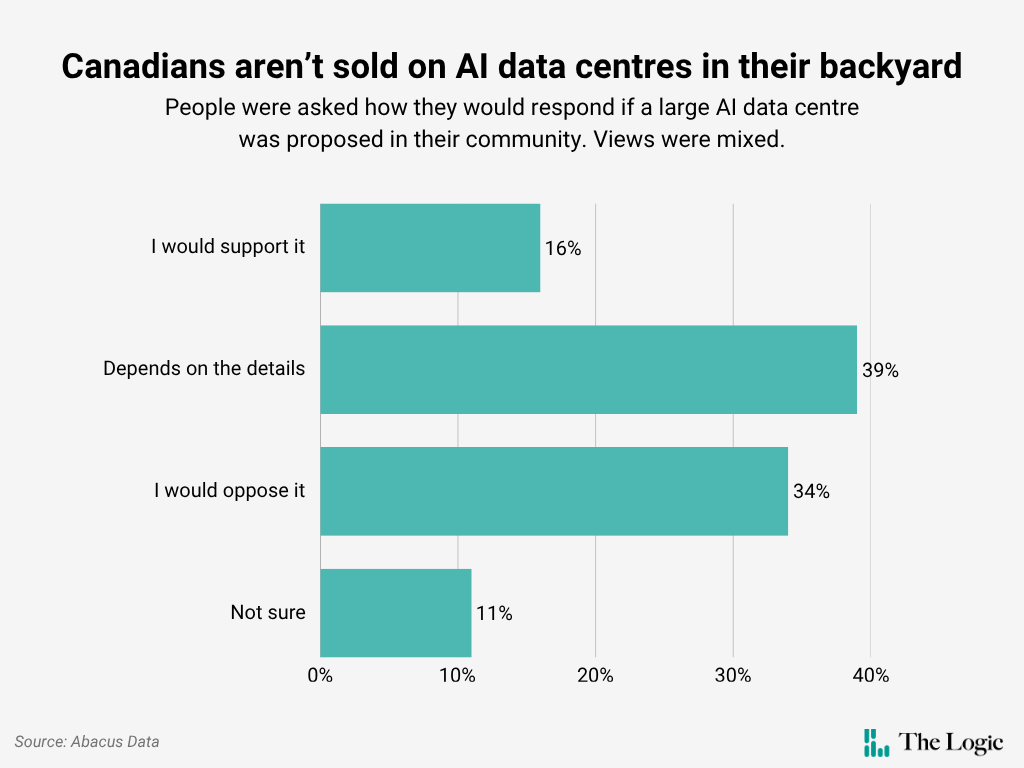
Just 16 per cent of respondents would support an AI data centre being built in their own community, the poll found, while 34 per cent would oppose it; 39 per cent said their reactions would depend on the details.
Talking Points
- Canadians think data centres are important for the country’s global competitiveness but would be skeptical of any particular project proposed near them, according to new polling from Abacus Data
- The average person is persuadable, says Abacus CEO David Coletto, but would-be builders need to take concerns about economic effects, power consumption and other local impacts very seriously
“[This suggests] a large share of the public is persuadable, but only if concerns are addressed and benefits are clearly articulated,” Abacus CEO David Coletto wrote in a report on the results. “At the same time, the fact that opposition outweighs support at the local level points to the risk of NIMBY-style resistance emerging as projects move from concept to reality.”
There are clear tensions in public opinion on data centres, Coletto wrote; people are open to them, “but that openness is conditional on trust, transparency and tangible local benefits.”
The responses were broadly consistent across Canada’s regions, with Quebecers tilting slightly more favourably (21 per cent of them would be supportive) and Atlantic Canadians tilting against (10 per cent in favour, 40 per cent definitely opposed).
In Alberta, where Premier Danielle Smith’s government is hoping to attract $100 billion worth of data-centre projects, 17 per cent of respondents would support a new data centre near them, 32 per cent would oppose it, and 45 per cent say their views would depend on the details.
Related Articles


A plurality of respondents expect that having more data centres would lead to job losses overall—Canadians aren’t convinced there’s an economic case for them, Coletto wrote, calling it “a critical finding”—and two-thirds think building more of them will increase the price of electricity, since they can consume huge amounts of power. Forty-eight per cent said governments either probably or definitely should not subsidize the construction and operation of AI data centres.
Despite such concerns, 57 per cent of respondents worried that Canada risks falling behind the U.S. and China if it doesn’t invest in data centres, and 56 per cent either somewhat or strongly agree that expanding them is essential if Canada wants to remain competitive in the global economy as the AI race heats up.
In the United States, where construction plans for AI data centres are generally further along, public opposition has halted multiple projects—even though, as another recent poll found, Americans tend to be a bit friendlier to the idea of data-centre projects than the Abacus poll suggests Canadians are.
Firms that want to build data centres in Canada are starting to pay attention to the roiling public sentiment. When telecom giant Bell unveiled plans for a new 300-megawatt facility in Sherwood, Sask., last week, its announcement touted the economic benefits it claimed the project would bring, and tried to explain how it would minimize its environmental impact.
In particular, Bell said the data-centre design for Sherwood “does not draw on municipal water resources” to cool its hardware. Bell CEO Mirko Bibic told The Logic that was in response to concerns raised by community members after the CBC first reported on the firm’s plans last month.
Some residents in Olds, Alta., and Lorneville, N.B., have also raised objections to data-centre projects from other developers in their communities, over energy use and noise. As Bell plots out new AI infrastructure across Canada, it’s aware of the potential for local opposition, Bibic said. “We listen to the stakeholders [in] the communities around us.” He claimed the municipal government has been “very supportive” of the Sherwood data centre, which Bell says will employ at least 800 people during construction, and generate 80 full time positions as well as 750 spin-off jobs in the local community.
The Abacus Data poll was conducted March 4 – 11, using a panel of 1,931 Canadians from the PureSpectrum platform. Online panels of this sort do not have margins of error, but a comparable probability-based sample would have a margin of error of 2.2 percentage points, 19 times out of 20.