Listen Now
0:00
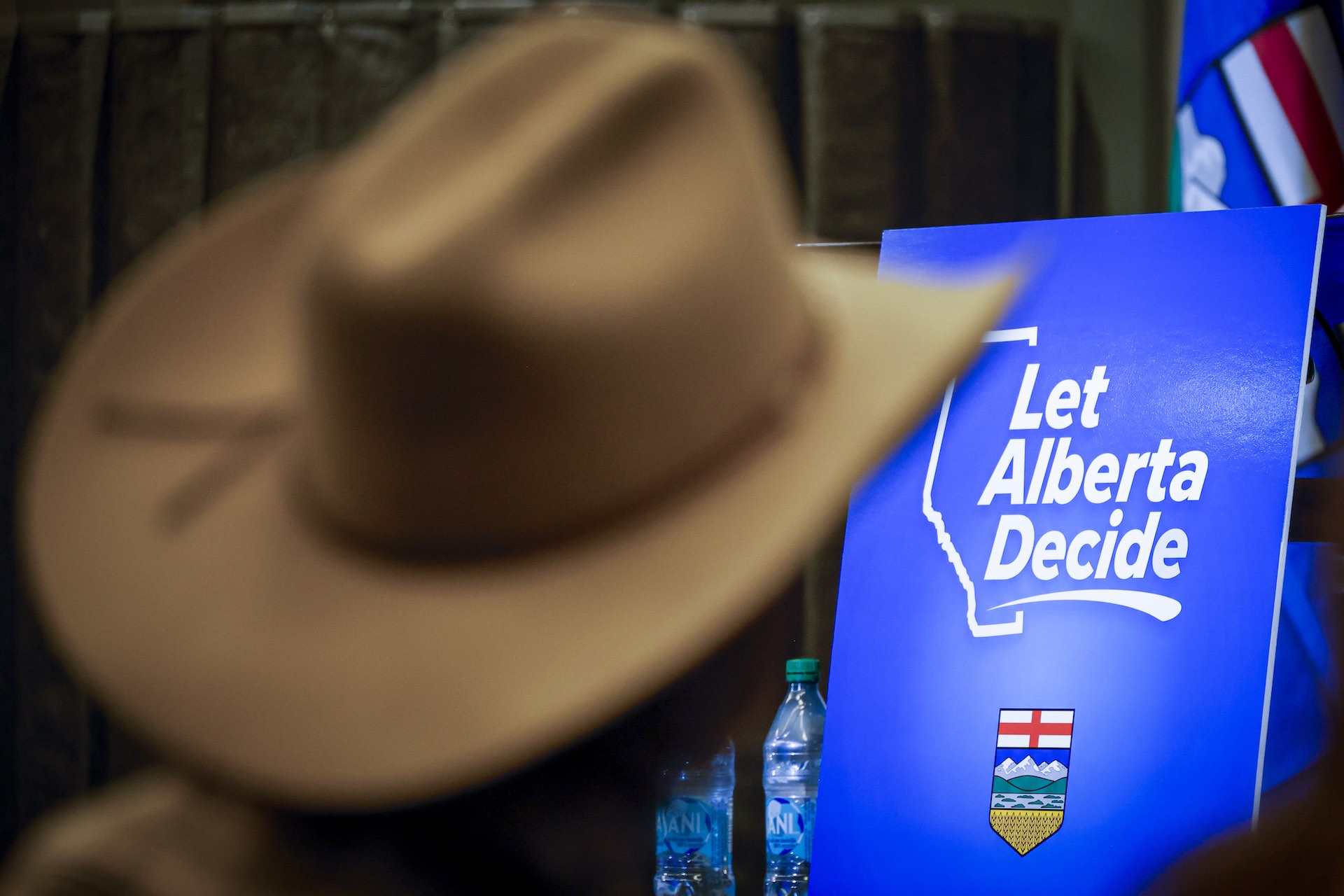
CALGARY — Tangible signs of Alberta’s separatist movement tend to appear far from Calgary’s shining glass office towers. Along the highways and backroads of rural Alberta, where the province’s deep-blue flag hangs from farm gates and acreage fences, the odd roadside billboard delivers a blunt exhortation: “Send Ottawa a message.”
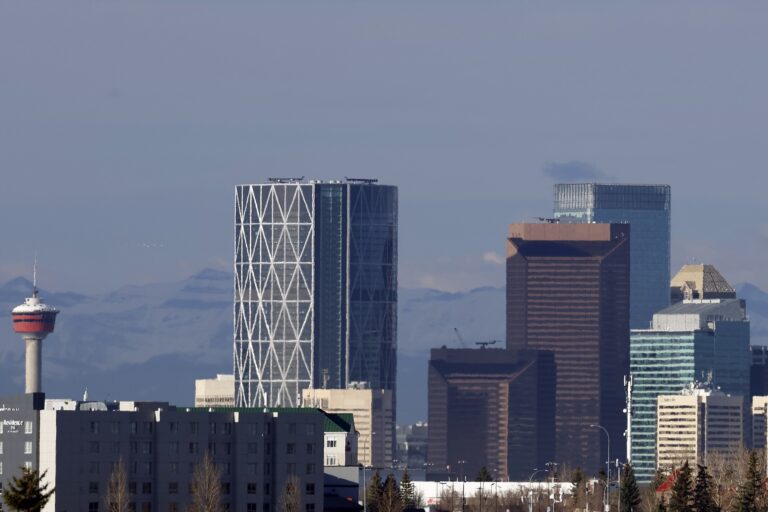
Yet as Alberta prepares for an Oct. 19 referendum on whether it should begin the process of pursuing independence, a different question is emerging for the oil-rich province: Where is corporate Calgary? Where are the voices of the province’s energy patch and business establishment?
Talking Points
- Corporate Calgary has so far stayed on the sidelines of the province’s separation debate, leaving open the question of how Alberta’s most influential business leaders think secession would affect the province’s economy
- Executives interviewed by The Logic, including oilpatch leaders, gave varying reasons for the general reticence, while acknowledging conflicting thoughts on separation; most said they opposed secession but expressed sympathy for the frustrations driving it
More than three decades after Quebec’s last sovereignty referendum, Alberta’s impending vote on separation has inevitably invited comparison with Canada’s previous national unity crises. But unlike Quebec’s referendum campaigns, where prominent business leaders—figures like former Bombardier chief Laurent Beaudoin and financier Paul Desmarais—became outspoken opponents of the separatist movement, Alberta’s corporate elite has largely remained on the sidelines.
With a few notable exceptions, Western Canada’s corporate heavyweights have left the region’s most pressing political and economic question to others in the public square—activists, political leaders, media commentators and the cacophony of voices on social media. Not coincidentally, debate in Alberta has been strikingly free of another defining feature of sovereignty battles in Quebec: threats or warnings from companies about taking their offices and money out of the province.
A recent poll from the Calgary Chamber of Commerce suggests it is quietly playing on their minds—48 per cent of chamber members who responded said they were likely to move their business if Albertans vote to begin a formal separation process. What few of them are doing is speaking their minds.
Monte Solberg, CEO of New West Public Affairs and a former federal cabinet minister, believes Alberta’s company leaders are “overwhelmingly” in the pro-Canada camp, but wary of stepping into a political minefield. “They don’t want to weigh in in a ham-fisted way and cause problems either for their cause or for their company,” said Solberg, who is one of the founding members of Vote to Stay, an organization advancing economic arguments against separation.
“They’re looking out for their shareholders,” he said of the corporate leaders. “They don’t want to wander into a thicket where they face boycotts or criticism from the media.”
Interviews with a cross-section of Alberta business people and public figures partly validate Solberg’s theory: several told The Logic either that they had no plans to speak up publicly, or that they expect Alberta’s corporate leaders will take a more cautious approach than their counterparts in Quebec. Their comments point to a more complex set of factors.
Related Articles

Some see separation as a low-risk possibility that companies can afford to tactfully wait out—polls, after all, consistently indicate support for it tops out around 30 per cent. Some may be wary of alienating an employee base that is more rural and politically frustrated. Others reckon the silence reflects a genuine ambivalence, or even sympathy, toward the movement in some corners of Alberta’s business community.
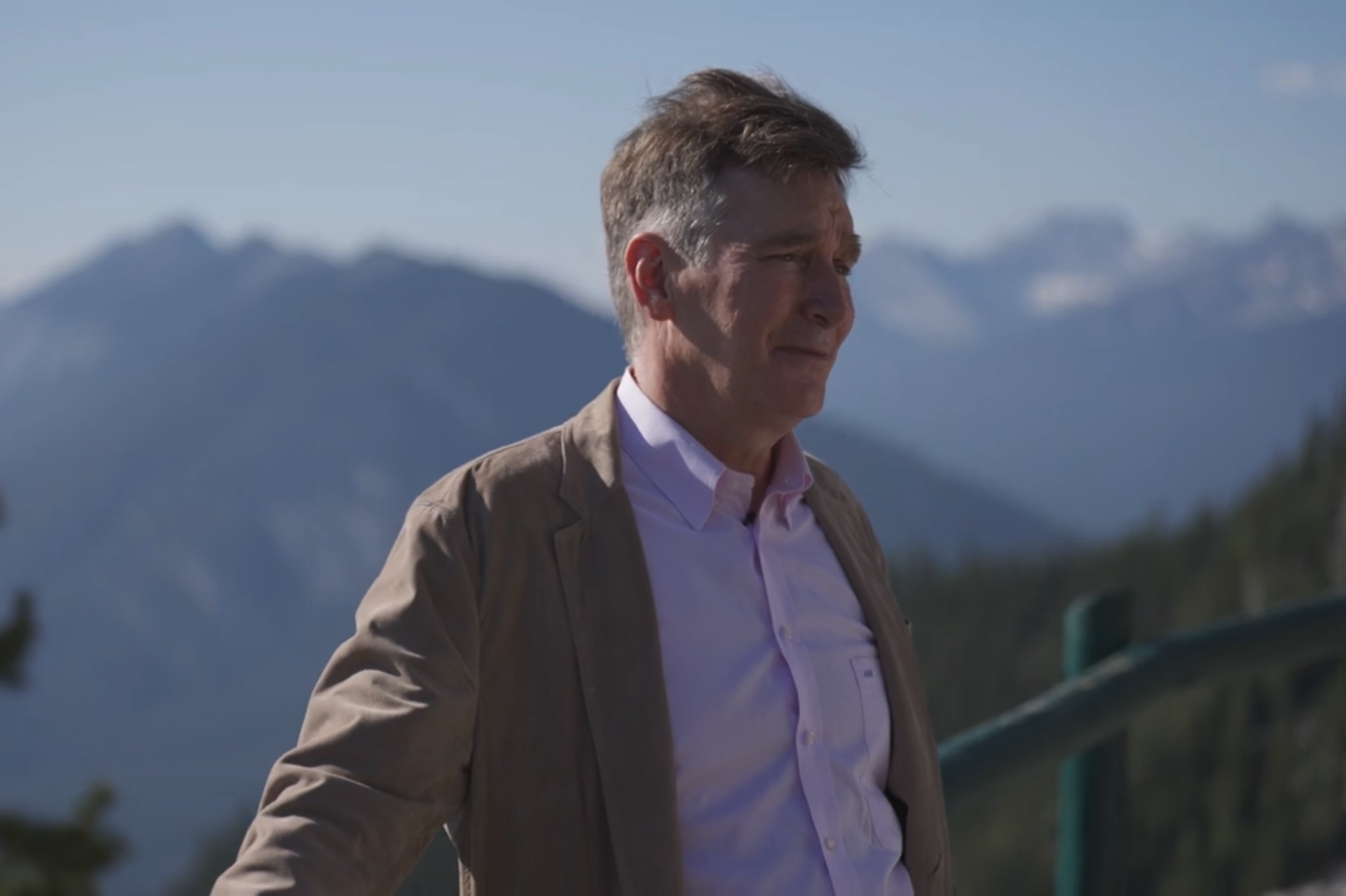
If corporate Alberta isn’t following a predictable script, said oil tycoon Adam Waterous, that’s partly because the usual arguments against secession—investment uncertainty, the risk of a corporate exodus—don’t apply to the province in quite the same way they did in Quebec, Scotland or even Brexit.
Alberta’s economic engine, the oil and gas sector, is not going to pack up and leave, said Waterous, a former investment banker who built heavy oil producer Strathcona Resources and heads Calgary-based private equity firm Waterous Energy Fund. What’s more, the sector may be entering a growth cycle where oil and gas production could double over the next decade, he said, making an en masse departure of business all the less likely.
“It’s just lazy thinking,” Waterous said of the exodus theory. “You think Suncor is moving? You think TC Energy is moving? No one’s moving. In fact, it’s the opposite.”
Waterous was one of five executives—three oilpatch CEOs, a finance executive and the head of a Calgary-based agri-business—who spoke to The Logic and pushed back on the idea that Alberta’s separatist debate was scaring off investors.
Another was Michael Belenkie, the former chief executive of Advantage Energy, a Calgary-based natural gas and light oil producer. Belenkie spoke before he stepped down from his positions with Advantage on June 15, but not before meeting with investors on behalf of the firm in Boston. “Not one single person said, ’Oh, I’m worried about investing in Calgary, or in Advantage, or Alberta, because of the separatist thing,’” he said of the meetings.
Some executives and analysts argue the opposite is happening. Even before war in the Middle East drove oil prices above US$100 per barrel this spring, there were signs that U.S. and international investors were interested again in the Canadian oilpatch. Between late August 2025 and late February 2026, the S&P/TSX Capped Energy Index gained more than 30 per cent, reflecting renewed interest in a sector that has spent years out of favour with investors.
Bob Geddes, chief executive of Calgary-headquartered drilling company Ensign Energy Services, pointed to a recent spate of deals involving foreign companies or capital moving into Alberta’s oilpatch. “Shell just laid down $20 billion to buy ARC [Resources]—they’ll close that here in a few months with the knowledge of this referendum,” Geddes said.
Geddes said U.S. companies are largely unfazed by Alberta’s political debate. Their attitude, he said, is that “it’s irrelevant. You drill a hole, you bring the oil and gas out, you sell it to the U.S., you make money. It doesn’t affect their investment decisions at all.”
Energy stocks and M&A deals aren’t the only place to look for the market’s verdict on Alberta separatism. There’s also the provincial bond market—where investors directly price the risk of lending money to the Alberta government. If political uncertainty in the province were leading investors to demand a higher risk premium, it could show up in Alberta’s borrowing costs first.
So far, the alarm bells haven’t rung.
Charles St-Arnaud, chief economist at Servus Credit Union, said he expected to see at least some evidence of referendum fear creeping into markets for instruments such as Alberta’s 10-year bonds. That hasn’t happened, he said, possibly because high oil prices and the province’s relatively strong fiscal position seem to be outweighing concerns.
“I would be surprised not to see at some point maybe some increase in yield or in spreads with Ontario, as an example,” said St-Arnaud, who lives in Calgary but was in Quebec during the 1995 referendum and happened to be working in London during Brexit.
It’s also a long time until Oct. 19, he noted. Investors may not be seriously focusing on the referendum until after Labour Day, St-Arnaud said, when they may be more likely to say, “OK, that’s a bit more imminent.”
Critics of Alberta’s sovereignty movement have portrayed it as shambolic, or rooted in a kind of economic greed over oil riches, with the implicit (and sometimes explicit) assumption that Alberta’s oilpatch is naturally sympathetic to the cause.
There is a kernel of truth here: no energy executives who spoke to The Logic voiced doubt that an independent Alberta would pursue lower taxes and a more accommodating approach to oil and gas development. While independence might not make it easier to build an oil pipeline to the West Coast, many in the industry have concluded that hardly matters. After years of failed pipeline battles, they see little prospect of a major new export route to the Pacific coast under Canada’s current political and regulatory framework.
As a result, some in the industry sound unruffled by the prospect of secession, even if they remain skeptical that it will come to pass. As Belenkie put it, “I don’t think people really believe separation is going to occur. But how could it be any worse than what we had for the last decade?”
There are good reasons for Alberta remaining in Canada, said Waterous—they’re just not economic ones. He argues an independent Alberta would enjoy “enormous” fiscal savings, lower taxes and a more attractive investment climate. “What’s going to happen? Alberta is going to be Dubai on the Rockies—the investment flows in are going to be very large.”
Why, then, does he still hope Alberta remains in Canada? “Money’s not everything,” said Waterous. “There are reasons to be part of a country beyond your standard of living.”
That, he argues, is precisely why pro-Canada campaigners cannot rely on warnings of corporate flight and economic devastation: “Ask Mark Carney how well the fear campaign worked out for Brexit.”
Belenkie, who represented Canada in rowing at the 2000 Summer Olympics, said critics outside the province risk making the situation worse by dismissing Alberta’s grievances outright. “There’s all these people that are on the fence right now,” he said. “Nobody wants to see people digging their heels in and making mistakes that could become permanent.”

Recent years have underscored the outsized role oil and gas play not only in the province’s economy, but in its identity—and how quickly disputes over federal energy policies can become existential questions about Confederation.
It’s a pattern that stretches back decades. Western Canada’s oilpatch has never forgotten the economic shock that immediately followed the introduction of then-prime minister Pierre Trudeau’s National Energy Program in 1980. Many took a similarly dim view of subsequent energy and climate policies under his son, former prime minister Justin Trudeau.
By now, the political backlash over Bill C-69—dubbed “the no more pipelines bill” by former Premier Jason Kenney—and the federal oil tanker moratorium in northern B.C. is familiar to many Canadians. Less appreciated outside the Prairies is the resentment generated by the more recent Trudeau government’s Clean Electricity Regulations (CER). Because Alberta and Saskatchewan rely heavily on natural gas for power, and can’t easily access hydroelectric or nuclear power, the regulations landed hardest on those two provinces. Some industry critics found it particularly provoking that violations could be prosecuted as offences under the Canadian Environmental Protection Act.
“So when you’re sitting out here in Alberta facing a regulatory environment imposed by Ottawa that’s patently absurd, and then enforced under the threat of criminal prosecution, what else are you going to say? You’re going to say, ‘You know what, you guys, we’re out. We’re just out,’” said Andrew Judson, a veteran energy-sector financier and corporate director in Calgary.
“I’m not endorsing this,” he hastened to add, “but these are some of the things I hear.”
Which is to say, attitudes within the industry reflect the conflicted and sometimes contradictory views of average Albertans. There are self-described proud Canadians in the oilpatch who have joylesslessly concluded that the threat of separation is the province’s only real leverage, and who would be pleased to see the separatist vote perform well enough in October to send a message to Ottawa.
“We have absolutely no power in Western Canada,” Geddes said, pointing to the seat distribution in federal Parliament. “[Alberta has] 37 seats. Ontario and Quebec have 200… You own Canada with Quebec and Ontario. That’s all you have to do to run Canada, and the rest comes along for the ride.”
“Most people are kind of fed up with that,” he added.
Geddes argued the referendum was forcing a necessary conversation with Ottawa. He also bristled at the notion that entertaining the idea was somehow unpatriotic. “My dad and my grandfather fought in the war. So if anyone doesn’t think I’m Canadian, I’m gonna punch you in the mouth.”
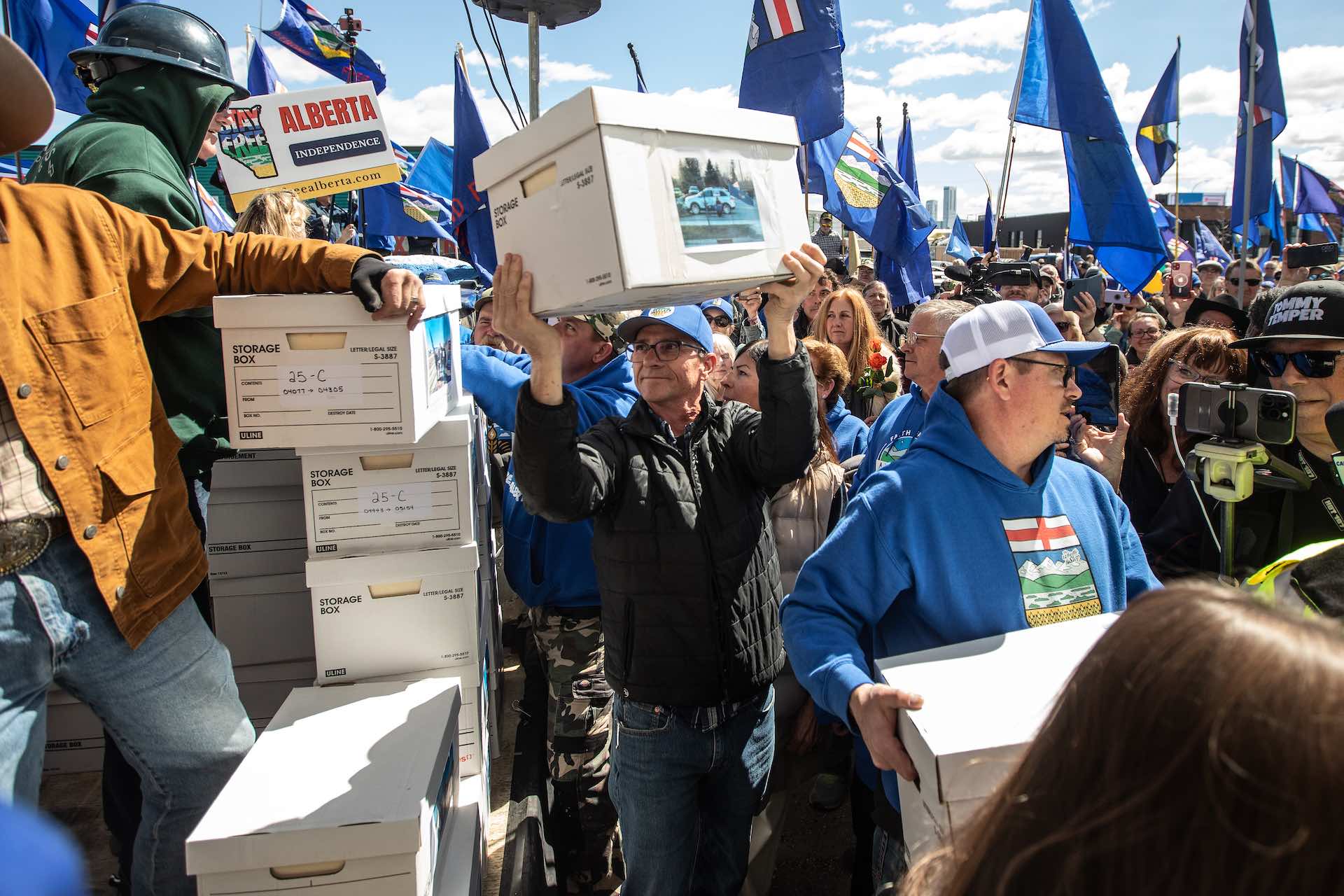
Former Alberta Premier Jason Kenney calls them “frustrated federalists.” While much media attention has been devoted to the more colourful and unhinged figures of Alberta’s separatist movement, he said, frustrated federalists are quieter and include “some pretty accomplished people—highly-educated, urban people running companies.”
“The most effective argument the separatists have is not actually a separatist argument. It’s ‘vote for separation because this will give Alberta stronger weight in the federation,’” said Kenney, who has been actively campaigning against Alberta separation for months. “‘Let’s hold a knife to Ottawa’s throat in the same way Quebec has for 60 years. After all, they got two-tier federalism, $13 billion in equalization and minimal interference from Ottawa.’
“Frankly,” he added, “I find it the hardest argument to rebut.”
That argument can be rebutted, he insisted, but Kenney worries Albertans may not approach the Oct. 19 vote as a straightforward question about independence. Instead, he fears low turnout, coupled with voters using their ballot to vent their frustrations with Ottawa, could produce a result that overstates the level of actual support for secession. Separatist supporters are likely to be more motivated to vote than federalists, Kenney said, while the referendum’s non-binding wording could reduce the sense of urgency among essentially pro-Canada voters. Some might stay home, he said; others might view their ballots as a low-risk way to express their exasperation with central Canada.
“I don’t think it’s a stretch at all to imagine a scenario where they get past 50 per cent in October,” said Kenney.
Suffice to say, there are real committed separatists, not just separatists for the sake of leverage, to be found in the C-suites of downtown Calgary.
The CEO of one agri-business, who asked not to be named because of the risks speaking out poses to the company’s commercial interests, conceded separation would be disruptive, but added: “No one’s going to stop eating. No one’s going to stop burning fuel. No one’s going to stop needing our products during that period. We’re not a service economy where people may structurally just move headquarters or look elsewhere,” he said.
The CEO allowed that things might’ve been different if Prime Minister Mark Carney had been the leader of the country during the Justin Trudeau years. But he dismissed the notion that relations could be salvaged now. “The damage is done. The movement’s started. Those of us who would be out the door already aren’t going to go backwards.”
Late last summer, during a heat wave that stretched into early September, Albertans packed community centres, convention halls and even a hockey rink for a series of so-called “Alberta Next” town halls on re-examining the province’s relationship with Ottawa.
Organizers tried to steer discussion to the topics on which the provincial government had asked the panel to gather feedback—like the prospect of Alberta withdrawing from the Canada Pension Plan, or the establishment of a new provincial police force. At nearly every stop, though, the conversation veered to secession.
“You absolutely could not avoid it,” said Judson, who was one of the 16-member Alberta Next panel chaired by Premier Danielle Smith. “In every single one of those meetings, someone would stand up and say, ‘Madam Premier, I’ve got a copy of the petition here supporting Alberta sovereignty, and I want to witness you sign it right now,’ or, ‘I’ve got the petition right here for a united Canada, and I want to witness you sign this petition and reject this idea of separatism.’
“Or somebody would get up and start singing ‘O Canada.’”
Judson emerged with one takeaway: this is “not going away anytime soon.”
The sentiment propelling Alberta’s movement has ebbed and flowed over the decades but in fact predates the province itself. From an early 20th century push to unite Prairie territories into a single province named Buffalo, to the rise of the Reform Party in the late 1980s, it has expressed long-standing resentment toward Ottawa for policies that favoured the interests of central Canadian industry over western farmers and producers. Its modern iteration is tinged with populist suspicion of central government treading on individual freedom, typified by the grassroots rhetoric of the Wexit movement in 2019 and the Freedom Convoy protesters who occupied downtown Ottawa in 2022.
Those root questions of economic fairness make the movement fundamentally different from Quebec nationalism. At its core is the sense among many Albertans of a profound mismatch between the province’s contributions to Canada’s prosperity and its political influence. As such, Waterous believes the movement is animated by one of history’s most familiar political grievances: “It’s taxation without representation. That is why empires bust apart.”
The question now for Albertans is whether separation, or the threat of it, is a sure enough remedy to justify a referendum—and whether the events set in motion by Smith will be worth the costs.

The debate comes at a delicate moment for the country, with Canada’s economy under pressure from U.S. tariffs on steel, aluminum, lumber and automobiles, and as it stares down an uncertain future for free trade in North America. In the meantime, having opened the door to a vote, Smith has begun mounting the economic case for the province remaining in Canada, floating an upfront transitional cost for separation of roughly $400 billion, plus up to $50 billion in additional annual costs to create a national government from scratch.
If Alberta’s corporate leaders are not yet sounding the alarm as their Quebec counterparts did, that does not mean they are blind to the real economic risks of separation, said Calgary Chamber of Commerce president Deborah Yedlin. In a recent survey of the chamber’s members, nearly three-quarters of respondents said they saw no tangible benefit to separation.
The chamber also commissioned an economic analysis by University of Calgary economist Trevor Tombe, which estimated Alberta could forgo between $10 billion and $15 billion in investment in 2026 alone—if investment levels declined by an amount similar to what was seen in the wake of Brexit. “I think it’s naive if people just think nothing will happen like what happened in Quebec,” Yedlin said. “Montreal was the financial centre for Canada. It’s not anymore.”
Headquarters can still move, even if the oil and gas assets don’t. Alberta has seen it before: Canadian energy giant Encana shifted its head offices south of the border to Denver, Colo., and changed its name to Ovintiv in early 2020; more recently, Imperial Oil—a majority-owned subsidiary of ExxonMobil—slashed its Canadian workforce and shifted key operations to the U.S. and abroad. While the risk of oilsands majors abandoning Alberta may be low, an unsettled political environment could motivate Canada’s multinational firms to relocate senior management or corporate functions to places like Houston, Texas.
What’s more, energy and agriculture aren’t the only games in town. At least some in the province’s rapidly growing tech and AI sector firms may view the threat of Alberta separation very differently from their counterparts in other sectors.
Jeff Adamson, co-founder of Calgary-headquartered fintech firm Neo Financial and Winnipeg-based delivery giant SkipTheDishes, is publicly urging Albertans to push for “straight answers” about how things like pensions, mortgages, savings and taxes will work in an independent Alberta. “The constitutional fight is going to take years, but I do believe that the financial disruption is actually going to start much sooner,” Adamson told The Logic.
A long summer of campaigning lies ahead for Alberta’s “leave” and “remain” camps, many of whom will descend on Calgary this week for Stampede parties and the annual political summer barbecue circuit.
Foreign investors are expected to attend in unusually large numbers too, including U.S. institutional investors and energy executives. From an investment perspective, the Iran war has made the Canadian oilpatch one of global energy’s most compelling turnaround stories: its oil and gas is in urgent demand even as Alberta debates whether it should remain part of the country.
As the days and the rhetoric grow warmer, pro-Canada supporters have begun mooting ways to address the friction between Alberta and the rest of the country. Among them: delivering on key objectives of the Canada-Alberta memorandum of understanding on energy; adjusting the federal equalization formula; or re-opening the debate over Senate reform in order to give less populous provinces like Alberta a stronger voice.
Solberg, for one, is urging Canadians outside the province to consider the issue from Albertans’ perspective, and take the province’s grievances seriously. “The problem isn’t the referendum,” he said. “The problem is this ongoing feeling that federalism doesn’t work for Alberta.”
The former longtime federal MP for Medicine Hat entered the House of Commons in 1993 as a Reform Party member, when the country was in the midst of the polarizing national unity debate that culminated in Quebec’s 1995 referendum. He said the instinct in some parts of the country to dismiss Alberta’s grievances is a mistake. “This is something that is deep-seated, heartfelt, and something that people are prepared to act on,” Solberg warned.
But it cuts both ways, he added, and Albertans tempted to use the referendum as a protest vote should understand the risk they’re running. “The argument I would make to corporate leaders everywhere is: don’t mess around with this, you’re playing with fire.”














