CALGARY — Walking tours of Calgary include a stop at Spanish artist Jaume Plensa’s “Wonderland,” a massive wire-mesh sculpture of a girl’s head that dominates the plaza in front of The Bow skyscraper.
Skip to content
 Attendees at The Logic’s Resilient Canada event in Calgary on May 13, 2025. Photo: Handout

Commentary
Carmichael: Carney can’t fix Canada without mending ties with Alberta
The country’s stagnant productivity might confound economists and decision-makers because they spend too little time thinking about the dynamics of power
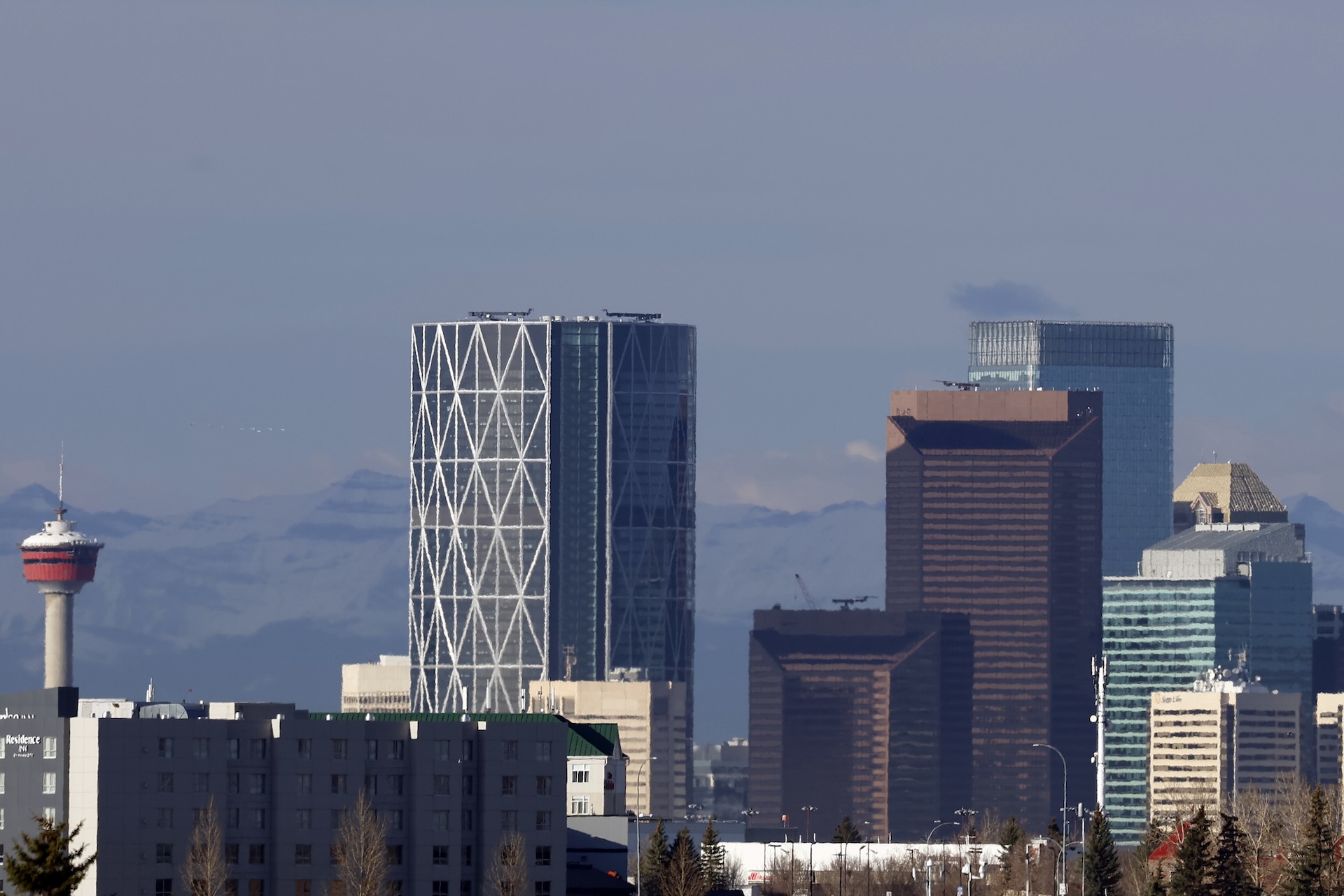
The Calgary skyline with the Rocky Mountains in the distance in April, 2024. Photo: The Canadian Press/Larry MacDougal
CALGARY — Walking tours of Calgary include a stop at Spanish artist Jaume Plensa’s “Wonderland,” a massive wire-mesh sculpture of a girl’s head that dominates the plaza in front of The Bow skyscraper.
There are two other larger-than-life Plensa sculptures in Canada: “Dreaming” in Toronto and “Source” in Montreal. It is symmetry at a moment when a critical mass of Albertans appear to have decided they have nothing tying them to the rest of Canada, particularly, the two middle provinces that just returned an unpopular Liberal government to power.
“It’s serious,” Kim McConnell, founder of marketing firm AdFarm and a member of the Canadian Agricultural Hall of Fame, said of the updraft of separation talk since last month’s election. “There’s a desire to do a lot of things as Canada today, but we also need a reset”—and without one, support for separation will grow, he said.
Related Articles

Talk of separation dominated a breakfast event hosted by The Logic, TMX Group and law firm Osler in Calgary last week. That wasn’t necessarily the plan, but with the announcement of Prime Minister Mark Carney’s new cabinet coming at about the same time guests were finishing their sausages and eggs, a dialogue about Western alienation was unavoidable. There was a groan when David Skok, The Logic’s founder and editor-in-chief, informed the room that the new environment minister came from Toronto. Few had heard of Julie Dabrusin until just then. For some, it didn’t matter; her constituency told them all they needed to know.
“You are going to see four more years of bad policy,” Andrew Phillips, chief executive of PrairieSky Royalty, a publicly traded landowner that leases its properties to oil and gas producers, told the room. “The reality is the same people are around [Carney].”
The Calgary gathering was the second leg of back-to-back breakfasts that The Logic and TMX organized to discuss the productivity crisis. The previous morning in Vancouver, the issue that most guests wanted to talk about was regulation. The Calgary group’s drift into a conversation about politics will strike some as indulgent and a waste of time. Not so. Canada’s stagnant productivity rate might confound economists and decision-makers precisely because they spend too little time thinking about the dynamics of power.
For decades, economists and investors mostly ignored politics. When I worked for Bloomberg in Ottawa in the early 2000s, the job was reporting on economic indicators and central bank decisions; anything politicians had to say was secondary. “National security aside, it hardly makes any difference who will be the next president,” Alan Greenspan, the former head of the U.S. Federal Reserve, said in 2007. “The world is governed by market forces.”
Recent history has forced a rethink. Rational expectations theory has little to say about what motivates Russian President Vladimir Putin, Chinese President Xi Jinping and U.S. President Donald Trump, yet it’s hard to think of three bigger economic variables than the autocratic whims of these three leaders. In an act of catching up, the Royal Swedish Academy of Sciences awarded the most recent Nobel Prize in economics to Daron Acemoglu, Simon Johnson and James A. Robinson, frequent collaborators who have shown through their work that prosperity is dictated by institutions, which are almost always created and shaped by politics.
All this to say that it matters how Carney, Premier Danielle Smith and others manage this tension between Alberta and middle Canada. It wasn’t looking good last week. The country looked more and more like a broken home as Smith and Liberal cabinet minister Steven Guilbeault sparred over the capacity of the Trans Mountain’s pipeline system.
Neither is a reliable narrator. Smith’s brand of populist politics requires an enemy, and Guilbeault, the former climate activist who was a central player in former prime minister Justin Trudeau’s government, makes for a good one. But this is how politics influences policy and, ultimately, the institutions that Acemoglu, Johnson and Robinson write about.
At the breakfast, there was a debate about whether Alberta’s separatist impulse has more in common with Quebec’s sovereignty movement or Brexit. One thing is clear: both have dramatically altered the trajectory of each economy. Nancy Southern, chief executive of ATCO, the Calgary-based utility and builder, said the separation debate has already caused a lack of confidence in Alberta among investors.
“I totally feel frustrated. I believe that we have had the short end of the stick for quite a while,” Southern told reporters after her company’s annual general meeting. “But this is our opportunity to now work together with a new prime minister, a new cabinet and see if we can’t get ourselves out of the way and actually deliver on this energy superpower that we all want to see.”
The country’s original, current and aspirational economic centres share more than a taste in art.
While in Calgary, I dropped by Avatar Innovations’ take on Shark Tank, the culmination of an incubator program at which teams assembled from the ranks of the city’s big oil and gas companies competed for backing from Avatar to commercialize ideas that would reduce the industry’s climate footprint. Elsewhere, the local arm of Toronto-based Creative Destruction Lab (CDL) was subjecting a batch of startups to a similar stress test.
Like Avatar’s cohort of aspirant entrepreneurs, none of the startups at CDL’s beauty contest were looking to get rich on the back of an ethos of “drill, baby, drill.” The founders I witnessed were simply trying to scale ideas that would chip away at Canada’s productivity problem—just like the startup scenes in Toronto, Montreal and many other cities.
At breakfast, Christoffer Mylde, a senior vice president at consulting firm Sproule ERCE and Norway’s honorary consul for Southern Alberta, observed that Norway sorted out its differences over energy production long ago: even socialists believe their country should pump the last barrel of oil, he said.
It was a polite way of saying that Canada’s productivity problem might be a political problem. “We need a vision that both Liberals and Conservatives can get behind,” Mylde said. “That is critical.”
Kevin Carmichael is The Logic’s economics columnist and editor-at-large. He has spent more than two decades covering economics, business and finance for outlets including Bloomberg News, The Globe and Mail and the Financial Post, where he also served as editor-in-chief.



Loading...
Thanks for sharing!
You have shared 5 articles this month and reached the maximum amount of shares available.
CloseThis account has reached its share limit.
If you would like to purchase a sharing license please contact The Logic support at [email protected].
CloseGift the full article!
You have gifted 0 article(s) this month and have 5 remaining.
Recipients will be able to read the full text of the article after submitting their email address. They will not have access to other articles or subscriber benefits.
Photo: The Canadian Press/Larry MacDougal
Attendees at The Logic’s Resilient Canada event in Calgary on May 13, 2025.
Most Popular This Week



In-depth, agenda-setting reporting
Great journalism delivered straight to your inbox.
Commentary
Carmichael: Canadian ignorance about India is a strategic weakness
Briefing
Aritzia shares pop after earnings rise 204%
First Nation in Alberta goes to court over fast-tracked oil pipeline
Chinese EV maker Geely Auto Group to launch in Canadian market in 2027
Best business newsletter in Canada
Get up to speed in minutes with insights and analysis on the most important stories of the day, every weekday.
Exclusive events
See the bigger picture with reporters and industry experts in subscriber-exclusive events.
Membership in The Logic Council
Membership provides access to our popular Slack channel, participation in subscriber surveys and invitations to exclusive events with our journalists and special guests.