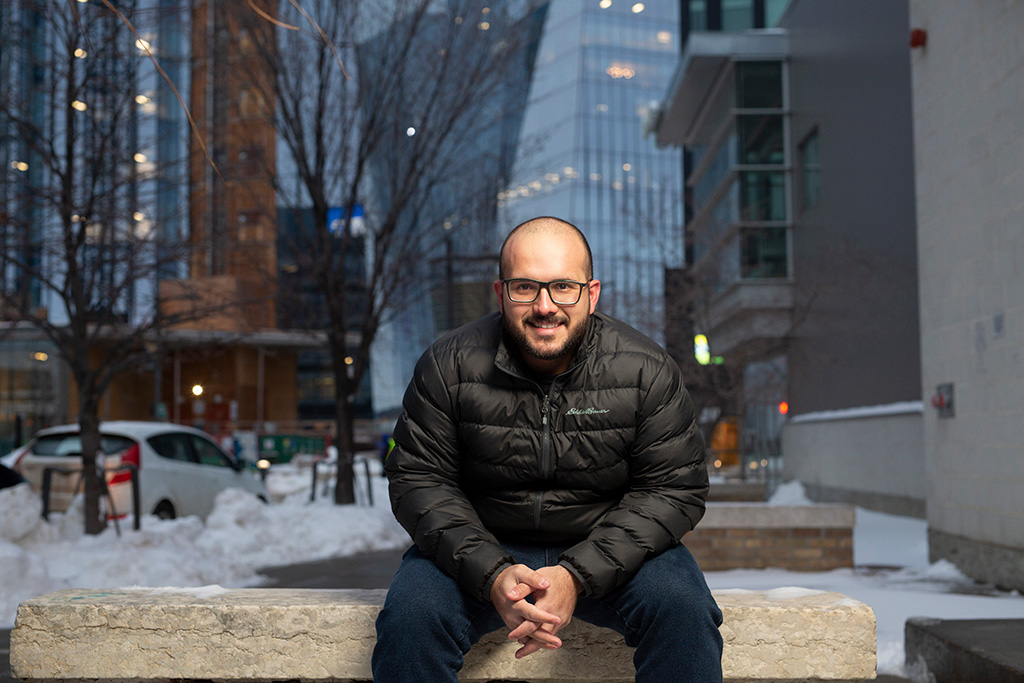
Hanniere Faria grew up in Anápolis, a town of 334,000 in Brazil’s inland Goiás state. So when the software developer started looking for jobs in Canada two years ago, “I didn’t want to live in Toronto, or big cities.” He landed in Saskatoon at Vendasta, a fast-growing SaaS firm with 450 employees, almost a third of them hired this year.
Faria is among the tens of thousands of professionals that Canadian companies have hired over the last three years via Ottawa’s new fast-track program for highly skilled foreign workers. Many have looked north as the U.S. has made it harder to get visas. But data obtained by The Logic suggests many of the new arrivals are indeed choosing to remain in Canada for the long term.
Talking Point
Canadian companies have used Ottawa’s new fast-track program for skilled foreign workers to hire tens of thousands of programmers, engineers and other professionals over the last few years, and a growing number are choosing to stay long term via permanent residence, data from the federal immigration department shows. Canada has benefited from new restrictions and longstanding delays in the U.S. immigration system, but a new administration has promised to fix those problems.
Ottawa’s Global Skills Strategy (GSS) promises to process work-permit and visa applications for highly skilled foreign workers in two weeks each; fast-growing tech firms had previously complained about losing top talent to foreign rivals because of months-long turnaround times. Between the program’s June 2017 launch and August 2020, the federal immigration department approved 39,742 first-time work-permit applications.
Many of those arrivals are seeking to stay long term. Over the same three-year period, 4,465 workers brought in under the GSS applied for permanent residence under the points-based Express Entry stream, per data from Immigration, Refugees and Citizenship Canada (IRCC). While that’s a relatively small share so far, the number of remainers is increasing—Ottawa received 2,030 requests in the first eight months of this year, double the volume from 2019.
Pre-pandemic, workers like Faria helped fill a talent gap. “If we are not able to address shortages in the labor market, it’s going to affect our output [and] productivity,” said Parisa Mahboubi, senior policy analyst at the Toronto-based C.D. Howe Institute. Tech workers were in particular demand, and Canada’s not the only nation facing an aging population and a talent gap. “This is a race about bringing more skilled immigrants into the country.”
Thousands of GSS workers have come from the U.S., where the Trump administration has restricted access and increased rejections for the H-1B visa program many Silicon Valley firms use to staff up. Staying long-term is also a challenge, since the U.S. caps the number of permanent residents from any single country to seven per cent of the annual allotment of about 140,000.
When Subash Padmanaban moved from New York to Toronto in September 2018, the wait time for an Indian citizen to get a U.S. green card was more than 20 years. “Until that time, you have to keep renewing your H-1B again and again, and if you get denied, you have to uproot your family and move in 15 days,” he said. “That’s not a healthy situation to be in.”
Padmanaban, who grew up in the southern city of Chennai and earned his PhD in biomedical and medical engineering at Arizona State University, is a research engineer at InteraXon, which makes brain-sensing meditation hardware. His degree, youth and work experience made him a competitive candidate for permanent residence under Express Entry, which awards points based on education, age and other criteria. He successfully applied exactly a month after getting to Canada. GSS arrivals may also qualify for provincial nominee programs and other federal streams.
Mala Sankara also picked the U.S. first, moving to Atlanta in mid-2014 on an H-1B to work for business-communication platform Movius. Once there, she discovered that “this lucrative American Dream is not easy, especially for immigrants coming from India and China.” While waiting on her visa extension, she found TextNow, a Waterloo, Ont.-headquartered firm with a popular free calling and testing service in the U.S.
Sankara arrived in Southern Ontario in January 2018. “The very first week, I was snow-tubing with [her team],” she recalled. At 111-person TextNow, she’s appreciated professional development opportunities like leading the quality-assurance team on an interim basis; she successfully applied for permanent residence at the end of her first year.
All three tech workers say the GSS lived up to its fast-turnaround billing. Padmanaban couldn’t quite believe the InteraXon recruiter when she said the whole process would be completed in a few weeks. “Somewhere deep down I thought, ‘It’s going to take a couple of months, at least, to get this work permit. I can wrap up my current project … and then move on,’” he said. Instead, 17 days after he accepted InteraXon’s offer, he had his stamped passport in hand. He packed most of his stuff into storage, and booked an Airbnb in Toronto. “I took three suitcases—that’s the Indian way of immigrating.”
Companies bringing in staff under the Global Talent Stream (GTS), designed to mainly fill in-demand tech roles, must first get Ottawa’s approval and commit to improving the domestic labour market by, for example, creating jobs for existing residents or funding skills training. Sankara and Faria were both among their firms’ first arrivals under the program, so the paperwork took a little longer to pull together, but once submitted, IRCC’s approval came swiftly. Processing times have lengthened during the pandemic—earlier this month, Bloomberg reported some companies have waited months.
Canadian startups have moved to take advantage of the Trump administration’s H-1B changes, and it’s worked. While 11,794 successful first-time GSS applicants over the program’s first three years were U.S. residents, just 798 were citizens, suggesting most were immigrants with temporary status in the country. But U.S. tech workers are still better paid than their Canadian peers, and the country remains the global destination of choice for would-be migrants. A change in government policy could reverse the northward flow.
President-elect Joe Biden has indeed promised to expand high-skilled visas for temporary workers, as well as raise the total number of employment-based green cards the U.S. issues. But his plan to link levels to unemployment and proposals for the H-1B program, plus the degraded state of the processing system, should preserve Canada’s immigration advantage for some time, experts recently told The Logic.
To compete with other countries for skilled workers, Canada needs to “create a path to permanent residency for these temporary foreign workers,” said Mahboubi, who suggests awarding more points to applicants with domestic experience than those with just a job offer. Such workers tend to fare better in the labour market, and made up more than half of economic-class immigrants in 2018, according to two recent studies from Statistics Canada.
Ottawa wants to admit 401,000 new permanent residents in 2021, part of an increased-level plan designed to make up this year’s pandemic-induced shortfall. The federal government is considering accelerating the switch to long-term status for temporary workers and international students. Meanwhile, application timelines for PR—already measured in months to the GSS’s days—have lengthened; because of COVID-19, Faria had to drive five hours across the provincial border to Red Deer, Alta. to find an open test centre for his English exam.
Still, like thousands of others who’ve come to Canada as highly skilled workers, all three scale-up employees are here for the long haul. Padmanaban cited InteraXon’s work on consumer electroencephalogram devices and Toronto’s booming tech ecosystem, where he’s found lots of people with similar interests. “There’s 100 people showing up on a Thursday afternoon for such a niche thing [as] wearable tech in health.” Sankara has found Waterloo residents to be welcoming, and “I’m able to [work] in a company where we do really cool, cool shit.”
For Faria, who arrived in September 2019, Canada was always the goal. After signing up with Vanhack, which matches foreign workers to tech firms, he picked Vendasta over a firm from Kitchener, Ont. for the better wages and the chance to work in a new programming language. His employer has now hired 10 developers via GTS; all have applied for PR or plan to. Another six are on the way. Faria sees “lots of room to grow” at Vendasta. He likes Saskatoon’s low cost of living and multicultural restaurant scene, even if there aren’t many tech companies. “The only thing that I really miss is açai.”