Though it may be some time before the results are final—and though the campaign of President Donald Trump is attempting to fight the ongoing vote-counting via the courts—as of Thursday morning, Democratic Party nominee Joe Biden had a path to victory in the U.S. election.
Skip to content

Special Report
What a Biden presidency would mean for Canada’s innovation economy
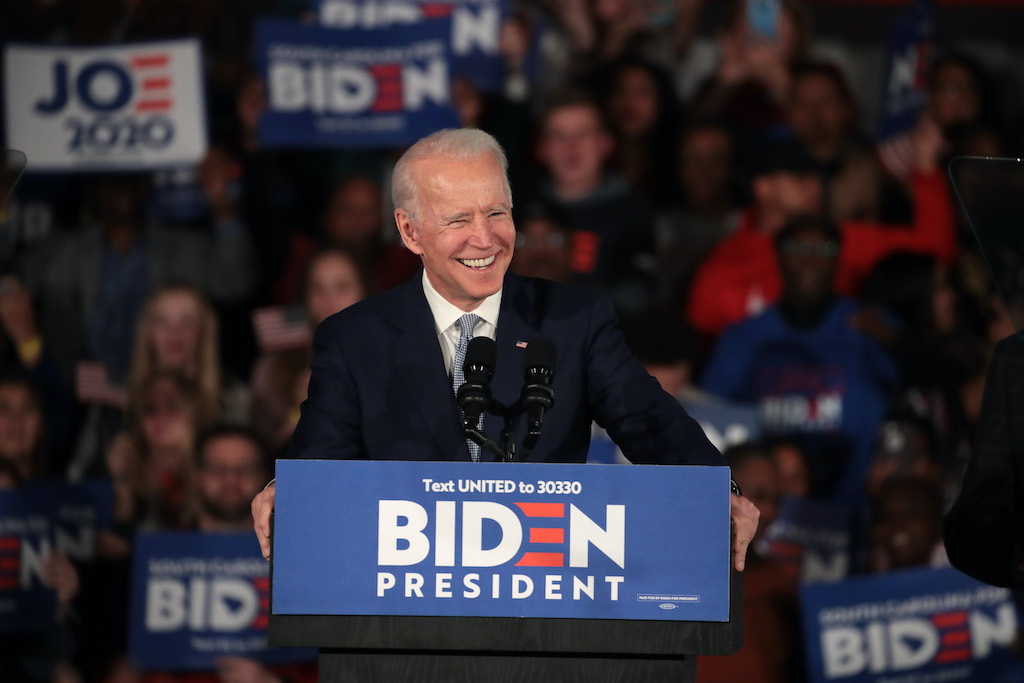
Joe Biden in Columbia, South Carolina in February 2020. Photo: Scott Olson/Getty Images
Though it may be some time before the results are final—and though the campaign of President Donald Trump is attempting to fight the ongoing vote-counting via the courts—as of Thursday morning, Democratic Party nominee Joe Biden had a path to victory in the U.S. election.
Talking Point
Joe Biden is proposing changes to the U.S. federal government’s policies on climate change, health care, immigration and labour rights, while the two parties have taken similar positions on other issues like digital taxation.
While Trump’s presidency has presented Canada with economic challenges—the protracted USMCA negotiations, for example, and disputes between the U.S. and China in which Ottawa has found itself in the middle—the U.S. has remained a major market for innovative Canadian companies and its venture capital firms major funders of Canada’s innovation economy. Tech firms here have benefited from the Trump administration’s immigration changes, which redirected some talent that would have otherwise have headed to Silicon Valley.
Biden is proposing changes to the White House’s positions on climate change, health care, immigration and labour rights—but on other issues like digital taxation, there’s a lot of similarities between the two parties. Here’s what a Biden presidency would mean for some key files affecting Canada’s innovation economy.
People
Innovation-economy firms in Canada have targeted highly skilled workers affected or put off by the Trump administration’s tightening of the U.S. immigration system, including a raft of changes to and restrictions on the H-1B visas many Silicon Valley giants use to hire. Canadian companies have used the federal Global Skills Strategy, a fast-track work-permit program launched in June 2017, to bring in thousands of engineers, developers and other professionals.
Other Trump moves have also redirected immigrants from the U.S. to Canada. In January 2017, he signed an executive order initially barring citizens of seven Muslim-majority countries from entering the U.S., with similar prohibitions later extended to other nations. “Somewhere between 260,000 [and] 280,000 people chose to apply to move to Canada instead of the United States as a result of the travel ban,” said Robert Falconer, a researcher at the University of Calgary School of Public Policy who studies immigration, citing a forthcoming paper. Many are international students, skilled workers, and university researchers directly contributing to R&D in fields like computer science and engineering.
Biden has promised to lift the ban, and to expand the number of high-skilled visas available for temporary workers. “Biden sends a stronger signal than the Trump administration of [being] welcoming to immigrants,” according to Falconer. But he said the White House has made significant changes to the U.S. immigration system that will slow a new president’s attempts to reverse its policies. That includes funding and staff cuts that limit the government’s capacity to handle applications, as well as making the process more complicated and lengthier to deter would-be arrivals.
While Biden also promised to lift the 140,000-person cap on employment-based green cards issued for employment, he would peg the number to domestic unemployment levels. “The United States, Canada, and the rest of the world [aren’t] exactly in an economic boom anymore, due to [the] COVID-19 pandemic,” Falconer noted. That means subdued levels for a while. Plus, immigration changes may not be high on the new administration’s domestic-policy agenda, as it grapples with the pandemic. Given all those factors, “Canada will continue to actually receive a large number of immigrants that would have otherwise gone to the United States.”
Canadian tech companies anticipated Trump’s 2016 win would create another stream of talent: expats returning from Silicon Valley. The administration’s policies and the U.S. political climate have made it an uncomfortable time to live there, said Laura Buhler, executive director of C100, a San Francisco-based network of Canadian executives and founders. But while some expats have returned—brought back in large part by the rise of Canada’s tech sector, Buhler said—people have continued to move south over the last four years. They’re driven by “the size of the opportunity that they can chase here, and what it means income-wise for them and their family, [or] what it means for their business,” Buhler said. “Those things are still here.”
COVID-19, not the election outcome, might actually help Canadian tech companies recruit in Silicon Valley. “When it comes to scale, one thing [Canada is] lacking is senior talent,” said Angela Tran, a San Francisco-based general partner at Vancouver-based VC firm Version One Ventures. “It’s really hard to get people to move to Canada from California, because of this thing called winter.” As the pandemic has made remote work viable or desirable, some of Version One’s larger Canadian portfolio companies have been able to hire U.S. employees without moving them across the border.
Policy
A change of president could also mean big shifts in major markets for Canadian cleantech and digital health startups. The Trump administration has moved to withdraw the U.S. from the Paris Climate Agreement, and has reduced policing of environmental regulations. While private-sector organizations are increasingly making their own carbon-neutrality and emission-reduction commitments, “some VCs that are looking at some of our seed portfolio companies in climate wonder about the total addressable market” in the absence of enforcement, Tran said.
Biden has promised a US$2-trillion climate plan, including green infrastructure, zero-emission transit and cleantech innovation funding. But he’s also pledged to prioritize American manufacturing and to favour domestic firms in federal procurement. Tran said protectionism is not a major concern, however. “None of our portfolio companies … have fears around being able to do business in the U.S.,” she said, although pandemic downsizing has hurt demand in some industries.
The Democratic nominee is also proposing an expansion of the Affordable Care Act, former president Barack Obama’s health-care reform that the Trump administration is challenging in the Supreme Court. In both Canada and the U.S., digital health platforms—including those offered to workers as part of employer-provided benefits— have seen sharp spikes in demand during the pandemic. “A lot of our portfolio companies are more consumer-facing, and are offering cheaper alternatives to treatment, diagnosis or care,” said Tran; they may benefit from a more privatized system. “But it is concerning that health care is moving away from being a basic right in this country … compared to Canada.”
While some candidates for the Democratic presidential nomination backed plans for a Canadian-style public health-care system in the U.S., inspiration on one major labour-policy issue could flow the other way. Both Biden and Democratic vice-presidential nominee Kamala Harris have backed a California law designed to make clear that gig workers using on-demand platforms like Uber, Lyft or Instacart are employees with the right to benefits, not independent contractors. A successful measure also on the ballot Tuesday will exempt ride-sharing and delivery drivers.
To be classified as independent contractors under California’s three-part test, workers must be free from the platform’s direction or control; doing tasks that aren’t core to the platform’s business; and have an independent business in the same industry. “It’s a good approach and something that we should look to in Canada, both at the provincial and federal levels, when we’re considering … how to classify gig workers,” said Sunil Johal, a fellow at the Brookfield Institute for Innovation + Entrepreneurship.
Many on-demand apps were created in California, and governments elsewhere may be persuaded by the approach their “home jurisdiction” is taking to regulating labour standards. And the Biden campaign has promised to “establish a federal standard” based on the three-part test. While Canada isn’t required to follow the U.S., harmonizing rules across borders would make it “much harder for the platforms to jurisdiction-shop and pursue the most friendly regulatory environment that may not be balanced,” said Johal, who chaired an Ottawa-appointed expert panel reviewing Canada’s labour laws.
The world
More than 130 countries are currently engaged in OECD-led negotiations to reform the way multinational corporations are taxed, with proposals to ensure firms pay where they make money, rather than just where they’re headquartered, and establish a global floor so that they can’t simply shift profits to places with lower rates. The Trump administration has been one notable holdout. In June, Treasury Secretary Steven Mnuchin called for talks to be paused and withdrew, citing the pandemic. “The administration didn’t want to be in the process of trying to negotiate an agreement at the OECD in the run-up to the election,” said Brian Jenn, who previously represented the U.S. on digital-tax policy at the multilateral organization.
But there’s also a philosophical disagreement. Jenn said European countries were pushing for an interim deal targeting digital companies, which are mainly headquartered in the U.S.; the administration would not agree to separate tech firms from the broader corporate tax overhaul.
That wouldn’t necessarily change under a President Biden. This is “one of the only areas of tax policy in the United States where there’s been a lot of bipartisan agreement recently,” said Jenn, now a Chicago-based partner at law firm McDermott Will & Emery, who cited senior congressional Democrats and Republicans’ support for the treasury department’s position in the OECD negotiations.
Last month, the organization extended its target to reach a deal to mid-2021, and expressed concern that countries would impose their own digital-services taxes (DSTs) if a consensus can’t be reached. The Trump administration has strongly opposed such measures, previously threatening France with tariffs. In June, the U.S. Trade Representative (USTR) launched Section 301 investigations of 10 digital-services taxes, the precursor to similar levies. While a Biden administration may be more reluctant to introduce new tariffs, “it’s really the only kind of tool or lever that the United States has against these DSTs,” Jenn said. The USTR investigations are likely to continue in the rest of Trump’s term through January, giving the new president “a bargaining chip” for negotiations with countries that impose such measures.
During the 2019 federal election campaign, the Liberals proposed a three per cent DST on the targeted-ad-sales and digital-service revenues of firms with at least $1 billion in worldwide and more than $40 million in Canadian revenue. The September throne speech, meanwhile, promised to tackle “corporate tax avoidance by digital giants.” Canada won’t get any special treatment if it proceeds with a tech-targeting levy, said Jenn, adding that such a measure may violate the USMCA.
Trade lawyer Barry Appleton said the federal government could implement a DST-like policy under the trade deal’s public-policy exemptions. But he expressed concern about “an ongoing fear in Canada to engage in policymaking because we’re going to make the Americans angry.” Biden might not react to Ottawa’s decisions with “very negative tweets” as Trump has, said Appleton, who’s also co-director of New York Law School’s Center for International Law. However, the new administration would be similarly unlikely to welcome Canada adopting, say, data legislation akin to Europe’s GDPR.
As technology-policy and geopolitical experts told The Logic in August, Canada has increasingly been drawn into digital and economic disputes between the U.S. and Chinese governments. Appleton said Biden is likely to take a different approach to Beijing than his predecessor, focusing more on standards in areas like 5G or data localization, and less single-mindedly on bilateral trade balances. But that won’t necessarily help Canada’s position. “Ottawa’s the meat in the sandwich,” he said. “It’s caught in the middle.”



Loading...
Thanks for sharing!
You have shared 5 articles this month and reached the maximum amount of shares available.
CloseThis account has reached its share limit.
If you would like to purchase a sharing license please contact The Logic support at [email protected].
CloseGift the full article!
You have gifted 0 article(s) this month and have 5 remaining.
Recipients will be able to read the full text of the article after submitting their email address. They will not have access to other articles or subscriber benefits.
Photo: Scott Olson/Getty Images
Most Popular This Week




In-depth, agenda-setting reporting
Great journalism delivered straight to your inbox.
News
RBC’s AI chief sounds the alarm over AI agents
Briefing
Canada and Ontario commit over $5B to support tariff-hit steel sector
Hackers will see cars as major targets in next 3 years, 83% of car-tech workers say
EA shutting down Edmonton studio BioWare
Best business newsletter in Canada
Get up to speed in minutes with insights and analysis on the most important stories of the day, every weekday.
Exclusive events
See the bigger picture with reporters and industry experts in subscriber-exclusive events.
Membership in The Logic Council
Membership provides access to our popular Slack channel, participation in subscriber surveys and invitations to exclusive events with our journalists and special guests.





