OTTAWA — Personal robot butlers may be the stuff of ’80s movies, but tech firms are now offering businesses artificial intelligence assistants capable of carrying out customer service and operational tasks.
Skip to content

News
Tech firms want to add AI ‘agents’ to the workforce—and your daily life
Toronto-based Ada lets businesses delegate customer service to virtual helpers
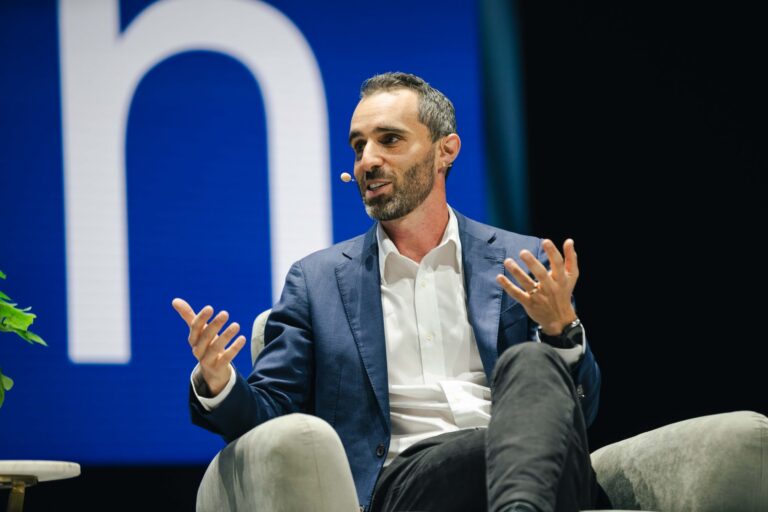
Ada chief product and technology officer Mike Gozzo at the company’s conference in San Francisco in November 2023. Photo: Ada | Handout
OTTAWA — Personal robot butlers may be the stuff of ’80s movies, but tech firms are now offering businesses artificial intelligence assistants capable of carrying out customer service and operational tasks.
ChatGPT and similar tools constructed with large language models can respond to users’ prompts with paragraphs of text, summaries of documents or lines of code. Machine learning pioneers and Big Tech executives anticipate the next big thing will be AI “agents,” systems capable not only of providing information but of going out and completing multi-step tasks on their own.
Talking Points
- Tech startups and researchers are betting the next evolution of AI is “agents,” systems that autonomously go out and perform tasks on behalf of their users.
- Toronto-based Ada is finding success selling businesses AI agents for customer service. The technology could eventually lead to personal assistants who can help consumers with e-commerce purchases, appointment scheduling and other daily functions.
For consumers, they could act as always-on personal assistants, scheduling your appointments, doing your online shopping or calling ahead to the hotel to book a spa treatment. While such AI helpers are not suiting up just yet, startups are starting to hire them out to businesses for functions like support and workforce management.
Toronto-based Ada launched its customer-service agent last November, and revenue from the product is growing rapidly, said CEO Mike Murchison. For years, the scale-up’s clients in sectors like retail and telecom have used its software to build chatbots that can check delivery schedules or change phone plans.
Previously, though, clients had to lay out the workflow the system should follow in response to a particular kind of request. Now, the agent plots its own path from the ask to the answer with the information it has about the user and integrations with other software systems, course-correcting as needed.
“The key difference here is that it’s autonomous,” said Mike Gozzo, Ada’s chief product and technology officer. AI agents can gather context, plan a sequence of actions, execute them, then iteratively improve. Ada claims the new system resolves over 70 per cent of clients’ customer-service interactions without involving a human rep, more than double the previous rate.
Related Articles


The company’s AI agents employ third-party and fine-tuned models, which it sources via Microsoft’s cloud service; the part that formulates a plan of action is currently powered by OpenAI’s GPT-4 Turbo. Outputs—finding the current location of a shopper’s package, say—are achieved using the APIs of clients’ e-commerce, CRM and other software tools.
On Wednesday, Ada announced its AI agents soon won’t need integrations, instead using machine vision to find information and take actions in customers’ apps. The firm is making it easier for taskmasters to see how the system is working through problems and train it more efficiently. And it will let them field requests via email, in addition to phone, messaging and social platforms.
Not all of Ada’s clients currently use the AI agents, but “that’s where all the momentum is,” according to Murchison. The goal, he said, is to automate 100 per cent of support conversations.
“Our competition is not a Zendesk, or a Salesforce, or some other chatbot vendor. We are in the market competing against human labor.”
The company, which has raised US$190 million to date according to PitchBook data, projects plenty of room to grow, even among the huge tech firms offering customer-service tools. “Our competition is not a Zendesk, or a Salesforce, or some other chatbot vendor,” said Gozzo. “We are in the market competing against human labor.”
Potential rivals are emerging. In February, San Francisco-based Sierra emerged from stealth with US$110 million in funding and clients including Sonos and WeightWatchers. Former Salesforce co-CEO Bret Taylor co-founded the startup; he’s also chair of model-builder OpenAI. (Murchison said Ada has yet to go head-to-head with Sierra in deal cycles).
Firms are also launching AI agents in other fields of business operations.
Toronto-based Borderless AI offers one to help with HR tasks, including generating contracts; onboarding new workers; and reviewing and approving employee vacation requests and expense claims. The firm, which announced a US$27-million seed round in March, is first targeting companies with remote international workers; its system can translate and reconcile requirements between different labour-law jurisdictions.
“The more adoption our AI agent gets, the smarter it gets,” said Borderless CEO Willson Cross. It uses Toronto-based Cohere’s Command-R and Embed models, and a technique called retrieval augmented generation that allows the system to work employment-law data into its outputs.
An agent could eventually be “your financial advisor, your doctor and your scheduler.”
Vancouver-based Cognosys offers something like an AI briefer, with agents that can conduct research, synthesize news as well as summarize and prioritize users’ email inboxes.
Researchers and firms are also working on personal-assistant agents. “The next evolution of these methods is that you’re not just going to ask ChatGPT and it gives you the answer,” said Ruslan Salakhutdinov, a Carnegie Mellon University professor. “It’ll go and do stuff for you.” Salakhutdinov, previously Apple’s director of AI research, said an agent could eventually be “your financial advisor, your doctor and your scheduler.”
At its I/O developer conference this month, Google teased agents that can manage shoppers’ e-commerce returns or find them a dog walker after they move to a new city. Meta is also working on task-accomplishing AI systems, as, reportedly, is OpenAI.
Consumer agents will fuel demand for business ones, sector executives predict. Take travel. While a small share of hotel guests currently call ahead with special requests, many more are likely to do so if they can let AI do the asking. “There’s going to be a big increase,” said Murchison.
Businesses will also expect their agents to be able to talk to one another—for example, a customer-service system could alert a client’s software-development tool about a code bug revealed by user feedback. That will require the agents to speak a common language.
Some in the field warn that agents could be the way AI escapes human control, with systems inflicting harm in pursuit of their goals. For now, they may simply make mistakes, or take a less efficient route to accomplishing a task than a person would. In a December paper, OpenAI researchers suggested safeguards such as ensuring an agent is the right one for the job, limiting the actions it can take and requiring human approval for important decisions.
Ada’s Gozzo said some customers are being cautious, running agents in pilots before deploying them widely. “There’s people that are afraid of it,” he acknowledged. “You’re trusting a machine to reason.” But he puts some of that down to doubts deliberately seeded by tech firms jostling for market share, and expects more businesses will follow the early adopters. “We’re going to be overrun with agents in short order—in the next two years.”



Loading...
Thanks for sharing!
You have shared 5 articles this month and reached the maximum amount of shares available.
CloseThis account has reached its share limit.
If you would like to purchase a sharing license please contact The Logic support at [email protected].
CloseGift the full article!
You have gifted 0 article(s) this month and have 5 remaining.
Recipients will be able to read the full text of the article after submitting their email address. They will not have access to other articles or subscriber benefits.
Photo: Ada | Handout
Most Popular This Week




In-depth, agenda-setting reporting
Great journalism delivered straight to your inbox.
News
Ottawa is softening its ban on stablecoin yield
Briefing
Rio Tinto gets nearly $165M in additional federal funds for Quebec aluminum
U.S. to lift tariffs on some Canadian products crucial to Maine: Collins
Carney warns of tech dependence after Starlink disruptions in Ukraine
Best business newsletter in Canada
Get up to speed in minutes with insights and analysis on the most important stories of the day, every weekday.
Exclusive events
See the bigger picture with reporters and industry experts in subscriber-exclusive events.
Membership in The Logic Council
Membership provides access to our popular Slack channel, participation in subscriber surveys and invitations to exclusive events with our journalists and special guests.






