The only visible sign of Apple’s presence in the Ontario tech hub of Kitchener-Waterloo is the gleaming, glass-fronted Apple Store nestled between a Lululemon outlet and a shoe mart at the Conestoga Mall.
But a brisk half-hour walk from Waterloo’s “premier shopping destination,” at the top end of town where a few tech firms cluster, sit offices in which a team of artificial intelligence researchers developed a novel approach to building deep learning models—work that could bolster the Silicon Valley tech giant’s growing AI ambitions.
Talking Points
- Apple’s acquisition of DarwinAI buys it a team of computer vision experts who developed technology for training AI models faster and making them smaller
- Sources with knowledge of DarwinAI told The Logic that Apple made the initial approach, with negotiations starting last October and the deal closing in January
Earlier this month, Bloomberg broke the news of Apple’s stealthy takeover of DarwinAI, a lesser known, seven-year-old startup of a few dozen people founded by four computer vision experts and two experienced tech executives with ties to University of Waterloo.
The Logic has learned that Apple approached DarwinAI about buying it last October and the acquisition closed in January. According to two sources, whom The Logic agreed not to name because they aren’t authorized to discuss the matter publicly, Apple paid more for DarwinAI than the startup’s valuation at the time of its most recent known fundraising. The announcement of that financing—a US$6-million round the startup closed in December 2022—didn’t include a valuation, but DarwinAI CEO Sheldon Fernandez told The Logic at the time that it pegged the company at less than the US$27-million valuation set by its previous round.
Fernandez declined to speak for this story, and Apple did not respond to multiple requests for comment. So to trace DarwinAI’s evolution and innovations, The Logic spoke with 10 sources with knowledge of the startup, the field of artificial intelligence and the Kitchener-Waterloo tech ecosystem. Some spoke on the condition they not be identified due to concerns about commercial sensitivities; Apple is renowned as a black box, disclosing much less about its acquisitions or plans than other large tech firms. The Logic also examined public filings, and drew on its own and other outlets’ prior interviews with DarwinAI’s principals.
Apple bought DarwinAI for its technology and for its team, said one of the sources. But in acquiring this relatively unknown Canadian startup, what exactly is the tech giant getting?
Much of the current generation of AI tools is built out of neural networks, a type of model that mimics the human brain, and one proved out by Canadian researchers. DarwinAI has developed methods for speeding up the training of AI models, while making them smaller and faster and giving users a window into how the systems are making decisions.
Co-founder Alexander Wong helped come up with the approach at the University of Waterloo (UW) in the late 2000s and early 2010s, because he didn’t have the funding for the computing power his research required, Fernandez has said.
A UW alumnus himself, Fernandez launched and sold a software consulting firm before joining DarwinAI’s founding team. The company’s original approach, which it dubbed “generative synthesis,” uses an AI system to analyze the design of a prototype model and consider the users’ requirements. Then it produces a new set of neural networks that require less computing power, but that work just as well. Fernandez once likened it to “middle out” compression, the novel method for making files smaller that turned the fictional startup Pied Piper into a tech giant on the HBO show “Silicon Valley.”
By late 2017, the startup was one of a few trying different ways to improve neural network performance and efficiency so they could run in “edge” settings like in autonomous vehicles. Two of the other contenders were snapped up by Big Tech companies in 2020: Xnor.ai by Apple, and SigOpt by Intel. But DarwinAI’s results were “thoroughly mind-blowing,” said Antoine Nivard, an investor who co-led the firm’s US$3-million seed round in September 2018, and who served on its board until 2021.
While Apple has long offered AI-powered features like its Siri voice assistant and photo composition, it has yet to launch a foundation model—the largest multi-purpose models used in generative tools—like OpenAI’s GPT-4, Google’s Gemini or Amazon’s Titan. “We have a lot of work going on internally,” Apple CEO Tim Cook said on an earnings call last month, calling the technology “a huge opportunity” for the company. The tech giant has scheduled its blockbuster Worldwide Developers Conference for June, with one executive promising it will be “Absolutely Incredible!” (Read: AI.)
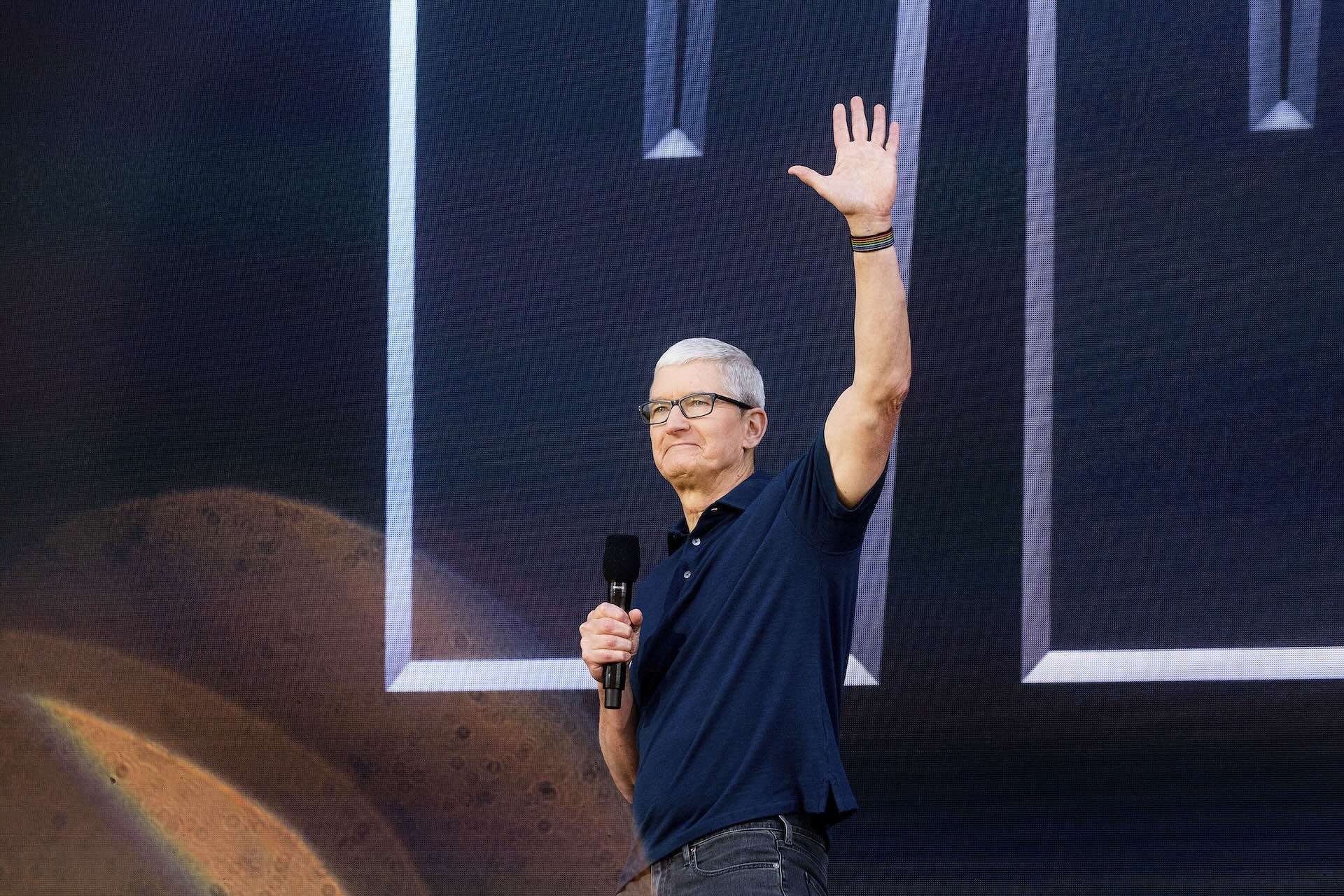
Apple CEO Tim Cook at the World Wide Developer Conference at Apple's headquarters in Cupertino, Calif., in June 2022. Photo: The Canadian Press/AP Photo/Noah Berger
Stock analysts expect Apple eventually will offer new AI capabilities that run on its devices. Researchers at other tech firms told The Logic that such an approach, which limits the data shuttling back and forth to the cloud, could enhance privacy, which Apple has made a key selling point for its brand.
Developers have historically needed large amounts of processing power to train and run AI models, typically using cloud computing services or large numbers of specialized chips. But generative synthesis can create models that work in “on-device edge scenarios such as mobile and other consumer devices,” Wong and his DarwinAI co-founders Mohammad Javad Shafiee, Brendan Chwyl and Francis Li wrote in a September 2018 research paper.
A presentation Fernandez voiced for an AI event in June 2020 claimed the firm’s optimization technique could reduce the size of models for voice recognition or image enhancement by 87 per cent and speed them up tenfold, letting them run on phones or TVs.
While that’s an obvious reason Apple might want to acquire DarwinAI, the startup tried a few different things with its technology over a seven-year history that saw it earn investment from the Business Development Bank of Canada’s Deep Tech Venture Fund, mainstay Canadian financiers Inovia Capital and Garage Capital, and industrial giants Honeywell and Lockheed Martin.
Its first product was a set of developer tools that optimized AI models and “eliminated the black box of artificial intelligence” by showing users how those models were reaching conclusions, Fernandez told The Logic last year.
The company had about 10 clients for the offering. But sources said it wasn’t as simple as DarwinAI thought it would be to sell to firms developing AI, despite the promise it could help them build faster, more transparent systems. Darwin AI’s potential clients didn’t want to use technology they didn’t own for such a core piece of their systems, and their internal teams didn’t appreciate having their own model-building attempts shown up by some unknown startup.
After exploring ways its technology could be put to use by clients in financial services and health care—it contributed to an effort to diagnose COVID-19 infections from chest X-rays and CT scans, and hired experienced medical IT executive Gary Pacheco from Telus Health to be chief technology officer, but found it difficult to commercialize an AI medical imaging product—DarwinAI decided to focus on the manufacturing sector.
The firm put its AI models and software to work detecting defects in printed circuit boards, plates connecting semiconductors and other critical components. At plants using the technology, production lines flowed through a freezer-sized unit containing cameras, which would photograph components as they passed. DarwinAI’s system then checked to make sure that they met the clients’ designs—no missing soldering or misplaced parts. It piloted the product with one of its investors, Honeywell, according to former employees.
As it worked to commercialize its technology, DarwinAI conducted small rounds of layoffs in early 2021 and late 2022, the ex-staff say. The firm started fundraising in mid-2022 in a difficult financing environment—the pandemic VC spending spree had passed but the ChatGPT-fuelled AI boom had yet to begin. “It wasn’t an ideal time to do it, but we just had to do it,” Fernandez told The Logic that December, as DarwinAI closed its US$6-million round at a diminished valuation. Ultimately, the size of the circuit board market—they’re built into everything electronic, from mobile phones to fighter jets—helped the firm find fresh capital.
Over the next few months, the offering found traction. In September 2023, Fernandez told The Logic that DarwinAI had a dozen clients using the system in production and about the same number piloting it. It was also expanding to new manufacturing lines within existing clients like Honeywell, and had enough cash to manage, according to a source with knowledge of the company.
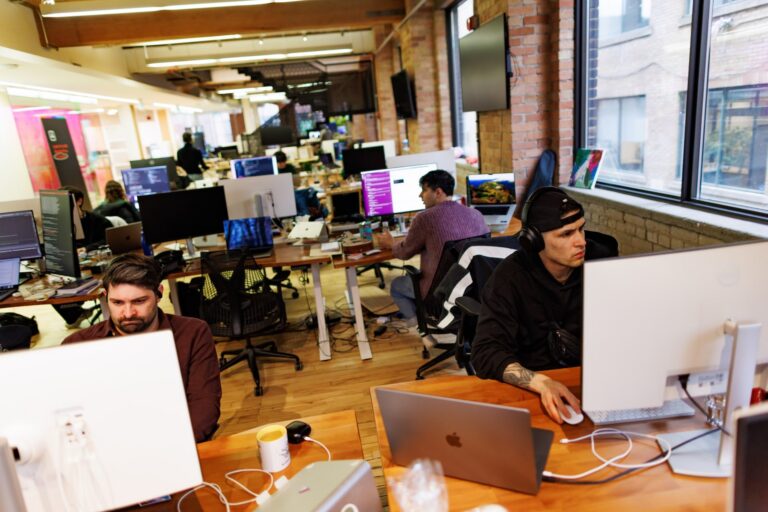
The staff of DarwinAI at their office in Waterloo, Ont. at the time of its US$6-million raise in December 2022. Photo: DarwinAI | Handout
The firm saw growing opportunity in the increasing demand for electronics and the increase in their production in North America, as governments sought to reshore critical supply chains while boosting adoption of electric vehicles and other chip-heavy products. It was fielding a lot of inquiries from potential clients, the source said.
Then, a tech giant came calling. “Apple made a very generous offer, and it was a nice home for everyone,” said one of the sources. The deal closed in January.
While Apple now designs its own chips, it outsources device manufacturing, so it’s unlikely to need technology to help it catch circuit board errors. But the current iteration of DarwinAI’s tech can train models on relatively small amounts of data, speeding up the process, as well as produce additional examples when there aren’t enough available, according to a former employee.
That wouldn’t be much of an advantage for firms building the large language models that power tools like ChatGPT, since text is abundant. But the technology is “the holy grail” in computer vision, the ex-staffer said, since it avoids the need to label every shifting object in each frame of a video. Researchers at Apple have recently published papers on multi-modal models that work with both text and images. Other tech firms have released video-generating tools.
Apple’s AI rollout may still be in its early stages, but its ambitions are long-standing. According to David Clausi, the University of Waterloo engineering faculty’s associate dean of research and external partnerships, the tech giant came to the school two or three years ago to scout researchers doing interesting AI work. Staff in the department’s dedicated office for industry collaboration arranged for Apple representatives to meet members of the university’s Vision and Image Processing Lab, including Wong, who like Clausi is among the lab’s directors.
DarwinAI isn’t the only notable local name with ties to the lab, of which Clausi and Wong are both directors. Kitchener, Ont.-based Miovision, a traffic technology scale-up, is built on work started there. The lab has also worked with nearby SkyWatch, a satellite imagery startup. The group makes the Kitchener-Waterloo area one of the country’s leading centres of computer vision expertise, said Clausi.
The lab is much more efficient and productive than its peers at turning out companies and AI solutions, all on a “shoe-string, self-generated budget,” he said. “The other ecosystems in Toronto, Montreal and Edmonton, they get barrels of money from the government.” The federal government’s $568.8-million Pan-Canadian AI Strategy, which subsidizes universities to hire AI researchers, runs through AI institutes in those cities. Clausi said the UW lab could do more with more money for research.
In addition to DarwinAI’s tech and team, Apple is also getting the startup’s IP, which includes at least four families of published, pending patents, according to Google Patents data. Post-acquisition, Wong is now a director of machine-learning research at Apple. The tech giant offered most, but not all of DarwinAI’s employees positions, according to multiple sources. They said Apple plans to keep most of the team in Waterloo, working together on AI.
Meanwhile, local tech players are wondering whether Apple will build a presence in the community beyond the Genius Bar at the Conestoga Mall.
“We have seen great value when a global player like Google or Apple makes a decision to invest in a Canadian entity,” said Iain Klugman, the CEO of business strategy firm NorthGuide who as head of local tech hub Communitech was instrumental in integrating Google—now a major local employer and philanthropist—into the community.
Charles Chung, a K-W entrepreneur and mentor with accelerators Creative Destruction Lab and FounderFuel, sees opportunities for the area’s startups and local jobs for grads of the region’s well-regarded STEM programs. “It can potentially be snowballing,” he said.
Not everyone agrees the deal is a local victory. Armen Bakirtzian, CEO of medtech scale-up Intellijoint, believes the acquisition will benefit “the commercial efforts of a foreign giant” at the expense of “local economic development efforts.” He noted that Apple so far hasn’t made an impression on the community. (Klugman and Chung said the same.) “It’s great that we got their attention,” said Klugman. “It’d be great if they decided to make investments in this community.”
In fact, Apple has already done at least one other AI deal in DarwinAI’s backyard. In 2020, it acquired Inductiv, a startup co-founded by UW professor Ihab Ilyas that specialized in tools for cleaning up data. But local tech founders say Apple did not establish a presence in the region on the back of that buy, and Ilyas is now in Seattle, according to his LinkedIn.
Wong, at least, remains a professor at UW, the school that trained much of DarwinAI’s core technical team; Wong himself supervised Shafiee’s doctoral work, and Chwyl and Li’s graduate work. Despite his startup commitments, Wong keeps up a steady pace publishing research, and a knack for creative titles—papers he’s co-authored have introduced new model-building techniques like “YOLO Nano,” “SquishedNets” and “FermiNets,” nicknamed for the particle-studying Italian physicist Enrico Fermi.
Nivard, who is now general partner at San Francisco-based Blank Ventures, contrasted the DarwinAI co-founder with Canadian AI luminaries like Geoff Hinton, Yoshua Bengio and Richard Sutton, who he said are very academic and not particularly interested in industrial uses of their inventions. “Alex is a different type of researcher,” Nivard said, describing Wong as “more minded around building commercial applications and building the next BlackBerry or Shopify with [his] technology in Canada.”
Unlike the founders of those companies, whatever Wong builds will be part of a massive, foreign behemoth. Nivard wonders if DarwinAI may simply have been “a tad too early” with its model-optimization innovations. Technology like that has “much broader and bigger use, demand and application today than they could ever get in 2018,” he said.