More than a quarter of the innovation-economy firms that held initial public offerings on Canada’s main exchange since 2021 have since reversed course—a trend that experts say is likely to continue as economic conditions and lower valuations have led to prime conditions for takeovers.
The disappearance of Canadian tech listings comes amid a complete freeze of innovation-economy initial public offerings on the country’s main stock exchange this year and just one corporate IPO by the end of November.
Talking Points
- Nearly 30 per cent of the innovation-economy firms that held IPOs on the Toronto Stock Exchange since 2021 have delisted or announced an intention to do so
- The TSX is poised for a sixth consecutive quarter with no innovation-economy IPOs and has only had one corporate IPO as of the end of November
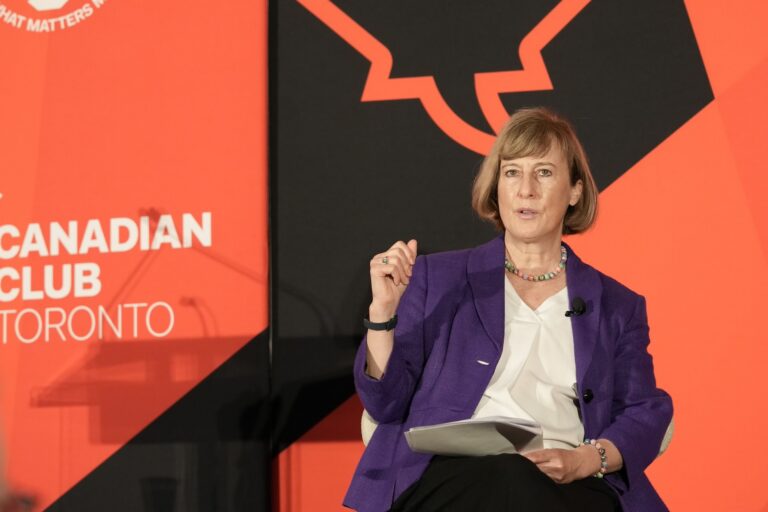
“We’re seeing a record number of take-privates, which is not surprising,” said Ramandeep Grewal, a partner at Stikeman Elliott’s corporate group. Companies considering acquisitions are taking advantage of attractive valuations thanks to the current economic conditions, she said. Grewal added that Stikeman has been involved in more of these types of M&A deals this year than in recent memory.
Just this year, seven innovation-economy firms that joined the Toronto Stock Exchange since 2021 have delisted or are in the process of doing so.
Most recently, the majority owner of embattled agtech firm Farmers Edge proposed taking the company private. In November, Q4, an investor-relations software company whose business relies on the health of public markets, agreed to a takeover. BBTV said it will go private in a deal with a numbered corporation owned by its CEO and a board director. Montreal-based telemedicine firm Dialogue Health was acquired by existing investor Sun Life.
In April, E Automotive decided to voluntarily delist, saying that staying public did not “offer substantial benefits.” In March, the exchange delisted HempFusion Wellness, which has since filed an assignment in bankruptcy, after it found the firm failed to meet its ongoing listing requirements. Magnet Forensics was acquired in early 2023. That followed MindBeacon’s sale to CloudMD in 2022.
Still, Dani Lipkin, managing director of the global innovation sector for the TSX and TSX Venture Exchange, said TSX-listed companies decide to go private every year, but some—such as Softchoice—also come back. Sometimes a company will go private if their business is struggling or presented with a strong acquisition offer. “They can sort themselves out on the private side and then come back and access capital when the right time is there,” said Lipkin.
Those remaining on the public markets may well be future acquisition targets as experts expect the number of delistings to grow in the near future.
“There’s still opportunities for take-privates,” said Grewal. Over the past year, some players have been exploring Canadian targets and are still in the assessment phase, she said.
Maxim Matushansky, an equity research analyst at RBC Capital Markets, expects the pace of consolidation to remain high. There’s now a large number of publicly traded companies, he said—in part, due to a record number of IPOs in 2021. Typically, a period with lots of new listings is followed by higher levels of mergers and acquisitions, he said, and “now, that’s been playing out.”
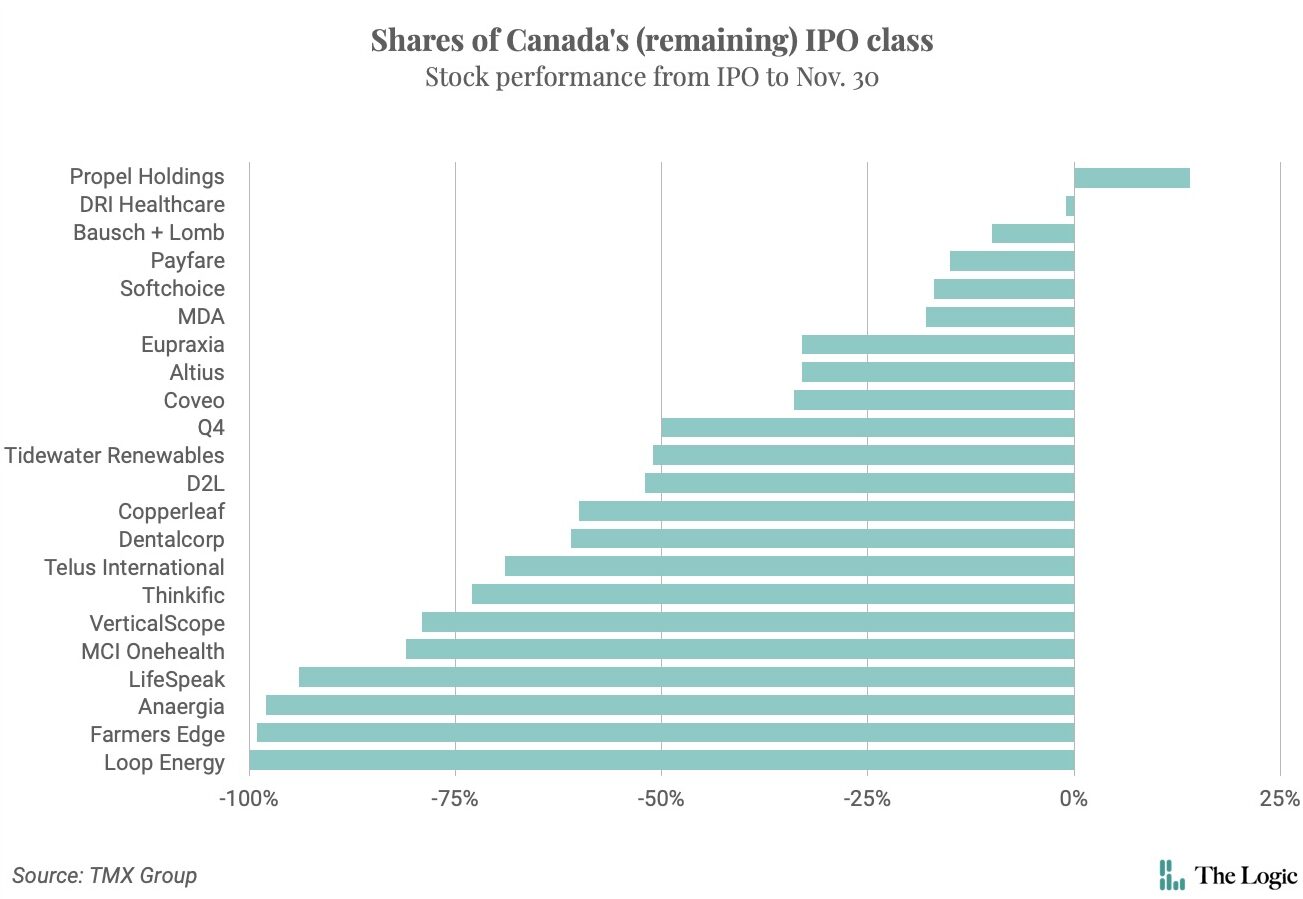
Part of the appeal comes from lower valuations. Of the IPO class of 2021 and onwards remaining on the public markets, all but one traded below their offering share prices by the end of November.
Several have launched strategic reviews, including Loop Energy and Anaergia, whose process is still underway as the company seeks more cash to keep operating. MCI Onehealth, meanwhile, reviewed its options as it was running out of money. In July, Well Health refinanced MCI and refocused it to AI tools. It later renamed itself Healwell AI and changed its TSX symbol to AIDX.
Some innovation-economy firms that went public from 2021 onwards with which The Logic spoke said they’ve been approached about potential acquisitions, but remain committed to staying public.
VerticalScope, which held its IPO in July 2021, has “received significant inbound interest” from parties looking to acquire or merge with it over the past 18 months, said CEO Rob Laidlaw, in an emailed statement. He declined to provide more detail on the nature of the discussions, but said the company has patient major shareholders and a profitable business model suited to weathering this type of economic storm.
Dentalcorp, which launched a strategic review late last year and determined it would stay the course on its business strategy, first decided to start that process “in response to several expressions of interest,” said CEO Graham Rosenberg. He believes the company is currently undervalued and will become more attractive as it executes on its strategy.
Everyone is having more conversations about the possibility of acquisitions now, said Greg Smith, CEO of Thinkific, adding his company has not been immune. That’s partly because of the recent trend of delistings, he said. “I think the topic is on a lot of people’s minds, partly because your price is down and some people out there maybe think they can get a deal,” said Smith. But he believes his firm is in a different position, having recently reached profitability on its adjusted EBITDA (earnings before interest, taxes, depreciation and amortization) faster than expected. Thinkific’s share price, he noted, has been recovering; though it’s still well below its IPO offering price.
Two companies from the cohort of firms that went public in 2021—Coveo and Softchoice—also highlighted their shares’ stronger performance relative to their peers, as well as how their work in AI makes them more appealing to investors.
While delistings have been on the rise, by the end of November, the Toronto Stock Exchange appeared poised for a sixth straight quarter with no innovation-economy firm—one from the tech, cleantech or life-sciences sectors—holding an IPO. Meanwhile, the exchange has only had one corporate IPO in the same period, compared to three last year.
“It was a bit more of a challenging year on a global basis,” said Lipkin of the overall drop in IPO activity around the world.
But he pointed to signs of life: the TMX continues to be in discussions with companies waiting to debut once economic conditions improve and a bump in additional financing activity.
There are some companies in the global tech sector planning IPOs in 2024, but they’re a more established cohort. Reddit, Klarna and StubHub, for example, will all be 17 years or older next year. Meanwhile, BlackBerry, which had announced it would spin off its Internet-of-Things division via IPO by June, decided in December to shelve that plan.
Matushansky expects the first IPOs to debut to be higher-quality firms, though it’s unclear to him when a window for new listings may open.
At least the first half of the year will continue to experience some market uncertainty, said Grewal. “Until things start to change, we’ll probably still stay in a wait-and-see pattern.”