CALGARY — Embattled agtech company Farmers Edge is cutting some of the in-person services it offers through its data-driven farming platform, The Logic has learned, part of a shift to remote services that some observers view as an attempt to cut costs.
Skip to content

News
Struggling agtech Farmers Edge pulls back from in-person services amid financial crunch
Winnipeg company’s move comes amid layoffs, closure of international office, sources say
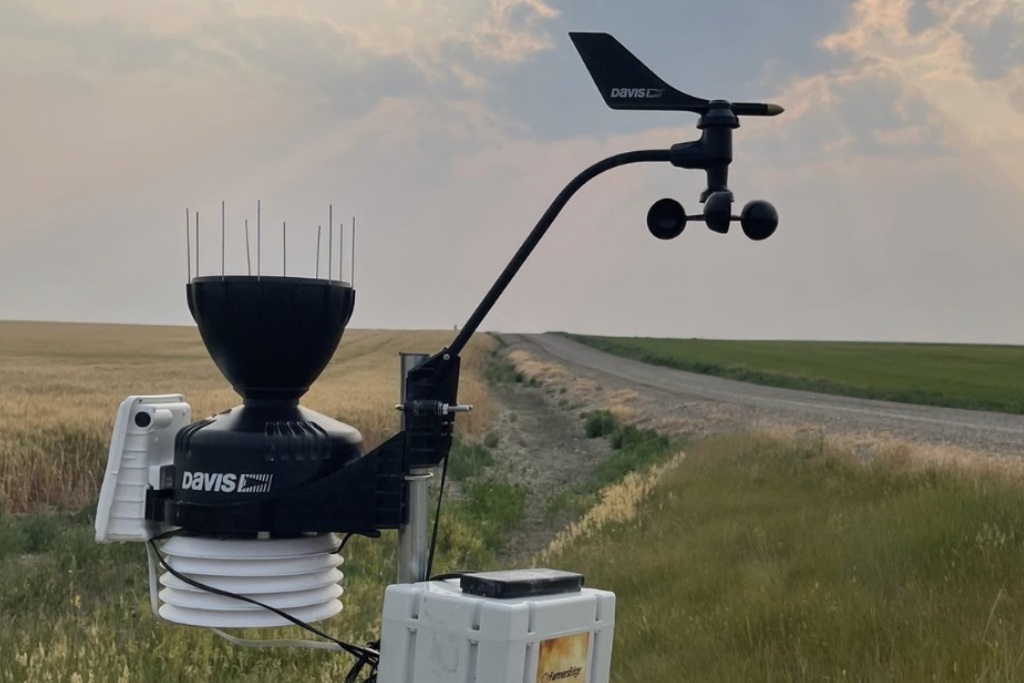
Farmers Edge is cutting some of the in-person services it offers through its data-driven farming platform, The Logic has learned. Photo: Farmers Edge | Handout
CALGARY — Embattled agtech company Farmers Edge is cutting some of the in-person services it offers through its data-driven farming platform, The Logic has learned, part of a shift to remote services that some observers view as an attempt to cut costs.
Farmers Edge offers farmers satellite imagery, data about their soil and crops and other such services to help them optimize yields and reduce costs. While farmers pay for access to the company’s software on an annual, per-acre basis, the company has also historically offered in-person services, where technicians visit clients’ farms to conduct soil tests, maintain equipment like weather stations, and ensure that crops are generally performing well.
Talking Points
- Struggling Winnipeg-based agtech firm Farmers Edge is cutting many of the in-person services it offered clients in a move some view as a cost-cutting effort
- The company has struggled to retain customers for its subscription data platform and its stock is trading at about 20 cents per share
In a July letter to some Farmers Edge clients, a copy of which The Logic obtained, the company said that after conducting “a strategic review of our operations,” it would now only offer those services virtually, with the exception of soil sampling.
The Winnipeg-based company is also laying off workers as part of the remote shift, according to two sources familiar with the issue whom The Logic agreed not to name because they were not authorized to speak publicly on the matter.
Meanwhile, according to a separate email obtained by The Logic, Farmers Edge is ending its operations in Australia. The country was part of the company’s overseas expansion efforts. As well as the U.S. and Australia, it opened local offices in Ukraine and Brazil. Its Australian operations accounted for almost $1.3 million in revenue in the first quarter of 2023, according to public filings, compared with $2.0 million from Canada and $2.9 million from the U.S. The company employed nine of its total 417 total workers in Australia at the end of 2022, compared to 78 for Brazil and one for Ukraine, according to public documents.
Farmers Edge did not confirm the layoffs, and did not respond to questions about its operations or business outlook.
Related Articles


Upstream Ag, a Substack newsletter created by former Farmers Edge employee Shane Thomas, first reported on the layoffs and the closure of the company’s Australian operations in late July.
The changes come as Farmers Edge—once one of Canada’s pre-eminent agtech companies, attracting about $78 million in backing from major venture capital funds like Silicon Valley’s Kleiner Perkins, and a stock-market darling after its March 2021 initial public offering—grapples with negative cash flows and a dwindling number of users on its subscription-based data service. The company’s stock value has plummeted as it struggles to convert unpaying subscribers to paying, falling from more than $19 per share after its IPO to around 20 cents today.
In an effort to restore investor confidence, the company split last year with its co-founder and longtime CEO Wade Barnes, replacing him with former Amazon Canada exec Vibhore Arora. The company has also gone through three CFOs in less than two years. The efforts haven’t yet yielded concrete results. Farmers Edge cut its net losses to $18.7 million in the first quarter of 2023, down from $22.2 million a year earlier, but continues to burn through cash. It will report second-quarter earnings on Aug. 10.
In March 2022, Fairfax Financial Holdings, its largest investor, extended a $75-million revolving loan to the company to help keep its balance sheet afloat.
In an interview with The Logic, Barnes—who in July launched Ronin Agronomy, an agtech company focused on carbon offsets—said he had sought to move Farmers Edge toward more of a virtual model to cut expenses when he was CEO.
“It is a strategy that I wanted to get to over time,” Barnes said. “I think around the cost structure, they must be trying to get there faster.”
While Barnes remains a Farmers Edge shareholder, he stressed that he is not directly familiar with the current management team’s turnaround efforts. But to make the remote-service transition successful, he said, the company will have to ensure its virtual offerings are as effective for farmers as in-person visits.
“Their question will be can they do that or not,” he said.
Some former Farmers Edge clients say the company’s services fell short of what it promised even when they were offered in person.
Barclay Uruski, who operates a 2,500-acre farm near Winnipeg, said Farmers Edge was supposed to do in-person check-ins once a year as part of their agreement when he was a client between 2016 and 2021.
“After the second year, we just didn’t see them,” he said.
The software itself also didn’t always work as promised, Uruski said. He was subscribed to a satellite imagery program that would send an alert if, for example, one of his crops became infested with grasshoppers. Initially, Uruski said, the program would ping his phone and pinpoint exactly where the problems were, but the service stopped working properly after the first few years. Another program that allowed farmers to input total costs and tabulate investment returns never worked, according to Uruski.
After about the third year with Farmers Edge, Uruski said that in-person customer service declined even further, and after about five years, he switched to a competitor.



Loading...
Thanks for sharing!
You have shared 5 articles this month and reached the maximum amount of shares available.
CloseThis account has reached its share limit.
If you would like to purchase a sharing license please contact The Logic support at [email protected].
CloseGift the full article!
You have gifted 0 article(s) this month and have 5 remaining.
Recipients will be able to read the full text of the article after submitting their email address. They will not have access to other articles or subscriber benefits.
Photo: Farmers Edge | Handout
Most Popular This Week




In-depth, agenda-setting reporting
Great journalism delivered straight to your inbox.
News
Panel decries Canada’s chaotic way of funding world-class science
Briefing
AI is pushing insurers to become asset managers, Canadian CEOs say
Trump administration faces lawsuit over 50% tariffs on Canadian goods
Canada-U.S. trade war to reduce real GDP by 1.4% over 2024 levels after five years: PBO
Best business newsletter in Canada
Get up to speed in minutes with insights and analysis on the most important stories of the day, every weekday.
Exclusive events
See the bigger picture with reporters and industry experts in subscriber-exclusive events.
Membership in The Logic Council
Membership provides access to our popular Slack channel, participation in subscriber surveys and invitations to exclusive events with our journalists and special guests.





