OTTAWA — The U.S. Supreme Court is set to hear arguments on Wednesday in a case against the broad-based tariffs President Donald Trump has slapped on countries around the world—including Canada. The Logic spoke to lawyers and policy analysts about what Canadian businesses should look for in an eventual ruling, including whether they can expect a refund.
Skip to content


Special Report
What the U.S. Supreme Court can do about Trump’s tariffs on Canada—and what it can’t
Small U.S. businesses and a dozen states are challenging Trump’s claims of a national emergency in a case that could limit his use of tariffs
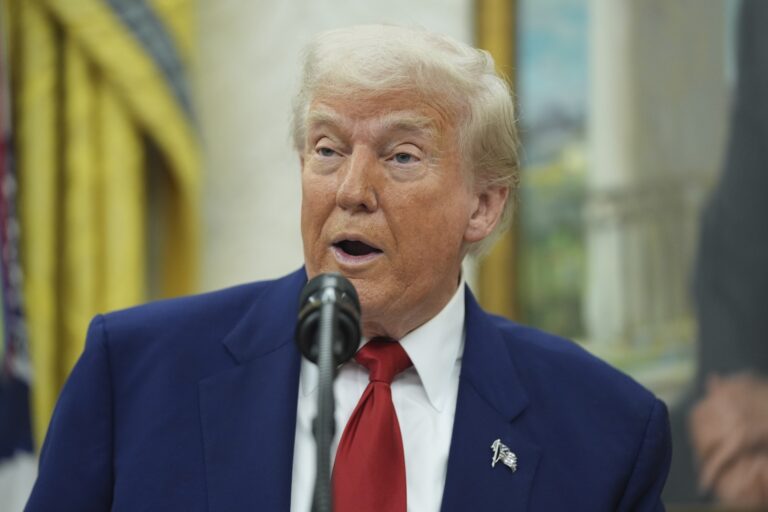
The U.S. Supreme Court will hear a challenge this week to the legal justification behind many of President Donald Trump’s tariffs. Photo: Getty Images/Anna Moneymaker
OTTAWA — The U.S. Supreme Court is set to hear arguments on Wednesday in a case against the broad-based tariffs President Donald Trump has slapped on countries around the world—including Canada. The Logic spoke to lawyers and policy analysts about what Canadian businesses should look for in an eventual ruling, including whether they can expect a refund.
What does this have to do with Canada?
Trump used the International Emergency Economic Powers Act (IEEPA), a 1977 statute that gives the president wide-reaching authority to regulate financial transactions in declaring a national emergency over foreign threats. That is what Trump did when he signed an executive order in February to declare universal tariffs on Canadian goods, purportedly over fentanyl entering the U.S. through its northern border. Trump declared similar emergencies to impose fentanyl-related tariffs on Mexico and China.
Related Articles

Separately, Trump used IEEPA in early April to impose “reciprocal” tariffs on much of the world, declaring a national emergency “arising from conditions reflected in large and persistent annual U.S. goods trade deficits.” Canada and Mexico were spared, but the executive order said a 12 per cent reciprocal tariff would eventually replace the duties linked to fentanyl.
How did this case end up in the Supreme Court?
More than a dozen lawsuits have been filed against the tariffs. The Supreme Court is hearing one that combined a challenge by a group of small businesses led by a New York-based wine importer with another launched by Oregon and 11 other states. In late May, the U.S. Court of International Trade ruled in the combined case that a president cannot use IEEPA as “leverage” to pressure other countries into doing what he wants. The U.S. Court of Appeals for the Federal Circuit upheld that ruling, but left the duties in place while the Trump administration appealed to the Supreme Court. Oral arguments are scheduled for Wednesday and the top court should rule by June.
At stake is not whether the tariffs are right or wrong, but whether IEEPA gave Trump the authority to apply them that way. “Congress wanted to provide broad and flexible authority in the context of emergencies,” Justice Department attorney Brett Shumate argued when the case was before the appeals court.
“The question in this case is whether the president has unilateral authority to impose tariffs of any amount on any country for any period of time, for unreviewable reasons.”
Ben Gutman, the solicitor general of Oregon who will argue at the Supreme Court on behalf of the states challenging the tariffs, said the law was not designed to go that far. “The question in this case is whether the president has essentially the unilateral authority to impose tariffs of any amount on any country for any period of time, for essentially unreviewable reasons,” he told The Logic in an interview.
What would a ruling to strike down—or keep—the tariffs mean for Canada?
Immediately, not much. The majority of Canada’s exports to the U.S. have remained duty-free due to a carve-out from these tariffs that Trump granted to goods that move through the United States-Mexico-Canada Agreement (USMCA). And this case does not address Section 232 of the Trade Expansion Act of 1962, which is the authority Trump used to impose national-security tariffs on steel, aluminum, autos, auto parts, heavy trucks, lumber and copper.
Still, Gutman noted that Trump granted the exemption for USMCA-compliant goods at his own “unchecked discretion.” That means a ruling in favour of Trump would also mean he gets to decide whether and when to take away that crucial carve-out. “This is not just about what President Trump might do with that power, but what future presidents might do if they have that authority, what exemptions they might grant or not grant, what rates they might impose or not impose,” Gutman said.
Jeffrey Schwab, senior counsel at the Liberty Justice Center based in Austin, Texas, suggested Trump showed his cards last week by threatening to hike tariffs on Canadian goods by another 10 per cent due to Ontario’s anti-tariff ad campaign airing in the U.S. “He thinks he can authorize tariffs wherever he wants, whenever he wants,” said Schwab, whose organization is representing the small businesses involved in the court challenge.
Could Canadian businesses get a refund?
The plaintiffs have not asked the Supreme Court to order a refund, but Timothy Meyer, an international business law professor at Duke University, said importers should be able to apply for one from U.S. Customs and Border Patrol for any tariffs deemed unlawful.
That does not mean the Trump administration will make it easy—especially as U.S. tariff revenue rose to a record US$195 billion for the fiscal year that ended Sept. 30. The standard window to seek a refund for tariffs paid last spring might close too quickly, depending on when the ruling comes out. The administration could demand onerous documentation—or force claimants to go to court for it, Meyer said. “You’re going to want to really make sure you’ve been keeping records of the tariffs that you paid,” he said.
Another potential outcome: the Supreme Court rules that persistent trade deficits do not justify declaring a national emergency under IEEPA, but that the fentanyl crisis does. That would leave the 35 per cent tariffs on Canada in place while other countries get relief.
Other tariffs
There are other ways for Trump to bring in tariffs if the court rules the IEEPA ones are unlawful, though they come with more oversight. The biggest for Canada: Section 232, which lets Trump tariff imports that an investigation by the Commerce Department finds to be a threat to national security.
Inu Manak, a senior fellow for international trade at the Council on Foreign Relations in Washington, D.C., said U.S. Commerce Secretary Howard Lutnick announced tariffs are on the way before launching, never mind completing such an investigation. “You can’t decide the remedy until you figure out what the problem is,” she said in an interview. “He’s basically been stretching the procedural limits of this statute in a way that I think could potentially have a court challenge on its own.”



Loading...
Thanks for sharing!
You have shared 5 articles this month and reached the maximum amount of shares available.
CloseThis account has reached its share limit.
If you would like to purchase a sharing license please contact The Logic support at [email protected].
CloseGift the full article!
You have gifted 0 article(s) this month and have 5 remaining.
Recipients will be able to read the full text of the article after submitting their email address. They will not have access to other articles or subscriber benefits.
Photo: Getty Images/Anna Moneymaker
Most Popular This Week




In-depth, agenda-setting reporting
Great journalism delivered straight to your inbox.
News
Panel decries Canada’s chaotic way of funding world-class science
Briefing
Feds pledge $15M for U.S. satellite navigation company Xona to expand in Montreal
Inovia raises US$200M for new VC fund as it eyes AI’s impact
43% of eligible Albertans voted ahead of Monday’s referendum
Best business newsletter in Canada
Get up to speed in minutes with insights and analysis on the most important stories of the day, every weekday.
Exclusive events
See the bigger picture with reporters and industry experts in subscriber-exclusive events.
Membership in The Logic Council
Membership provides access to our popular Slack channel, participation in subscriber surveys and invitations to exclusive events with our journalists and special guests.





