OTTAWA — Lydia Dawson has managed through disruption before—even leading her business, which used to sell custom-made costumes for dance performances, through a pandemic-era pivot to producing face masks to keep things moving during lockdowns.
Skip to content


News
Small merchants rush to claim USMCA carve-out as de minimis ends
Online sellers in Canada are joining the paperwork push to avoid U.S. tariffs on low-value goods
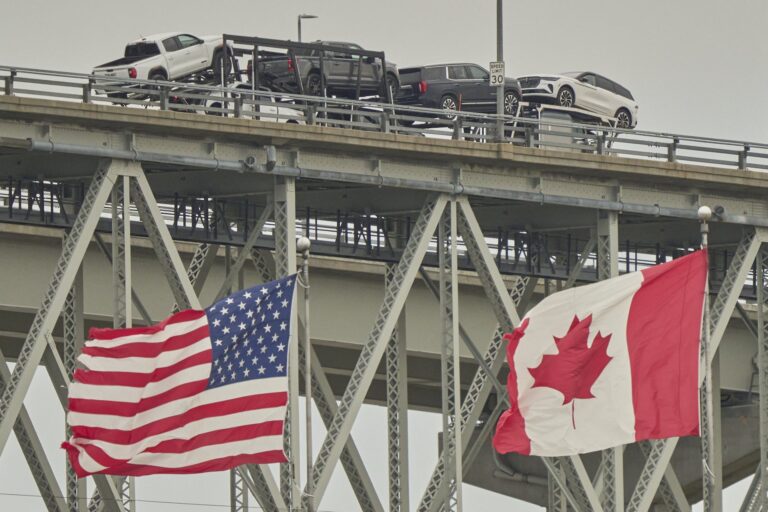
Low-value packages sent from Canada to the U.S. now face steep tariffs if they don't comply with the USMCA. Photo: AFP via Getty Images/Eric Thomas
OTTAWA — Lydia Dawson has managed through disruption before—even leading her business, which used to sell custom-made costumes for dance performances, through a pandemic-era pivot to producing face masks to keep things moving during lockdowns.
This week, the co-owner of My Own Design, a dancewear and fitness boutique in Brampton, Ont., faces a bigger challenge: proving the yoga mats and leotards she sells online to customers in the United States comply with the North American trade pact, to avoid steep tariffs.
“What kind of paperwork do you have to do? How do you fill it out? Who’s going to help you fill it out?” Dawson said last week as she sorted through her options.
Canadian businesses have been scrambling this year to prove their goods comply with the United States-Mexico-Canada Agreement (USMCA) to escape President Donald Trump’s 35 per cent fentanyl-related tariffs. It can be an onerous task to trace and document the entire supply chain for manufactured goods, but that is often what it takes. Eligibility depends largely on whether the amount of content that originates from Canada, Mexico or the U.S. reaches a certain threshold.
Talking Points
- The end of the “de minimis” rule exempting low-value goods from U.S. tariffs has more Canadian businesses joining the scramble to prove compliance with the North American trade pact
- Statistics Canada added new questions on USMCA compliance to its latest quarterly survey on Canadian business conditions
Now, a whole new swath of merchants has to figure it out.
Last Friday, the Trump administration suspended the “de minimis” rule that allowed packages whose contents were worth less than US$800 to enter the U.S. duty-free. Dawson, who owns the store with her daughter, Jessica Dawson-Gaglione, was caught up in the change. She said her company does about $150,000 worth of sales in a year. About 10 per cent of them are to U.S. customers online. While she did get hit with Canada’s recently repealed retaliatory tariffs on merchandise she sourced from the U.S., the de minimis rule shielded her from Trump’s tariffs on U.S.-bound goods. Those sales of ballet shoes or resistance bands stayed below the limit.
“If it isn’t one thing, it’s the other,” she told The Logic the day the change took effect.
Related Articles

A growing number of Canadian firms have decided the headache is worth it. U.S. trade data shows that 56 per cent of Canadian goods crossed the border through USMCA in June—a significant increase from the average of 38 per cent in 2024. That underestimates how many Canadian goods are now entering duty-free, however, as data shows there were no tariffs collected on 92 per cent of the Canadian goods the U.S. imported in June 2025. (A report by Oxford Economics suggests this was partly due to an uptick in goods moving through another part of the U.S. tariff schedule.) As a result, Canada’s effective tariff rate is the lowest among major U.S. trading partners.
Canadian figures on the use of USMCA, also known as CUSMA, are harder to come by. Statistics Canada is working to change that. The agency included questions about USMCA compliance for the first time in the latest edition of its quarterly Canadian Survey on Business Conditions, an online questionnaire that asks business operators across the country about their expectations and how they are responding to emerging issues.
The third-quarter survey results published on Aug. 27 said about 61 per cent of Canadian businesses or organizations that responded to the survey bought goods from the U.S. within the past year that complied with the continental trade deal. Those businesses reported that an average of 71 per cent of the goods they purchased from the U.S. were compliant. In the other direction, about 41 per cent of businesses reported selling USMCA-compliant goods to the U.S. within the past year. About 79 per cent of total goods sold into the U.S. were compliant, the survey suggested.
“What kind of paperwork do you have to do? How do you fill it out? Who’s going to help you fill it out?”
Andrew DiCapua, principal economist at the Canadian Chamber of Commerce, noted the data shows about 29 per cent of businesses or organizations said they did not even know whether they sold any USMCA-compliant goods below the border. “I think it kind of adds to this fog-of-war sentiment,” said DiCapua. “We don’t really know the actual numbers of compliance, or which sectors are being affected the most.
“We just have to kind of wait for the official data to get a better sense of the impacts.”
The carve-out through the North American trade pact, which is up for review by next July, is playing such a significant role in Canada’s better-than-expected economic outlook that Prime Minister Mark Carney cited the need to preserve the deal when he announced last month that Canada would drop most retaliatory tariffs on U.S. products. They were repealed on Monday.
Joy Nott, a partner at KPMG who focuses on trade and customs practice, said business executives are coming to appreciate the importance of USMCA compliance. “Companies are understanding now that they have to potentially make some serious changes to their supply chain in order to be profitable on a go-forward basis,” she said.
A sampling of recent earnings calls from publicly traded companies has the USMCA-related exemption showing up as a silver lining. Mike Pilato, CEO at Toronto-based Jamieson Wellness, told analysts on Aug. 7 that headlines about Trump’s tariffs “create noise” that can delay orders, but the duties themselves have “really no impact under the CUSMA deal.”
Michael Walton, CEO of Vancouver-based Rogers Sugar, shared a similar story. “It is worth noting that much of what we and our customers export to the United States is administered under the CUSMA, which has not been impacted by the recent announcements on tariffs,” he said Aug. 12. “Obviously, we cannot predict the future, but we anticipate that this will continue to be the case going forward.”



Loading...
Thanks for sharing!
You have shared 5 articles this month and reached the maximum amount of shares available.
CloseThis account has reached its share limit.
If you would like to purchase a sharing license please contact The Logic support at [email protected].
CloseGift the full article!
You have gifted 0 article(s) this month and have 5 remaining.
Recipients will be able to read the full text of the article after submitting their email address. They will not have access to other articles or subscriber benefits.
Photo: AFP via Getty Images/Eric Thomas
Most Popular This Week



In-depth, agenda-setting reporting
Great journalism delivered straight to your inbox.
News
Panel decries Canada’s chaotic way of funding world-class science
Briefing
Feds pledge $15M for U.S. satellite navigation company Xona to expand in Montreal
Inovia raises US$200M for new VC fund as it eyes AI’s impact
43% of eligible Albertans voted ahead of Monday’s referendum
Best business newsletter in Canada
Get up to speed in minutes with insights and analysis on the most important stories of the day, every weekday.
Exclusive events
See the bigger picture with reporters and industry experts in subscriber-exclusive events.
Membership in The Logic Council
Membership provides access to our popular Slack channel, participation in subscriber surveys and invitations to exclusive events with our journalists and special guests.







