OTTAWA — Donald Trump’s return to the White House will mean a return to playing defence for the Canadian government, as it tries to preserve Canada’s most important trade relationship and military alliance while the new president seeks tariffs, a less stalwart NATO and a reversal of much of Joe Biden’s green industrial policy.
Skip to content

 An auto worker producing a Chevrolet Silverado at a GM plant in Oshawa, Ont., in February 2022. Photo: The Canadian Press/Chris Young
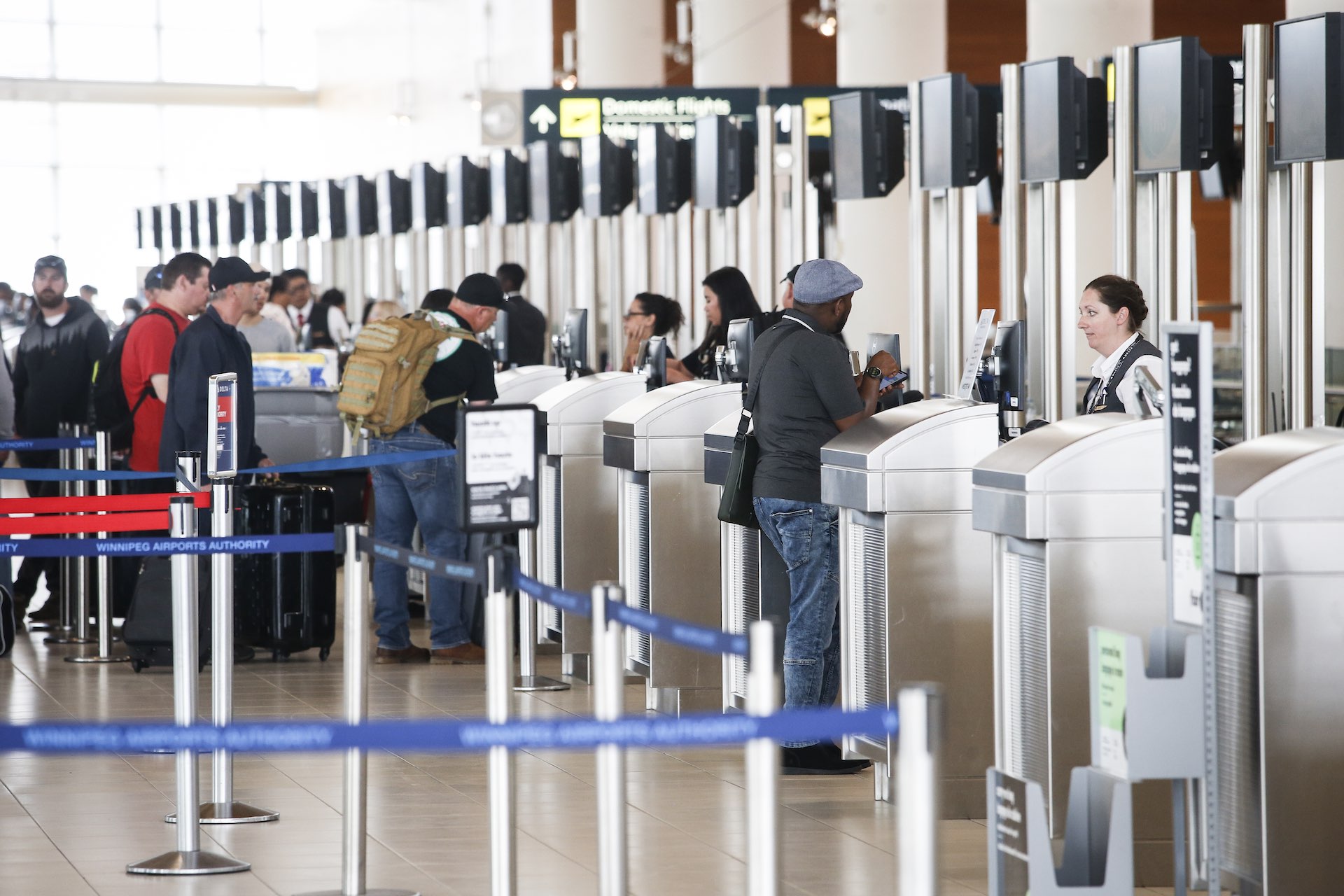 Travellers pass through a document checkpoint at the Winnipeg International Airport in June 2023. Photo: The Canadian Press/John Woods

Special Report
What a new Donald Trump presidency means for the Canadian economy
Return to White House raises fears of indiscriminate tariffs, grinding trade talks, wave of deportees seeking asylum here
Donald Trump at an election night watch party at the Palm Beach Convention Center on Wednesday, Nov. 6, 2024, in West Palm Beach, Fla Photo: AP Photo/Evan Vucci
OTTAWA — Donald Trump’s return to the White House will mean a return to playing defence for the Canadian government, as it tries to preserve Canada’s most important trade relationship and military alliance while the new president seeks tariffs, a less stalwart NATO and a reversal of much of Joe Biden’s green industrial policy.
The process of installing the next U.S. president has several stages yet, but projections early Wednesday showed Trump on course to win at least 277 electoral college votes to Kamala Harris’s 224. With the vast majority of votes tallied, major U.S. news organizations declared him the winner of a very close, very hard campaign.
Talking Points
- For Canada, Donald Trump’s expected return to the U.S. presidency means once again trying to influence those around him to preserve the trade and security relationships that Canada depends on
- Trump’s promise to slap tariffs on virtually all U.S. imports is particularly worrying for Canadian industries, like the auto sector, that move goods across the Canada-U.S. border repeatedly
- Whether the green-industry incentives in the Inflation Reduction Act survive, and how the Trump administration implements his promised mass deportations, will have huge consequences for Canada as well
“Canada is looking at a very uncertain and disorienting time,” said Matthew Holmes, executive vice-president of international affairs and chief of public policy at the Canadian Chamber of Commerce.
Trump’s words and his deeds often don’t match up. As president, for instance, he touted a massive infrastructure plan as a key priority, and it didn’t get off the ground—to the point that the recurring, never-executed “Infrastructure Week” became a joke.
In 2016, Trump was elected on promises to “drain the swamp” in Washington, D.C., then named deeply connected businessmen to key posts. This year, he has disavowed the conservative agenda-setting “Project 2025” while saying he’ll hire a previous administration official who worked on it.
This haphazard approach can yield unexpected results. Trump seemed never to fully understand that U.S. allies in NATO don’t pay cash dues to the military organization, but his public demands that they support the alliance better seem to have made a difference. He campaigned in 2016 on overturning Roe v. Wade, the decades-old Supreme Court ruling on the right to abortion, which seemed improbable until justices he appointed did it.
“We’re going to see several months, maybe, of these shock-and-awe policies where people say, ‘Oh, they’ll never do that.’ And of course, he does it,” said Laura Dawson, executive director of the Future Borders Coalition, which advocates for smoother border crossings between Canada and the United States.
Related Articles

Expect serious attempts at universal tariffs, mass deportations, a rewrite of the North American free-trade agreement negotiated under the last Trump administration, and renewed personal antagonism between Trump and Prime Minister Justin Trudeau, she said.
Here are some things to watch on key files.
Trade
Trump has promised to impose a 10 per cent tariff on everything imported into the U.S. More than three-quarters of Canadian firms’ international sales go across the border, so the impact on this country’s economy and businesses could be massive. Trump’s plan would lead to an almost 2.7 per cent drop in exports at the end of 2026 and drag down sales of services, economists at Desjardins estimate.
Canadian businesses would also suffer as a more protectionist U.S. dragged down global economic growth.
Canada has a couple of months before Trump is in power and can turn his tariff rhetoric into action. It must not waste a day in making sure the incoming administration understands how important Canadian goods are to the U.S. economy, said Holmes, from the nickel that goes into U.S. warplanes to the components that support swing states’ auto plants.
“Making that case about the strategic trade flows that we have with each other will be really acute and really necessary in the coming months.”
It’s not just tariffs. “There are frictions that exist between the U.S. and Canada on trade, regardless of who sits in the White House,” said John Dickerman, the Washington-based vice-president of U.S. affairs at the Business Council of Canada. Long-standing irritants include U.S. softwood lumber restrictions and Canadian dairy market controls.
There’s also bipartisan concern in Washington about the newer issue of Ottawa’s digital services tax (DST). Both the Trump and Biden administrations expressed opposition to such measures, claiming they target U.S. firms. The Liberal government says it’s committed to the levy while governments around the world negotiate changes to the way multinationals are taxed. Trump’s first administration withdrew from those OECD-led talks, and his second is unlikely to commit to an international solution, Dickerman said.
Industrial policy
Despite getting policy guidance from Tesla CEO Elon Musk, Trump has threatened to repeal all unspent money under Biden’s signature Inflation Reduction Act (IRA), potentially depriving manufacturers of promised production credits for EV components.
Canada has said it will rescind some of its production incentives and tax credits to Northvolt, Volkswagen, Stellantis and LG when the IRA ends. Joanna Kyriazis, director of public affairs at Clean Energy Canada, said Ottawa should think twice about that plan.
“If Trump repeals portions of the IRA, Canada becomes a more attractive destination for North American battery supply-chain investments,” she said in an email to The Logic. “We should double down on supporting our EV industry.”
As it is, lawmakers in Trump’s own party might push back against a repeal of IRA incentives. And even as he derides Biden’s clean energy agenda, Trump could be open to approving projects like critical minerals mines under the Defense Production Act, which has funded several Canadian battery-metals projects, said Bentley Allan, a principal at the Transition Accelerator.
“A lot of Republican governors are really happy to see the economic investment in their jurisdictions and the number of jobs that are coming out of that,” said Holmes.
Autos
The Trump administration will appreciate trade barriers Canada is throwing up against Chinese-made vehicles, steel and aluminum, said Holmes, but the hardest part is yet to come, as Chinese auto brands are poised to start selling cars here.
“I think that will force a very serious conversation between the two countries and around our policies,” said Holmes.
If a Trump administration triggers a repeat of the last USMCA negotiations under Robert Lighthizer, Canada could face another tough fight fending off changes favouring U.S.-made parts in auto manufacturing.
A Trump reversal of tailpipe emissions standards would pose another issue for the auto sector, said Kyriazis. The current policies, which include consumer incentives to buy North American-made electric vehicles, have spawned a market for Canadian-made EVs like the Dodge Charger, she said. But Trump vowed to “end the electric vehicle mandate on day one.”
Energy
The “general consensus” is that cross-border energy trade would likely avoid Trump’s threatened tariffs because Canada’s heavy crude oil doesn’t displace American supply the way other commodities do, said Heather Exner-Pirot, a Calgary-based representative of the Business Council of Canada. Trump is also more supportive of pipelines like Keystone XL that would expand Canadian oil exports.
Still, his promise to shred the IRA—which showers U.S. energy companies with some US$369 billion in subsidies to help them reduce emissions or build renewable capacity—could open the door for Ottawa to remove similar subsidies here.
The current Liberal government introduced a suite of investment tax credits to encourage hydrogen development, clean manufacturing, carbon capture and storage (CCS) and other emissions-reductions efforts. Conservative Leader Pierre Poilievre has yet to say whether he would maintain them should his party win the next election.
Given the lack of market demand for energy that is produced using carbon sequestration technology, the CCS credit in particular may be threatened if Trump scraps similar support in the U.S. As Exner-Pirot said: “We don’t see people paying a premium for lower-emissions oil or gas.”
Security
“The upside of Trump is that he wants some very visible actions that achieve what he wants for his own ego, but then he moves on,” said Dawson. “He’s not a detail guy.”
Much of the U.S.-Canada security relationship is details, in her view: management of the Arctic, waterways, crime that crosses the border. “The sorts of things that are actually very important to us, but don’t have that sizzle.”
If those stay in the hands of military and intelligence technocrats, that’ll be fine for Canada, she said.
But economic-security matters like cooperating on developing critical minerals and “friendshoring” supply chains are also detail-heavy, and likely to get lost if the Trump administration simply divides the world into “unfair traders and the U.S.,” she said.
Dawson herself is not a huge fan of friendshoring, seeing it as a way to shift international trade from a rules-based system to a series of transactional relationships. But Canada has been a friendshoring champion, trying to position itself as a vital supplier of raw materials to fellow liberal democracies. If Trump doesn’t care, that’s going to be tough.
Immigration
“Trump has taken almost every possible position on high-skilled immigration,” said Julia Gelatt, associate director of the U.S. immigration policy program at the Migration Policy Institute, a think tank in Washington, D.C.
In June, the former president promised green cards for international students who graduate from U.S. colleges and universities. But during his first term, the government increased scrutiny of applications under the H-1B visa widely used by Silicon Valley firms, leading to slower processing and more rejections.
While the Biden administration reversed many of those measures, Gelatt expects a re-elected Trump to reimpose them. “At least initially, we would see lots of efforts to slow legal immigration,” she said.
Holmes said Canada should try to scoop up highly skilled workers who want to leave the United States because of a Trump presidency, or are forced out: “If this presents an opportunity, we should take it.”
Recent history shows many high-skilled workers still make the U.S. their first choice, though. And Ottawa isn’t as receptive as in the past. The Liberal government has cut the number of new permanent residents Canada will accept, and is looking to cap the number of foreign workers and international students entering the country.
Meanwhile, if Trump follows through on promises to deport millions of people—possibly through mass roundups and confinement in detention camps—Canada should expect significant numbers of those migrants to try to come here, Holmes said.
“That’s going to put incredible pressure on our own border and our own processing,” said Holmes.
Dawson, who specializes in border issues, quantifies it. A business traveller making a routine entry to Canada might pass through a Canada Border Services Agency check in seconds—a couple of minutes at most. An initial asylum claim takes hours to process.
“Think of the backlogs that that creates,” she said.
Furthermore, with changes to the Safe Third Country Agreement on asylum claims having closed semi-official entry points like the one at Roxham Road in Quebec, Dawson expects more migrants will make uncontrolled crossings over treacherous ground, assisted by smugglers.
Known unknowns
Which parties control the two houses of Congress, and what they’ll go along with, will matter, too. After Tuesday’s vote, the Republicans had retained their majority in the Senate, with a gain of two seats, and comfortably led elections for the House of Representatives, where 218 seats are needed for majority. As of this writing, the GOP was ahead in 197 districts to the Democrats’ 180, with 58 still to be decided.
Much will also depend on Trump’s attention span and focus on details, and whom he names to his cabinet. Said Holmes: “The Trump playbook is largely one that’s influenced by external events and the people in the room advising him at a specific moment in time as the decisions are made.”
In some ways, that means dealing with Trump is simple.
“I think somebody in the Prime Minister’s Office should be shopping for some very nice golf clubs for Donald Trump,” said Dawson. “That was the secret of [Japan’s former prime minister] Shinzo Abe’s success last time around: give the man gifts.”



Loading...
Thanks for sharing!
You have shared 5 articles this month and reached the maximum amount of shares available.
CloseThis account has reached its share limit.
If you would like to purchase a sharing license please contact The Logic support at [email protected].
CloseGift the full article!
You have gifted 0 article(s) this month and have 5 remaining.
Recipients will be able to read the full text of the article after submitting their email address. They will not have access to other articles or subscriber benefits.
Photo: AP Photo/Evan Vucci
An auto worker producing a Chevrolet Silverado at a GM plant in Oshawa, Ont., in February 2022.
Travellers pass through a document checkpoint at the Winnipeg International Airport in June 2023.
Most Popular This Week




In-depth, agenda-setting reporting
Great journalism delivered straight to your inbox.
News
Brookfield’s new CEO flexes the firm’s soft power with its $50B Canadian bet
Briefing
AI is pushing insurers to become asset managers, Canadian CEOs say
Trump administration faces lawsuit over 50% tariffs on Canadian goods
Canada-U.S. trade war to reduce real GDP by 1.4% over 2024 levels after five years: PBO
Best business newsletter in Canada
Get up to speed in minutes with insights and analysis on the most important stories of the day, every weekday.
Exclusive events
See the bigger picture with reporters and industry experts in subscriber-exclusive events.
Membership in The Logic Council
Membership provides access to our popular Slack channel, participation in subscriber surveys and invitations to exclusive events with our journalists and special guests.





