OTTAWA — Next time should come as no surprise. Within days of taking office in January 2017, president Donald Trump twisted the economic ties that bind the U.S. and Canada, exiting Pacific trade talks and forcing NAFTA open.
Skip to content

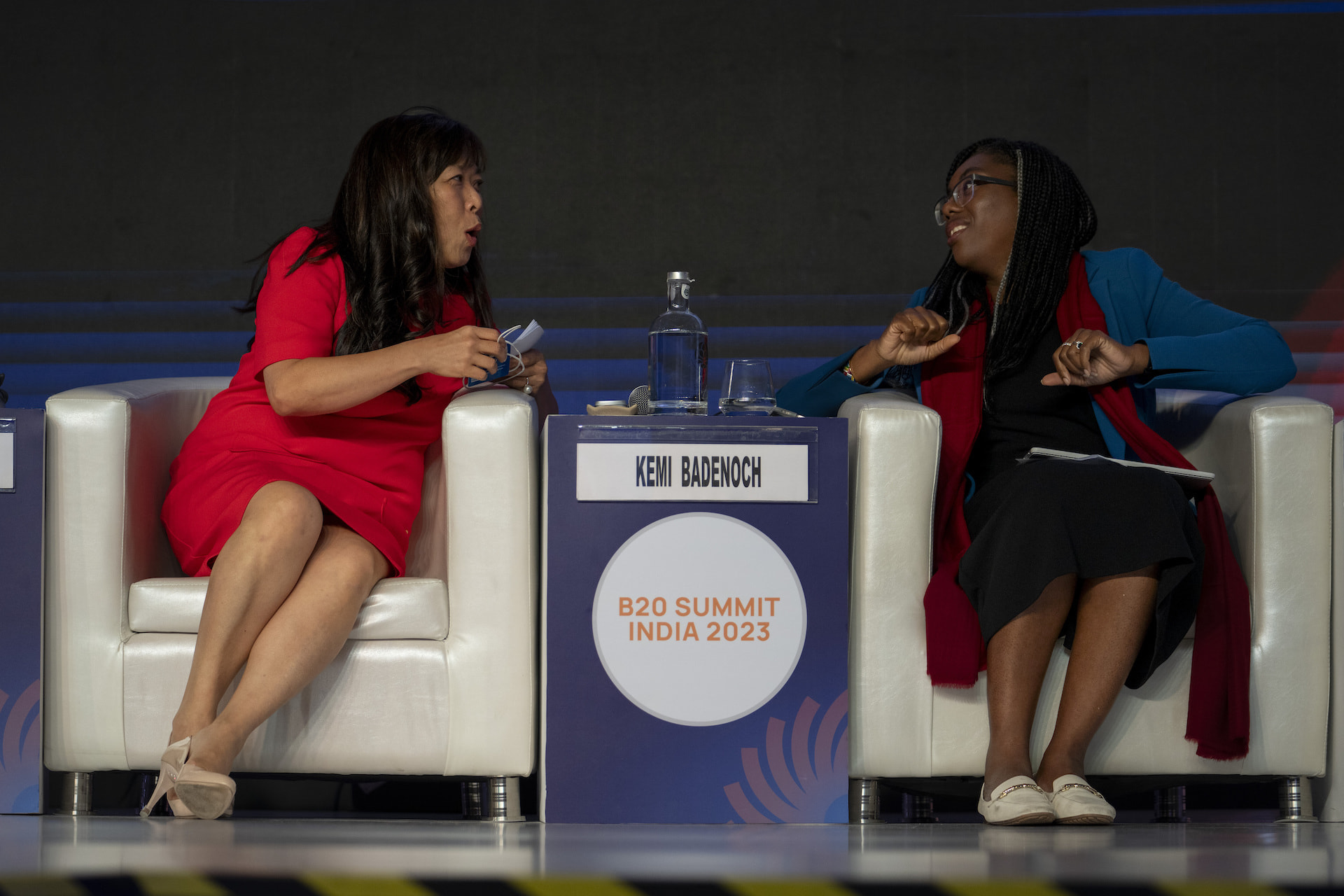 From left: Canadian Trade Minister Mary Ng and British Trade Secretary Kemi Badenoch at the B20 summit in New Delhi in August 2023. Photo: AP Photo/Altaf Qadri
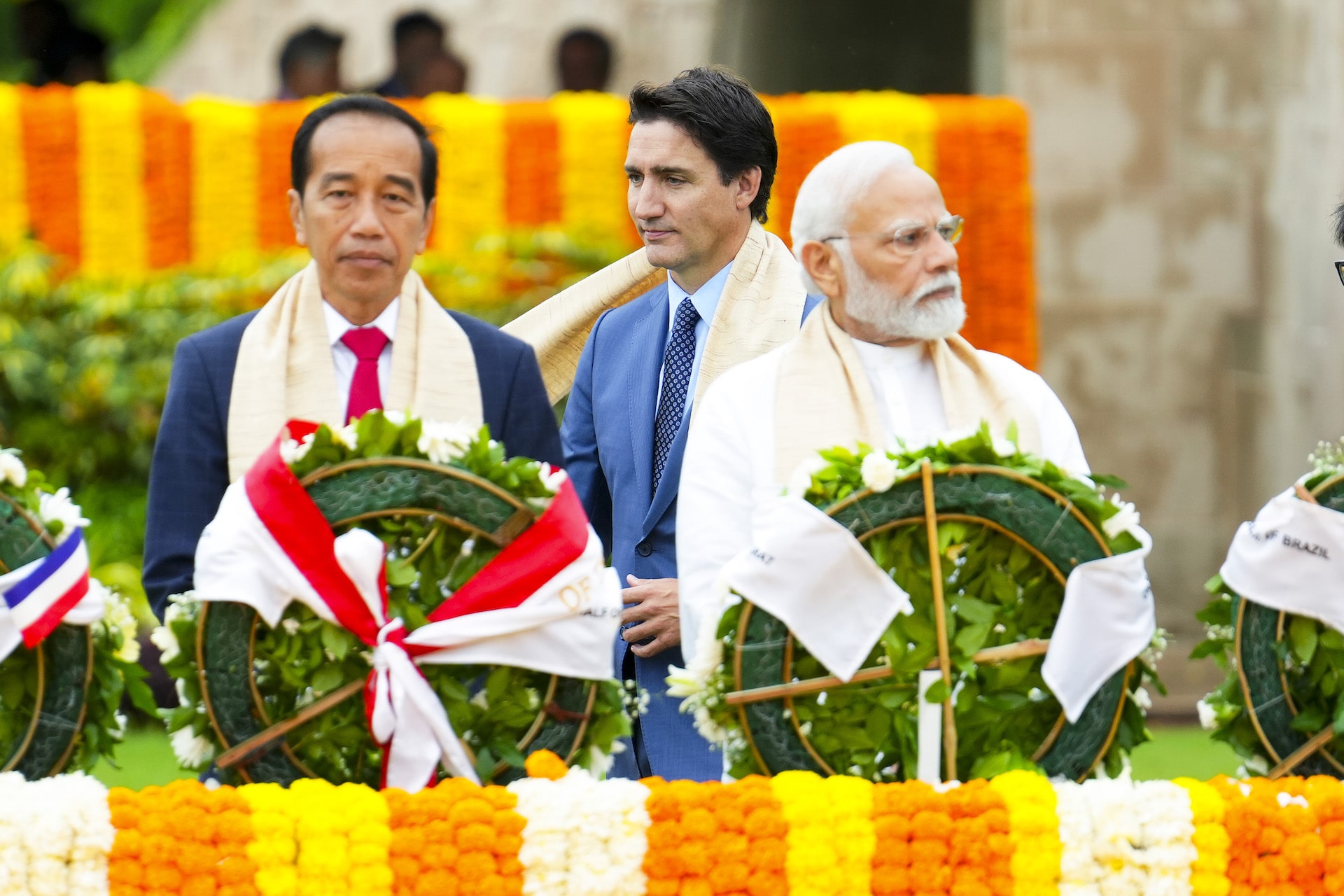 From left: Indonesian president Joko Widodo, Canadian Prime Minister Justin Trudeau and Indian Prime Minister Narendra Modi during the G20 Summit in New Delhi in September 2023. Photo: The Canadian Press/Sean Kilpatrick

The Big Read
Trading places: How Canada spent (or squandered) the Biden years
Donald Trump’s Canada-bashing first presidency revealed this country’s glaring need for new markets. As he runs again, we’re still exposed
Photo: Photo illustration by Paul Kim for The Logic. Photo of Donald Trump: The Associated Press/Pool/Michael M. Santiago. Photo of Joe Biden and Justin Trudeau: The Associated Press/Andrew Harnik. Photo of Vancouver: Getty Images/Cathryn Atkinson.
OTTAWA — Next time should come as no surprise. Within days of taking office in January 2017, president Donald Trump twisted the economic ties that bind the U.S. and Canada, exiting Pacific trade talks and forcing NAFTA open.
Those moves heralded an increasingly fractious period in the world’s largest trading relationship that few Canadian policymakers would care to repeat. Within months, Washington and Ottawa were publicly sparring over the tariffs on steel and aluminum sold south. By June 2018, after Justin Trudeau vowed to answer U.S. actions in kind, Trump trade advisor Peter Navarro was declaring that “a special place in hell” awaited Canada’s prime minister.
Talking Points
- Ottawa is preparing for the possibility of more trade disruption if President Donald Trump is elected to a second term. During the first, the Liberal government launched a so-far successful effort to boost Canada’s overseas exports.
- Despite being on track to hit those targets, the share of Canada’s trade that’s with the U.S. has actually increased, and giant green programs Trump is threatening to torch have further tied the two economies together.
Facing an Ottawa-skeptic White House, the Liberals were forced into action abroad, reupping a longstanding push to expand the markets in which Canadian goods and services are sold. That November, it set a measurable trade diversification target, of increasing overseas exports by 50 per cent by 2025. And once NAFTA was saved, Ottawa’s trade negotiators fanned out to finish or start other deals.
Now, with the increasingly real prospect of a repeat Trump presidency and its attendant trade wars, Canada is once again seeking to shore up support among friends across the border, and to make new ones abroad. And the last round of efforts to reduce dependency on its biggest trading partner have taken on renewed importance.
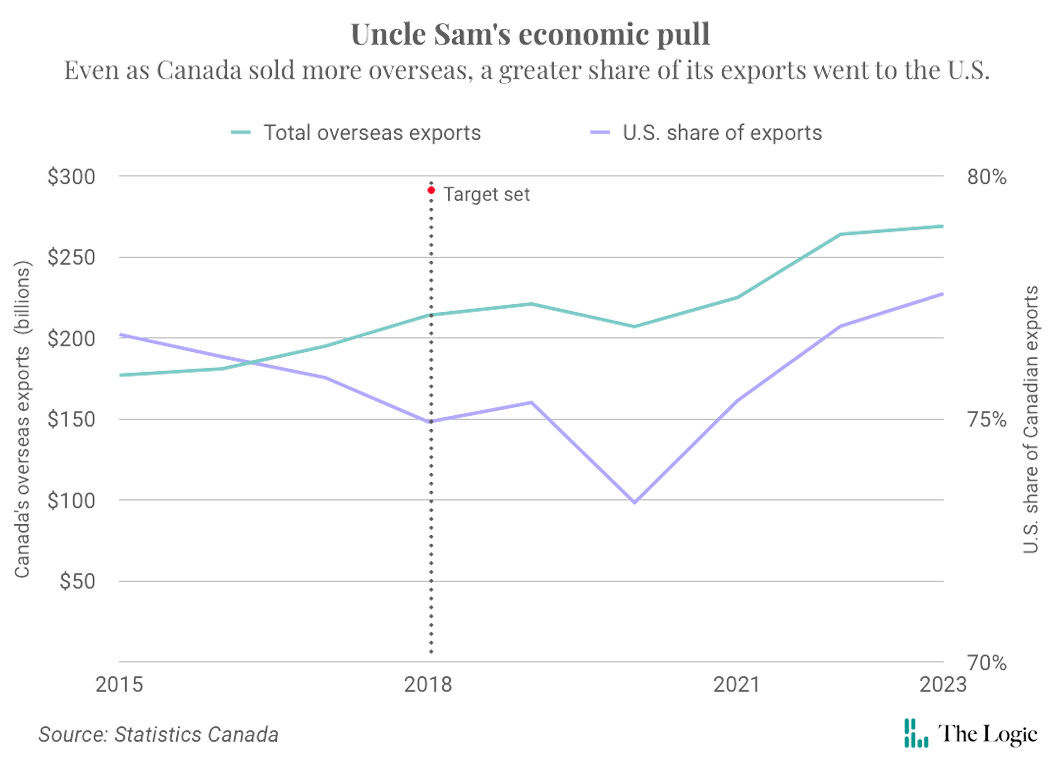
A first look suggests they’re going well. After flagging during the pandemic, the value of overseas exports rose to $269 billion in 2023, according to Statistics Canada—within striking range of the $292-billion target that the 50 per cent goal represents.
That’s only part of the equation, though. Over that same period, the share of Canadian exports going to the U.S. actually rose, from 75.9 per cent in 2017 to 77.6 per cent in 2023. In other words, Canadian businesses sold more in other markets, but they sold even more to the world’s biggest one that happens to be just across the border. “The needle has not moved,” said Eric Miller, an ex-economic diplomat who now runs a Washington, D.C.-based consulting firm.
The United States remains far and away Canada’s largest trading partner, accounting for $969 billion of the country’s $1.52 trillion in international commerce in 2023. Business groups, former trade officials and economists note that it can be hard to see beyond the U.S., and they credit Canadian governments and firms with looking further afield. Still, they say, the country’s political and business leaders could do more to expand its economic ties abroad.
The job’s unlikely to get easier. The current White House is its own kind of protectionist, but— rhetorically, at least—has returned to treating Canada as an economic ally rather than a foe. If recent polls are any guide, it’s about to give way to an administration openly hostile to the northern neighbour, with an economic plan that could tear out important new pillars of the trading relationship, and nail tariffs on anything that moves into the U.S.
Have Canada’s policymakers and businesses squandered the peace?
Related Articles


The push for new markets is not new. “We tend to advance our interests in trade diversification particularly when our relations with the United States are a bit tenuous,” said Meredith Lilly, a Carleton University professor and former top federal foreign affairs advisor. “Then, when there’s a perception that our trade relations with the United States are good, we down tools on trade diversification efforts.”
In the early 1930s, facing significant U.S. tariffs, Ottawa signed trade deals with the U.K., New Zealand and Ireland. In the early 2010s, with the fate of the Keystone XL pipeline dividing Stephen Harper’s government and Barack Obama’s administration, Ottawa promised new economic treaties with the European Union (EU) and India. In both cases, an election changed the bilateral mood.
The Biden administration has not fully turned back the clock to pre-Trump times. Ottawa objected, for example, to “Buy American” provisions for federal spending, and had to lobby hard to ensure new U.S. electric vehicle tax credits applied to Canadian-made cars and parts.
Another part of Biden’s homerish agenda, however, has drawn the two economies closer together. Washington is seeking to reshore manufacturing for green and critical technologies via US$369-billion from the Inflation Reduction Act (IRA) and the US$52.7-billion CHIPS and Science Act. Ottawa has offered billions of its own for EV battery factories and semiconductor packaging plants, whose products it hopes will slot into the new continental supply chains.
It’s not just governments looking to derisk their sources, after pandemic-induced shortages of crucial kit and materials. “We’re seeing companies looking for suppliers who are more local,” said Dennis Darby, CEO of Canadian Manufacturers and Exporters, noting his members are being pushed to make in North America.
A change in the White House could strand Canadian firms and facilities set up to join new U.S.-led green supply chains—if elected, Donald Trump reportedly plans to slash IRA programs and reverse regulations supporting EV sales. But Canada had to compete with Biden’s incentives to avoid losing critical sectors like automaking to the U.S., said Steve Verheul, Ottawa’s former chief trade negotiator. “There really wasn’t much of a choice.” And Verheul sees a potential upside: If the U.S. does reverse course on climate, Canada could draw even more investment by maintaining its green incentives.
Regardless of the U.S. election outcome, production will continue to shift to North America, according to Benjamin Tal, deputy chief economist at CIBC World Markets. “We see the establishment of trade blocs,” he said. “The reliance of Canada on the U.S. will grow over the next five years, not fall.”
In October 2018, the NAFTA countries reached a new agreement that would bear their names instead of that of their continent. But Canada has concluded negotiations on just two free trade deals since, both rollovers of existing treaties. That’s despite the Liberals’ ambitions for a series of new pacts with old allies, as well as emerging markets and economic blocs.
Over the last year, two sets of talks have suffered significant setbacks.
Canada and the U.K. launched negotiations on a permanent post-Brexit trade deal in March 2022, seeking to replace a rollover agreement. But this past January London pushed pause, with talks stalling over agriculture issues. A senior official at Global Affairs Canada told The Logic that the U.K. had sought an extension of import quotas for its cheese while holding out on sanitary requirements for Canadian beef exports. The official spoke on condition of anonymity to discuss the confidential negotiations.
Ottawa had also relaunched negotiations with New Delhi on an economic-partnership agreement in March 2022—the Harper government never did get its deal—with plans for an early-progress accord in the near term. Ministers and officials swapped terms over several months and rounds.
But in September 2023, India’s ambassador revealed that Canada had asked for a halt. The stop was related to Ottawa’s concerns about Indian agents’ alleged involvement in the killing of a Sikh activist leader in British Columbia, the senior official told The Logic.
Another major Liberal target in Asia also fell to geopolitics. Canada and China launched exploratory discussions on a trade agreement in September 2016. But the prospect of a deal disintegrated when the Chinese government in December 2018 detained two Canadian citizens days after the arrest in Vancouver of Huawei CFO Meng Wanzhou at the request of the U.S.
Ottawa never got close to a trade deal with Beijing. It may have been a distraction anyway, Tal said, citing China’s now-slowing growth. To Lilly, the former foreign affairs advisor, Canada “perhaps wanted to pursue an overly simplistic trade diversification agenda” of trying to “offset some of our exposure to this very large country to the south by increasing our trade ties with this very large country on the other side of the ocean.” She noted that trade with China is complicated by Canada’s need to stay aligned with U.S. policy, which is increasingly tying together national security and economic relations.
Faced with the prospect of a repeat Trump presidency and its attendant trade wars, Canada is again seeking support across the border and trying to make new friends abroad.
Trevor Kennedy, vice-president for the Indo-Pacific at the Business Council of Canada, said it’s “unfortunate” that the India and U.K. negotiations have stalled. But he expressed optimism about Ottawa’s efforts to close deals this year with Indonesia, and with the Association of Southeast Asian Nations (ASEAN) the next. “Those are two very important additions to our coverage around the world [that] would be commercially meaningful,” he said.
Verheul, who played a critical role in USMCA, said Ottawa’s inability to land a major deal since then is not necessarily a bad sign. “Countries have moved away from many of the principles of trade agreements,” he said. “There’s more protectionism. There’s more cases where rules are being ignored or breached.”
To avoid irrelevance, trade policy needs to expand beyond its traditional focus on market growth to account for how governments are intervening to address climate change, according to Verheul, now a fellow at the Public Policy Forum think tank and principal at advisory firm GT&Co.
Deals are just a starting point. Business groups and former diplomats say filling gaps in government programs will help more companies into overseas markets. Kennedy, for one, believes Canada lacks critical infrastructure needed to move some exports. “We can’t just sign a trade agreement and then walk away,” he said.
Take natural gas. The new LNG Canada liquefaction and loading facility at Kitimat, B.C., is due to come online in 2025. Joint venture partner Mitsubishi is set to take 2.1 million tonnes of its output annually—15 per cent of the total—or roughly $1.6 billion worth, at recent prices. Last year, total Canadian exports to the firm’s home country, Japan, were $15.8 billion. Such a “remarkable” boost from just one LNG project has Kennedy calling for more infrastructure to get energy, hydrogen and critical minerals to markets in Asia.
Opportunities in the Indo-Pacific he identified include: selling food and fuel to Korea ($6.95 billion in total Canadian exports in 2023) and Vietnam ($776 million); small modular nuclear reactors to Indonesia ($2.3 billion) and the Philippines ($1.24 billion); and aerospace products to the growing airline sector in India ($5.14 billion). The goal has never been to divert trade away from the U.S., Kennedy said, but instead to do more of it with other fast-growing and populous markets.
“Countries have moved away from many of the principles of trade agreements. There’s more protectionism, more cases where rules are being ignored or breached.”
Ottawa is putting more attention and resources into Asia. The Liberal government’s Indo-Pacific Strategy, released in November 2022, included $45 million for trade missions; $37.7 million to expand export-support programming; and $24.1 million for a new office in Singapore that will help Canadian firms learn the local markets and connect with customers. Over the last year, Trade Minister Mary Ng has led business delegations to Japan, Korea, Malaysia, Singapore and Vietnam.
Firms that have used Ottawa’s Trade Commissioner Service praise the intel and connections the export fixers—many of them located in the service’s more than 160 foreign outposts—provide in new markets. Deanna Horton, formerly Canada’s ambassador to Vietnam, said officials and companies here should cultivate relationships in new markets via communities of expats and university alumni around the world. “Especially on the services side, you need to have representative offices,” said Horton, now a fellow at the University of Toronto’s policy school. “You need to be close to your clients.”
Canada could also be more proactive in its pursuit of megaprojects like infrastructure builds, according to Miller. “The Canadian model has been, ‘I want you to get on a plane and fly to Ho Chi Minh City, Karachi, Jakarta, and figure out how to do business,’” he said. Miller suggests adopting the Japanese approach, in which Tokyo offers financing, then bundles Japanese companies products and services to build them. That’s how Jakarta’s rail rapid transit system, opened in March 2019, got done.
Businesses could also be taking better advantage of the channels Ottawa has already opened for them. Firms selling into the EU are still leaving money on the table—only 65.4 per cent of Canadian exports eligible for tariff reductions under the Canada-EU Comprehensive Economic and Trade Agreement (CETA) used them in 2021. Makers of machinery, electronics and cars and parts all underutilized their carve-outs.
In the case of the Comprehensive and Progressive Agreement for Trans-Pacific Partnership (CPTPP), firms from other major participating countries selling here generally used more of the tariff reductions negotiated than Canadian firms going the other way; Japan is the exception.
Ng, who has been charged with export promotion since July 2018, insists Canada’s trade diversification efforts are working. “We will continue to do more with the United States, given the various areas of integration,” she told The Logic in an interview, citing growing areas of cooperation like EVs and other green technology. In preparation for Trump’s possible return, the Liberal government has once again been sending delegations south to court U.S. officials and remind them of the two economies’ mutual dependence.
But Ng noted exports to countries covered by CETA and CPTPP have also increased significantly since those deals took effect—up 21 per cent and 20.3 per cent, respectively, through 2023—and that her trade missions are thronged with firms making connections abroad. Efforts to get small, women-owned and Indigenous businesses into new markets are also working, she said.
“Diversification—absolutely we’ll continue to do that,” she said. “And I think we will see that yield in the years to come.”
As Lilly points out, though, businesses are ultimately the ones doing the trading, and “they’re responding to their incentives.” For most Canadian firms, the U.S. just makes sense—it’s the world’s largest economy, with a common language, culture and land border. “So long as that works for them, there are not reasons to look much farther afield.”



Loading...
Thanks for sharing!
You have shared 5 articles this month and reached the maximum amount of shares available.
CloseThis account has reached its share limit.
If you would like to purchase a sharing license please contact The Logic support at [email protected].
CloseGift the full article!
You have gifted 0 article(s) this month and have 5 remaining.
Recipients will be able to read the full text of the article after submitting their email address. They will not have access to other articles or subscriber benefits.
Photo: Photo illustration by Paul Kim for The Logic. Photo of Donald Trump: The Associated Press/Pool/Michael M. Santiago. Photo of Joe Biden and Justin Trudeau: The Associated Press/Andrew Harnik. Photo of Vancouver: Getty Images/Cathryn Atkinson.
From left: Canadian Trade Minister Mary Ng and British Trade Secretary Kemi Badenoch at the B20 summit in New Delhi in August 2023.
From left: Indonesian president Joko Widodo, Canadian Prime Minister Justin Trudeau and Indian Prime Minister Narendra Modi during the G20 Summit in New Delhi in September 2023.
Most Popular This Week




In-depth, agenda-setting reporting
Great journalism delivered straight to your inbox.
News
Canada faces a satellite-launch crunch as SpaceX retires its workhorse rocket
Briefing
Cohere says it caught an Alibaba model trying to send data to a server in China
Feds and First Nations to work on sharing resource revenue, with a sovereign wealth fund one option
Zafin buys U.S. fintech Naehas in nine-figure deal
Best business newsletter in Canada
Get up to speed in minutes with insights and analysis on the most important stories of the day, every weekday.
Exclusive events
See the bigger picture with reporters and industry experts in subscriber-exclusive events.
Membership in The Logic Council
Membership provides access to our popular Slack channel, participation in subscriber surveys and invitations to exclusive events with our journalists and special guests.