Listen Now
0:00
Alberta plans to set a floor on the price of industrial emissions credits to tighten up the carbon market as part of its deal with Ottawa to get a new pipeline built to the B.C. coast.
The federal and provincial governments will also team up for the first time to offer so-called “contracts for difference” for up to 75 megatonnes of emissions reductions projects over 10 years, starting in 2030, essentially backstopping the long-term value of those credits. The deal would make both governments liable for up to $600 million each.
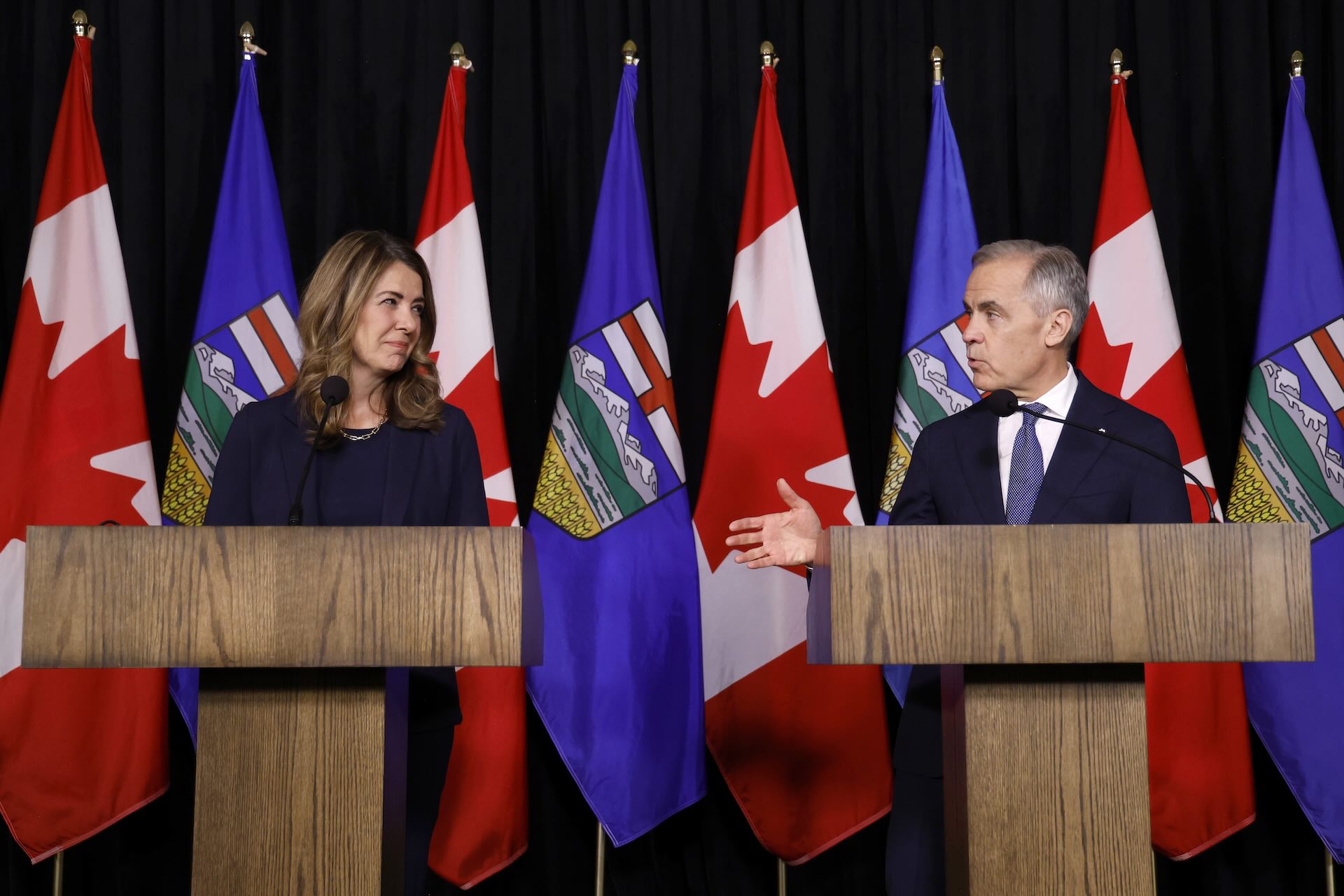
The moves were part of a raft of new policies Prime Minister Mark Carney and Premier Danielle Smith agreed to in Calgary on Friday that follow on the pipeline pact they signed last November.
Related Articles

“It means that we’re much closer to attaining our joint ambitions to make Canada into a global energy leader and a trusted supplier of responsibly produced, lower-emissions energy in the world,” Smith said at a signing ceremony with the prime minister.
The two governments also plan to increase the headline price for Alberta’s carbon credits to $140 per tonne by 2040, with the goal of getting the market price (what companies actually pay) up to $130 per tonne in that time—a benchmark that Carney said will eventually apply to all provinces.
And they have set a target to get shovels in the ground on the new pipeline as early as Sept. 1, 2027, on the condition that they can nail down an agreement to build the massive Pathways carbon-capture project.
The new scheme: The Alberta carbon market has two prices: the headline price for credits, and what companies actually pay in the market.
The sticker price is currently set at $95 per tonne, but a glut of credits in the market drove the market price as low as $17 per tonne last year. They’re currently trading at about $40 per tonne, according to federal officials who provided a briefing on the new policies on the condition they not be named.
The new plan would raise the price compared to the status quo, but at a much slower rate than what the Canadian government had originally intended. Under the current law, the headline price was expected to hit $170 per tonne by 2030.
Alberta was expected to raise the price to $110 per tonne in 2026, in line with the federal benchmark, but Smith froze the price at $95 per tonne, citing the impact of U.S. President Donald Trump’s tariffs.
The change will save the oil industry $250 billion by 2050, according to an Alberta official at the briefing. The province also plans to make the thresholds for firms to receive carbon credits more stringent over time, meaning companies would have to reduce emissions more and more to keep claiming them.
Setting the floor: Alberta will introduce new regulations to set a minimum price for credits, starting in 2030 at $60 per tonne. The province will ramp that up slowly to $110 by 2040. It was not immediately clear how it will ensure credits are traded at or above the minimum.
The price floor is intended to keep the cost of credits from dropping too far behind the headline price, while the contract for difference policy will make sure heavy polluters can sell their carbon offset credits for a guaranteed price on the open market.
The Canadian Climate Institute has said the stakes of that kind of policy are high. The certainty it affords companies can help drive investments into low-carbon projects, it noted, but taxpayers take on the risk of paying the difference if the new policy fails to raise the price.
Carney suggested that risk is not a bad thing. “We will have skin in the game, so that market actually works,” he said.
Pathway to a pipeline: Friday’s agreement makes clear there will be no new pipeline without a plan to get the Pathways project up and running, but the governments have yet to agree with the oil and gas industry on what that plan will look like.
Smith has said the federal and provincial government needed to figure out the carbon price before those talks could start in earnest.
The decision to push carbon price increases into the future risks lowering the incentive for oil companies to buy into Pathways, but officials argue the greater certainty and predictability of their new carbon scheme will make it easier for firms to make long-term investments in decarbonization.
The federal government also added new incentives, extending the Carbon Capture, Utilization, and Storage Investment Tax Credit to 2035 and extending investment tax credits for carbon capture to systems that use the technology for enhanced oil recovery.
Friday’s deal envisions Pathways will be up and running by 2035, with the aim of reducing emissions by 16 million tonnes per year by 2045. That falls short of the Pathways Alliance’s earlier projections that it would reduce emissions by 22 million tonnes by 2030.
Meanwhile, Alberta is expected to submit its pipeline plan to Ottawa’s Major Projects Office by July 1. An official from Alberta said the province will have more to say then about bringing a private sector proponent on board to lead the project.
Mixed reaction: The Canadian Climate Institute said the agreement puts Canada’s goal of reaching net-zero emissions by 2050 firmly out of reach by offering more relief for oil companies and heavy emitters. “Taking 14 years to get to a price of $130 is unnecessarily slow,” said Ross Linden-Fraser, the institute’s research lead. Over the course of the negotiations on the agreement, the oil industry has pushed back against having any industrial carbon price, claiming it hurts the sector’s competitiveness abroad.
The Canadian Chamber of Commerce, however, applauded the governments’ willingness to “put politics aside” in the name of progress on the issue. “This agreement delivers long-term certainty for industry based on jurisdictional alignment on industrial carbon pricing, backstopped by government guarantees,” CEO Candace Laing said in a statement.
This story was updated to add details, and reaction to the announcement.