Listen Now
0:00
OTTAWA — Canada’s oil sector is pushing back hard against the industrial carbon tax, a linchpin of Ottawa’s energy deal with Alberta, as negotiations to set a higher price on emissions stall.
The pact calls for an increase to $130 per tonne from $95, but several industry leaders say the policy undercuts their competitiveness as global demand for oil spikes.
Talking Points
- As talks between Alberta and Ottawa to ramp up the cost of emissions lag, leaders in the oil industry say any level of industrial carbon pricing is hurting their ability to compete for capital
- Energy sector expert Heather Exner-Pirot said the balance of power has shifted between the sector and the federal government, as the prime minister promises to make Canada an energy superpower and get Canada’s oil to new markets
“What will be incredibly important is that all parts of the MOU agreement are considered in the context of how they impact Canada’s competitiveness with respect to other oil and natural gas producing and exporting nations who are also competing for global capital,” Lisa Baiton, CEO of the Canadian Association of Petroleum Producers (CAPP), said in a statement.
Several producers are now speaking out against the concept of an industrial carbon price altogether, said Heather Exner-Pirot, director of energy, natural resources and environment at the Macdonald-Laurier Institute, which raises questions about the prospects of the Ottawa-Alberta MOU that is already weeks behind its target deadlines.
Related Articles

Executives of oil and gas companies have mainly done so in private, or in events with others in the sector.
The new position is a sign that “the balance of power has shifted” between the industry and the federal government, Exner-Pirot said, because Ottawa’s promise to make Canada an energy superpower gives the sector some leverage.
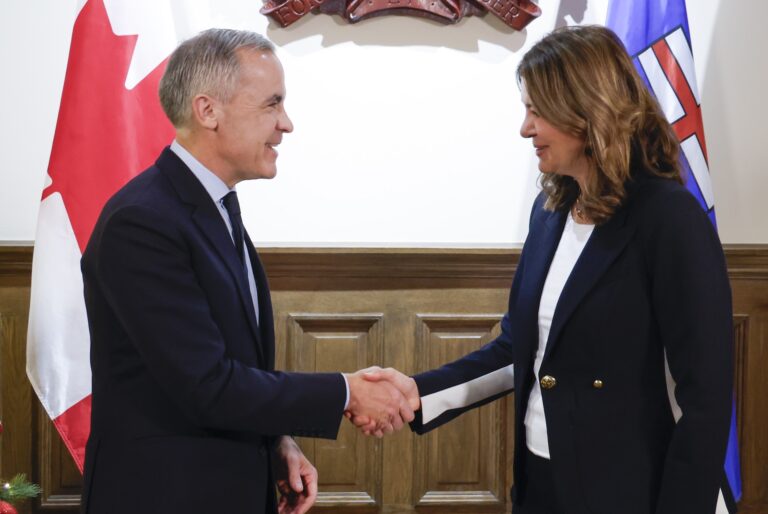
Premier Danielle Smith and Prime Minister Mark Carney struck the sweeping deal in November. It aims to increase oil production and build a new pipeline from the Alberta oilpatch to the B.C. coast, while increasing Alberta’s electrical capacity in order to power AI data centres.
The two governments have yet to agree on two key elements: an increase to the industrial carbon price, and a plan for the proposed Pathways carbon-capture project. They had hoped to reach an agreement on both elements by April 1, but that deadline passed without one. Both governments have said the talks continue.
The main sticking point is how quickly to ramp up the price on emissions and how stringent it will be, Smith said Thursday. She acknowledged, however, that some companies don’t think they should be paying at all.
“Let’s be frank about it, the Americans don’t have this. There are no other energy producing nations in the world that have this kind of tax structure,” she said at a press conference. “This is a priority for the government of Canada, and so if we’re going to get new pipeline access built, then we recognize that we’ve got to meet [Ottawa] partway.”
For now, though, Carney is showing little willingness to compromise on the deal. At his own press conference in Ottawa on Thursday, he said the global context for oil and gas is “very attractive,” and that, from his perspective, the effective carbon price in Canada is low compared to headline price. “That’s something we’re looking to rectify,” he said.
(The headline price is the sticker price for emissions set by the government, while the effective carbon price refers to the amount companies actually pay for credits in carbon markets.)
One of the biggest determinants of the sector’s long-term competitiveness and profitability will be whether it can reach new markets, Carney added.
In the meantime, the U.S.-Israel war in Iran has cut off a major trade route for the world’s supply of oil, creating an unprecedented energy crisis that has partners in Europe and Asia clamouring for Canadian crude, said Exner-Pirot. Carney has also signed agreements with China and India to increase oil and gas exports to their countries.
Oil companies “would like to grow, and they’d like to produce more, and they’d like to be an energy superpower, and obviously the policies would still constrain those ambitions,” Exner-Pirot said.
Earlier this year, CAPP criticized the federal government’s vision for the industrial carbon tax outlined in a December discussion paper. It suggests tightening the rules to make sure demand for carbon credits outstrips the supply so the effective price is as close as possible to the headline price. In a January letter to federal Environment Minister Julie Dabrusin, the group said even the current regulations impose significant costs on Canadian oil and gas producers, “challenging their ability to attract capital and limiting Canada’s ability to position itself as a global energy superpower.”
In her statement to The Logic, Baiton said the government’s proposal would cost resource-based industries billions, and “undermine Canada’s competitiveness at a time when other oil and natural gas producing jurisdictions, who are direct competitors for capital, face little to no comparable carbon compliance burden.”
Several oil executives spoke out against the levy at an energy symposium hosted by CAPP and BMO in Toronto earlier this month. Cenovus Energy CEO Jon McKenzie told The Canadian Press the levy would ensure more of the global supply of oil comes from Canada’s competitors.
The criticism marks a shift in message on the part of industry leaders, who in recent years have gotten behind the industrial carbon tax as an effective way to boost innovation in emissions reduction. At a parliamentary committee two years ago, executives from some of the largest oil companies in Canada touted their partnership with the Pathways Alliance to build the massive carbon-capture project, and expressed support for the industrial carbon price.
“I do support a price on carbon across the economy because I believe that will drive the innovation and the economic incentives, on all of our parts, to continue to improve our business,” Suncor CEO Rich Kruger told the committee in 2024.
McKenzie also expressed support for the policy at the committee, though he stressed it should apply across the economy and not just target the oilsands.
At the time, the industry was pushing back against the proposed cap on carbon emissions, which Carney agreed to abandon as part of his pipeline pact with Alberta in November.
The Pathways project, however, is a pivotal part of the deal. As Smith put it after the signing of the MOU: “I don’t know that the prime minister would have agreed to a new bitumen pipeline without Pathways, and we wouldn’t have agreed to Pathways without a new bitumen pipeline.”
As such, the project is dependent on the carbon price, said Deborah Yedlin, CEO of the Calgary Chamber of Commerce. “In the best of all possible worlds, that price is really low,” she said, “but I don’t think that gives Pathways the certainty it needs to go ahead.”
Increasing the value of captured emissions would help justify the upfront capital cost of Pathways, but the challenge, said Yedlin, is finding a balance. “We want something that’s durable and doesn’t compromise competitiveness and allows for development to go ahead.”
The Calgary business sector has always viewed Pathways as a way to future-proof the industry, Yedlin said, but that may be shifting too. “The truth is, circumstances have changed, which provides some latitude to make changes. In terms of how we move forward,” she said.
Chris Severson-Baker, executive director of the Pembina Institute, has said delaying the carbon price increase will only deter investment in Canada. He argues Alberta’s pricing system, known as TIER, has seen credits trading at prices too low to support decarbonization projects.
“Alberta kicking the can down the road on these policies, especially carbon pricing, is self-defeating,” he said in a press release after the MOU parties missed the April deadline. The institute estimates $40 billion in investments hinge on the government following through on the pact they struck in November.














