TORONTO — Businesses have a long wish list for Prime Minister Mark Carney after voters handed the Liberals a minority government and fourth consecutive election win on Monday.
Skip to content

Special Report
Business leaders have a big to-do list for Mark Carney
Demands range from turbo-charging internal trade to building out energy and digital infrastructure, while standing firm in a Trump face-off
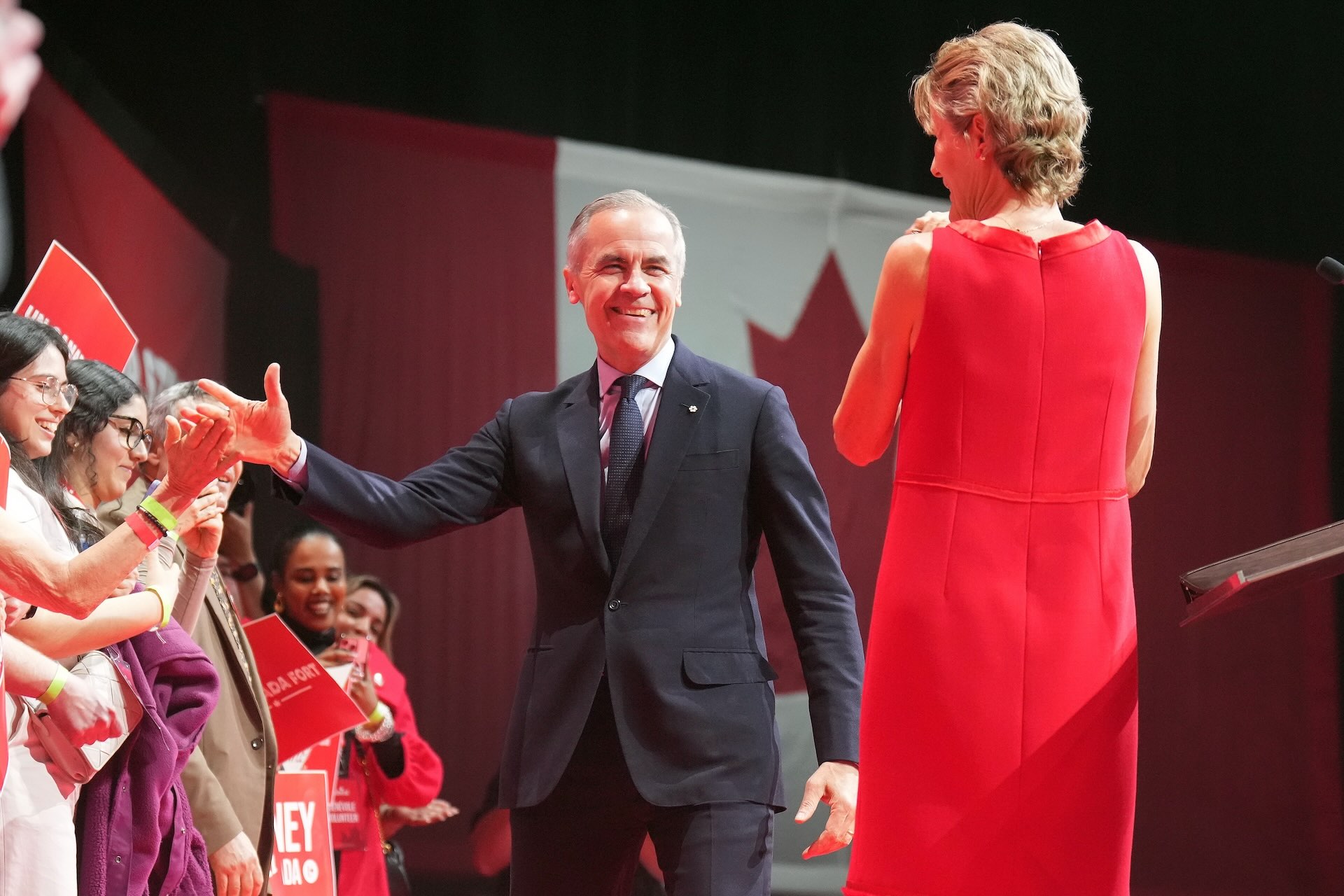
Canadian Prime Minister Mark Carney arrives to address supporters at his campaign headquarters on election night in Ottawa, Monday, April 28, 2025. Photo: The Canadian Press/ Nathan Denette
TORONTO — Businesses have a long wish list for Prime Minister Mark Carney after voters handed the Liberals a minority government and fourth consecutive election win on Monday.
U.S. President Donald Trump wasn’t on the ballot, but he was the focus of this election campaign. Carney will immediately face tough negotiations on auto tariffs and the fate of the North American trade deal. But business leaders also want the Liberals to make good on promises to reduce red tape, speed up megaprojects and reform innovation programs.
Talking Points
- Business leaders are urging Mark Carney to act quickly on his election promises to open up internal trade, build energy and digital infrastructure, and lower taxes
- The re-elected Liberal government must also face tough negotiations with the Trump administration on tariffs and free trade
North American negotiations: Carney received a congratulatory call from Trump on Tuesday, and the two leaders agreed to meet each other in person soon. “The leaders agreed on the importance of Canada and the United States working together—as independent, sovereign nations—for their mutual betterment,” said a readout from the Prime Minister’s Office. Last month, they agreed to begin negotiating a new “economic and security relationship” as soon as the federal election was over.
Goldy Hyder, CEO of the Business Council of Canada, urged Carney to keep Mexico in mind and prioritize extending the United States-Mexico-Canada Agreement (USMCA), which is up for review next year, rather than trying to go it alone.
“In our view, a bilateral arrangement could create unnecessary risk and undermine Canada’s mutually beneficial trilateral economic partnership with the United States and Mexico,” Hyder wrote Tuesday in an open letter to Carney. “Business leaders in all three countries agree that the agreement must continue to serve as the central mechanism for governing trade and investment, resolving disputes and increasing continental competitiveness and productivity.”
Related Articles
He encouraged Carney to invite Mexican President Claudia Sheinbaum to the G7 summit that Canada is hosting in Kananaskis, Alta., in June, as well as hold a North American Leaders’ Summit while there. “When you’re the host, you should take a look at who your friends are and where your partners are,” Hyder told The Logic.
Hyder also noted USMCA, which was negotiated during the first Trump administration, has offered both Canada and Mexico some protection from the U.S. tariffs linked to border security, as well as the lower “reciprocal” tariffs that could replace them. Those moves might have created extra paperwork for Canadian businesses trying to prove their exports meet the rules-of-origin criteria, but Hyder said it also suggests Trump sees value in the agreement.
Pete Hoekstra, the new U.S. ambassador to Canada, said in a statement Tuesday that “reviewing and strengthening our strong trading partnership” is on his long to-do list. He joined several other new ambassadors Tuesday in presenting his credentials at Rideau Hall, where Gov. Gen. Mary Simon stressed the importance of diplomacy in “turbulent times.”
Markets yawn: Canadian stocks were largely flat in Tuesday trading, with the S&P/TSX composite index—which tracks the bulk of the Toronto exchange by market cap—swinging between a 0.22 per cent drop and a 0.45 per cent increase.
Some sectors showed more movement. The S&P/TSX capped energy index traded down as much as 1.42 per cent on Tuesday. While both Carney and Conservative Leader Pierre Poilievre promised during the campaign to develop and export Canada’s natural resources, the Conservatives were generally seen as more bullish on oil and gas than the Liberals.
Shares in major banks, asset managers and insurers swung slightly the other way, with the S&P/TSX capped financial index trading up as much as 0.85 per cent Tuesday. A former central and investment banker, Carney has not proposed the kinds of taxes on financial institutions that former Prime Minister Justin Trudeau’s government used to raise revenue.
Making cents of the result: The Canadian dollar held relatively steady against its U.S. equivalent on election night, hitting a high of US$0.724 at about 10:20 pm ET Monday, shortly after all the major networks called a Liberal victory. That’s just off its recent peak of US$0.725 on April 21. But the loonie gave up some of its gains against the greenback as the party’s path to a majority narrowed. By 10:20 am ET, the Canadian dollar had dipped to US$0.722, down in Tuesday trading but still well above the early-February lows brought on by Trump’s tariff threats.
Business reacts: Business leaders and groups lined up to congratulate Carney on his victory, and remind him of their recommendations.
Canadian Chamber of Commerce CEO Candace Laing called for the Liberals and opposition parties to jointly “chart a more prosperous path long term,” including by cutting government spending as well as corporate and personal income taxes, while also expanding the country’s trade infrastructure.
Hyder said he wants to see a federal budget soon that gives Canadians a clearer picture of the country’s fiscal situation, including the impact of U.S. tariffs. He also wants the federal government to return to having a fiscal anchor, a clear target for spending relative to revenue or debt. “You can’t keep changing the goal posts every time something isn’t going your way,” he said.
While Carney’s platform drew on ideas from homegrown scale-ups, “the real test will be in delivery,” said Benjamin Bergen, president of the Council of Canadian Innovators. He’s previously called for the Liberals to add Buy Canadian requirements to their proposals to build digital infrastructure and set up new programs to acquire technology.
Lawrence Zhang, head of policy at the Centre for Canadian Innovation and Competitiveness, also emphasized that Carney’s government must focus on execution. He cited increasing business investment and R&D commercialization, and ensuring industrial policy gives Canadian sectors a global edge as key priorities. The centre is a unit of the Washington-based Information Technology & Innovation Foundation, a tech-aligned think tank.
Tech leaders give props: Shopify CEO Tobi Lütke congratulated Carney in a short X post. After initially advising the Trudeau government, the commerce company founder became a loud and frequent critic of its economic and digital policies. Lütke previously called Carney “a great candidate,” but said his election platform “commits Canada to continued economic decline.” The Shopify CEO had also expressed support for some Poilievre proposals, including cutting taxes, streamlining project approvals, and tougher criminal penalties.
Other tech leaders cited the importance of their sectors to the country’s growth prospects. “AI presents a unique opportunity to strengthen Canada’s economy, quality of life and sovereignty,” Cohere CEO Aidan Gomez said in an X post congratulating Carney. “We look forward to the opportunities ahead to build a strong future for Canada.” The Liberal platform promised to spend on AI adoption and infrastructure, while the Conservatives had signalled they would cut Ottawa’s $2-billion program to increase the country’s compute capacity, which has awarded Cohere $240 million.
Pipe dreams: Canada’s energy sector is urging Carney to bolster exports, namely by building out critical infrastructure that can help producers reach new markets. The industry sees a rare window of opportunity to break free from decades-long pipeline bottlenecks amid growing public support for natural resource projects in the face of U.S. trade rifts.
“This is a moment for bold leadership and co-ordinated action,” said Deborah Yedlin, president and CEO of the Calgary Chamber of Commerce. “With a new mandate in place, the federal government has a time-bound opportunity to strengthen Canada’s economic foundations, reinforce our global position and deliver tangible results for Canadians.”
Achieving such expansion will require major policy changes. The chamber is calling on Carney to harmonize the major projects approval process, abandon the Liberal’s proposed oil emissions cap and scrap clean electricity regulations that restrict natural gas development.
Environmental groups, meanwhile, urged Carney to hold the line and stick with Trudeau-era energy policies that support clean energy development. The Pembina Institute, a clean energy advocacy organization, wants to see a carbon border adjustment mechanism and greater emphasis on greening Canada’s grid.
Car trouble: Autos are likely to be a topic in Carney’s initial dealings with Trump, who has ordered his administration to put tariffs on auto parts by the end of this week and could table part of that plan as soon as Tuesday night. Depending on how those levies are implemented, they could lead to mounting costs in the auto sector, where components sometimes cross the border multiple times.
The Liberals tied their industrial policy of building an electric vehicle supply chain closely to the Biden administration’s green agenda. Trump has gutted that strategy in the U.S., and auto manufacturers have started pulling back on some Canadian plants and plans. But Ottawa shouldn’t abandon EVs just because Washington is doing so, according to Rachel Doran, executive director of Clean Energy Canada. She called for Canada to lean into its advantages in critical minerals and renewable energy. “The world is going electric and transportation,” Doran said, a transition that will happen “with or without the U.S.”



Loading...
Thanks for sharing!
You have shared 5 articles this month and reached the maximum amount of shares available.
CloseThis account has reached its share limit.
If you would like to purchase a sharing license please contact The Logic support at [email protected].
CloseGift the full article!
You have gifted 0 article(s) this month and have 5 remaining.
Recipients will be able to read the full text of the article after submitting their email address. They will not have access to other articles or subscriber benefits.
Photo: The Canadian Press/ Nathan Denette
Most Popular This Week




In-depth, agenda-setting reporting
Great journalism delivered straight to your inbox.
The Big Read
Alberta’s referendum is just the start of the turmoil
Briefing
EverWind plans $10B data centre and wind development in Nova Scotia
Canada ready to force Stelco to sell its Canadian operations, Joly says
Feds plan a 60 MW defence-oriented data centre for Ottawa
Best business newsletter in Canada
Get up to speed in minutes with insights and analysis on the most important stories of the day, every weekday.
Exclusive events
See the bigger picture with reporters and industry experts in subscriber-exclusive events.
Membership in The Logic Council
Membership provides access to our popular Slack channel, participation in subscriber surveys and invitations to exclusive events with our journalists and special guests.